Dehradun Protesters Save 4,369 Trees With Daily Tree Hugs
When a highway project threatened over 4,000 century-old trees in Dehradun, students and retirees showed up every single day to hug them. Their peaceful protest, inspired by the legendary Chipko movement, actually worked.
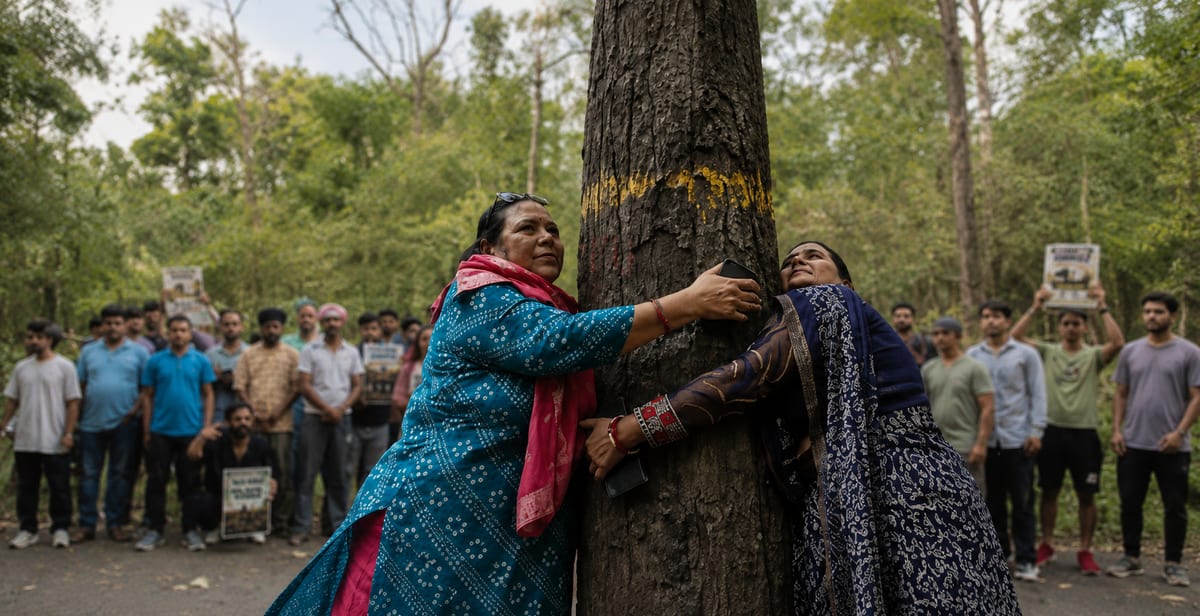
In July 2026, thousands of sal trees standing for over a century faced chainsaws to make way for a wider highway near Dehradun. Instead of watching them fall, ordinary residents decided to wrap their arms around the trunks and refuse to let go.
The scene at Saat Mod, a tree-lined stretch of National Highway 7, became a living history lesson. Students stood alongside retired government officials, environmentalists, and everyday citizens, all channeling the spirit of the Chipko movement that began in these same Himalayan foothills fifty years earlier.
The Bhaniyawala-Jolly Grant-Rishikesh highway was being widened from two to six lanes to handle growing traffic to Jolly Grant Airport and the Char Dham pilgrimage route. The project threatened 4,369 mature trees, many standing in a critical elephant corridor connected to Rajaji Tiger Reserve.
Rather than stage a single dramatic protest, residents showed up every day. They hugged trees marked for felling, tied sacred threads around trunks as pledges of protection, and turned the roadside into a sustained cultural performance that nobody could ignore.
The most creative moment came on July 16 during Harela, Uttarakhand's annual festival celebrating greenery and monsoons. Instead of traditional celebrations, protesters dressed entirely in black for "Kala Harela," mourning the trees being cut down on the very day meant to honor nature.
Their message was never simply "stop the highway." Protesters asked whether gentler alternatives had been genuinely explored, especially given that Dehradun district alone had lost nearly half of the 46,000 hectares of forest land diverted for development across Uttarakhand since 2000.
The highway plans did include conservation measures: a 3.5-kilometer elephant underpass, wildlife crossings, and 40 hectares of compensatory afforestation developed with WWF-India and the Wildlife Institute of India. But residents wanted proof that every tree-saving option had been exhausted first.
The Ripple Effect
After days of peaceful, persistent presence, tree felling was paused and fresh consultations opened with residents and environmental experts. The protesters achieved something remarkable using nothing but presence, memory, and shared purpose.
The trees already felled cannot grow back, and the highway story isn't finished. But Saat Mod proved that ordinary people can still shape decisions that once felt entirely out of their hands, one tree hug at a time.
More Images
%2Fenglish-betterindia%2Fmedia%2Fmedia_files%2F2026%2F07%2F24%2F1-2026-07-24-16-26-22.png)

%2Ffilters%3Aformat(webp)%2Fenglish-betterindia%2Fmedia%2Fmedia_files%2F2026%2F07%2F24%2F3-2026-07-24-16-45-24.png)
%2Ffilters%3Aformat(webp)%2Fenglish-betterindia%2Fmedia%2Fmedia_files%2F2026%2F07%2F24%2F3-2026-07-24-16-34-18.png)
Based on reporting by The Better India
This story was written by BrightWire based on verified news reports.
Spread the positivity!
Share this good news with someone who needs it