
Earth's Nights Show Hope: Cities Dim as LED Lights Spread
NASA satellite data reveals a surprising shift happening across our planet: many cities are getting dimmer at night thanks to energy-efficient lighting and conservation efforts. The complex pattern of lights tells a story of progress, challenges, and humanity's changing footprint.
After watching Earth's nighttime glow for nearly a decade, NASA scientists have discovered something unexpected: our planet isn't just getting brighter. In fact, many of the world's most populated areas are dimming as communities embrace smarter, more sustainable lighting.
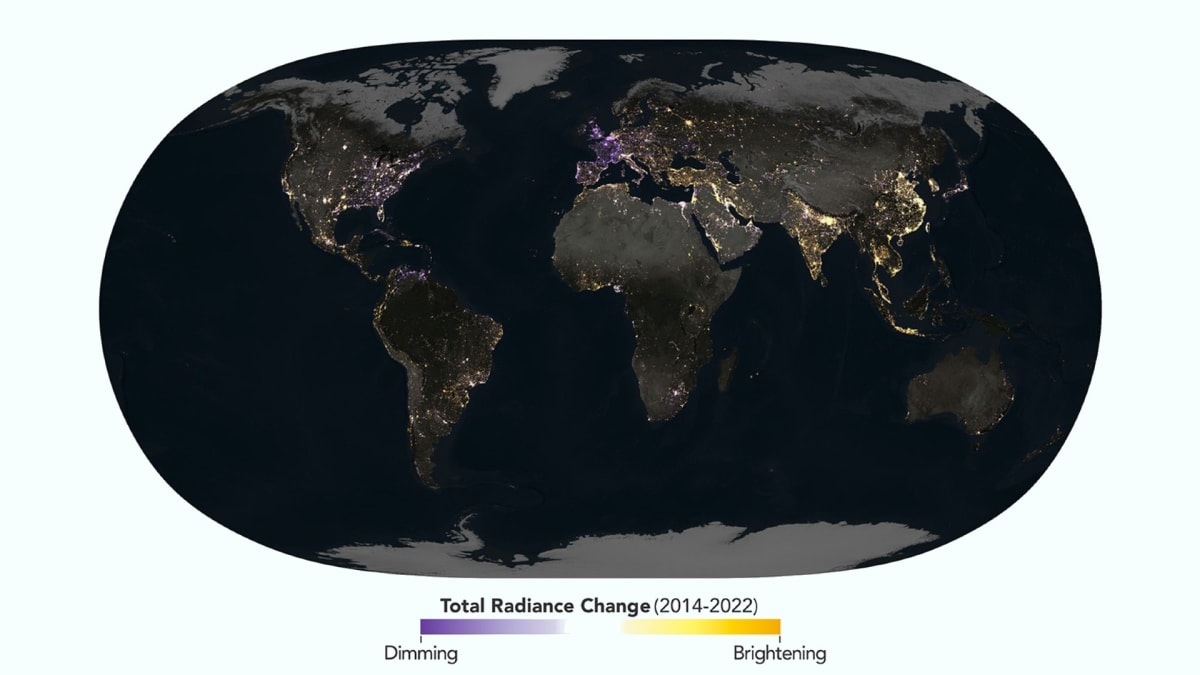
Between 2014 and 2022, NASA's Black Marble satellites captured a surprisingly hopeful pattern. While some regions grew brighter from development and electricity access, others dimmed thanks to LED technology, conservation policies, and efforts to reduce light pollution.
The US East Coast offers a perfect example of this positive shift. Cities that once blazed bright are now using less energy-efficient LEDs, creating what scientists call a "dimming trend" that saves power and reduces waste. Meanwhile, West Coast cities grew brighter alongside population increases, but with cleaner technology doing the heavy lifting.
Europe showed some of the most dramatic improvements. France led the charge with aggressive dark-sky initiatives that cut light pollution while maintaining safety and quality of life. These conservation policies spread across the continent, proving that progress doesn't always mean more light.
The satellites also captured stories of hardship and resilience. War-torn regions in Ukraine, Lebanon, and Yemen went dark from conflict and infrastructure damage. Venezuela's economic collapse showed up as dimming cities, while Afghanistan's struggles appeared as patches of darkness spreading across the landscape.
But the maps revealed triumphs too. Across sub-Saharan Africa and Southeast Asia, previously dark regions lit up as electrification projects brought power to communities for the first time. These bright spots represent millions of people gaining access to electricity, education opportunities, and economic growth.
The technology behind these observations goes far beyond pretty pictures. NASA's satellites filter out moonlight, clouds, and atmospheric effects to show only human-generated light. This daily data helps researchers track urban growth, monitor disaster recovery, and understand migration patterns in near real-time.
Why This Inspires
What makes this story remarkable isn't just the technology. It's what the lights reveal about our choices. Every dimming city on the East Coast represents communities choosing efficiency over excess. Every bright spot in rural Africa shows the power of infrastructure investment to transform lives.
The data proves we can grow while using less. We can light our streets safely while protecting the night sky for stargazing families and migrating birds. We can measure our impact from space and actually see our efforts to do better working in real time.
Scientists now have a constantly updating portrait of human activity viewed from orbit. This mirror held up to our planet shows both our struggles and our progress, our conflicts and our solutions. The shifting patterns prove that change is possible when communities commit to it.
Earth's nights are no longer changing in just one direction. They're responding to our collective decisions about energy, conservation, and sustainability, creating a more complex and ultimately more hopeful picture of humanity's future.
More Images


Based on reporting by Space.com
This story was written by BrightWire based on verified news reports.
Spread the positivity!
Share this good news with someone who needs it