Einstein Proven Right Again by Loudest Space Signal Ever
Scientists just captured the clearest gravitational wave ever detected, putting Einstein's century-old theory through its toughest test yet. The cosmic signal from colliding black holes confirmed predictions with stunning precision.
Einstein's theory of gravity just aced its hardest exam yet, and the results prove that a century-old idea still holds up against the most extreme forces in the universe.
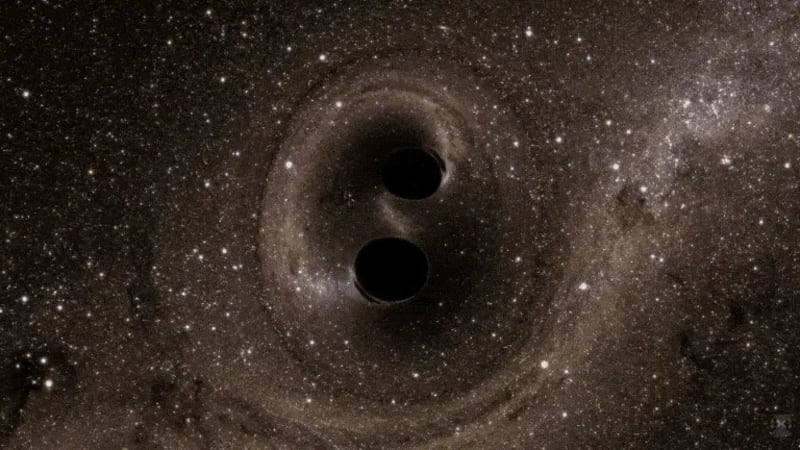
On January 14, 2025, detectors at the Laser Interferometer Gravitational-Wave Observatory picked up an extraordinary signal called GW250114. Two massive black holes, each about 30 times heavier than our sun, had collided 1.3 billion light-years away.
The collision sent ripples through space and time itself, and scientists recorded the signal with three times more clarity than the groundbreaking 2015 discovery that first proved gravitational waves exist. That extra clarity made all the difference.
"This one event provided more information than everything we've seen before regarding certain tests of general relativity," explained Keefe Mitman, a researcher at Cornell Center for Astrophysics and Planetary Science. The signal was so loud and clear that scientists could zoom in on details they'd never captured before.
After the two black holes merged, the newly formed giant briefly vibrated like a struck bell. Scientists detected distinct tones in this "ringdown" phase, each revealing key properties of the black hole.
For the first time, they confidently identified a subtle "overtone" that appears right at the start of the ringing. Einstein's theory predicted this feature would exist, and there it was in the data.
The team measured the black hole's mass and spin two different ways, and both measurements matched perfectly. If they hadn't, physicists would have faced a major crisis in understanding how gravity works.
Why This Inspires
This discovery represents more than just confirming old predictions. A decade of steady upgrades to the detectors made this breakthrough possible, showing how patient, persistent work pays off.
The detectors became sensitive enough to measure distortions in space 700 trillion times smaller than the width of a human hair. That's the result of teams solving countless small problems, from reducing noise from passing trucks to filtering out seismic vibrations.
The signal also confirmed a prediction Stephen Hawking made 50 years ago about black holes. The surface area of a black hole's event horizon can never shrink, even when enormous energy escapes during a merger.
Scientists measured the two original black holes at about 93,000 square miles combined, roughly Oregon's size. The merged black hole measured 155,000 square miles, closer to California's size, matching Hawking's prediction exactly.
While Einstein's theory keeps passing every test, physicists know there's still more to discover. General relativity can't explain dark matter, dark energy, or how gravity works at quantum scales.
That's why each new gravitational wave signal matters: future detections might finally reveal where Einstein's theory breaks down and point the way toward a more complete understanding of our universe.
More Images

Based on reporting by Google News - Science
This story was written by BrightWire based on verified news reports.
Spread the positivity!
Share this good news with someone who needs it