Einstein Proven Right Again With Best Gravity Test Yet
Scientists just measured one of Einstein's wildest predictions with 10 times more accuracy than ever before, using disco ball satellites and laser beams. The experiment confirms that Earth really does drag the fabric of space around with it as it spins.
More than a century after Albert Einstein predicted it, scientists have captured the clearest proof yet that our spinning planet drags spacetime itself along for the ride.
Researchers measured frame-dragging with unprecedented precision, improving accuracy by more than tenfold compared to previous attempts. Think of it like a spoon spinning in honey, pulling the sweet stuff around with it as it turns.
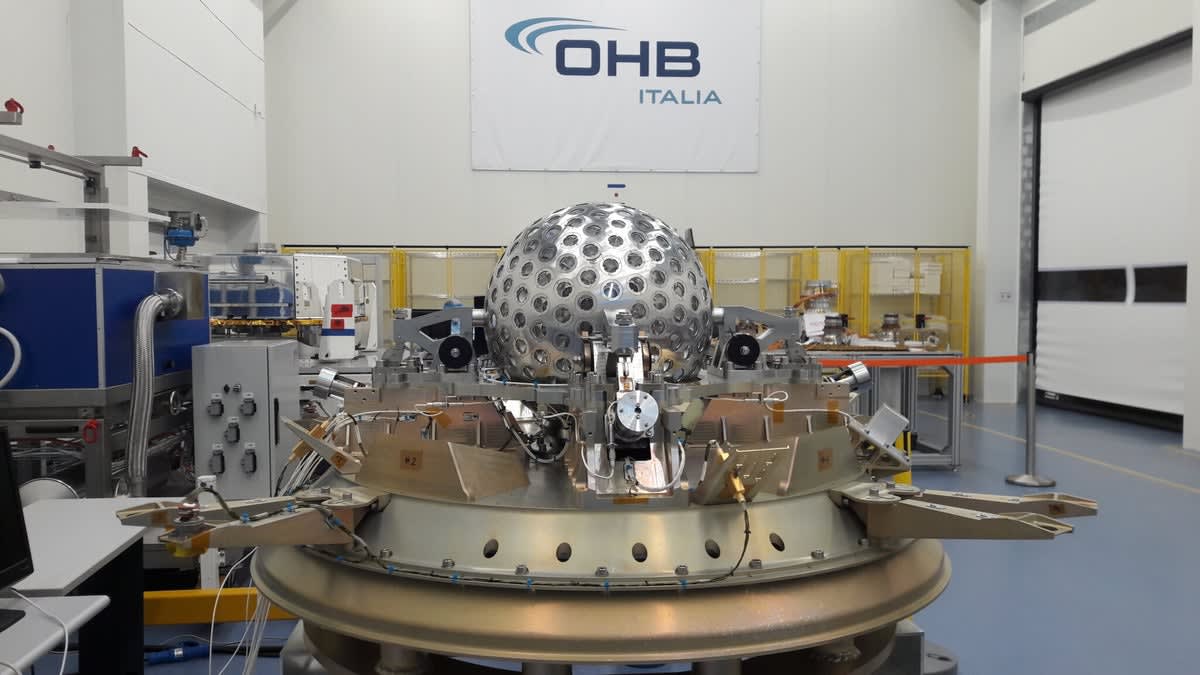
The breakthrough came from an unlikely source: mirror-covered satellites that look like galactic disco balls orbiting thousands of kilometers above Earth. Scientists bounced laser beams off these satellites to track their exact positions as our planet's rotation tugged at the very fabric of space around them.
The mission, called LARES-2, launched in 2022 under the leadership of physicist Ignazio Ciufolini from Sapienza University of Rome. His team combined data from LARES-2 with two older NASA satellites to cancel out confusing effects from the Sun and Moon's gravitational pull.
The result? They pinned down frame-dragging with an uncertainty of just one part in a thousand. That level of precision rules out alternative theories of gravity that scientists had been curious about.
What makes this achievement even sweeter is the elegant simplicity of the approach. NASA's previous attempt using Gravity Probe B cost $750 million and achieved far less precision. This new method treats the entire orbit of the satellite as one giant gyroscope, delivering results 100 times better at a fraction of the cost.
The team had to track one particularly tricky lunar-solar tide for three years to account for its effects. That patience paid off with a bonus: new measurements of this tide that could help scientists studying earthquakes and ocean behavior.
Why This Inspires
Einstein's general theory of relativity debuted in 1915, yet scientists keep finding new ways to prove he was right. Each confirmation isn't just about validating old ideas. It's about pushing the boundaries of what we can measure and understand about our universe.
The elegant, cost-effective approach shows that brilliant science doesn't always require massive budgets. Sometimes the best answers come from creative thinking and careful patience.
Daniel Holz, an astrophysicist at the University of Chicago, calls it "another feather in Einstein's cap." While some creative theories that might have challenged relativity are now ruled out, that's exactly how progress works. We test, we learn, we move forward.
The cosmos continues to bend and curve exactly as Einstein predicted, and our ability to see those curves just got sharper than ever.
More Images


Based on reporting by Scientific American
This story was written by BrightWire based on verified news reports.
Spread the positivity!
Share this good news with someone who needs it