EU and Thailand Team Up to Fight Online Scams in Asia
The European Union, Thailand, and Southeast Asian nations just launched a major partnership to protect millions from cyber criminals and online fraud. Senior officials gathered in Bangkok to turn shared concerns into coordinated action against scam networks.
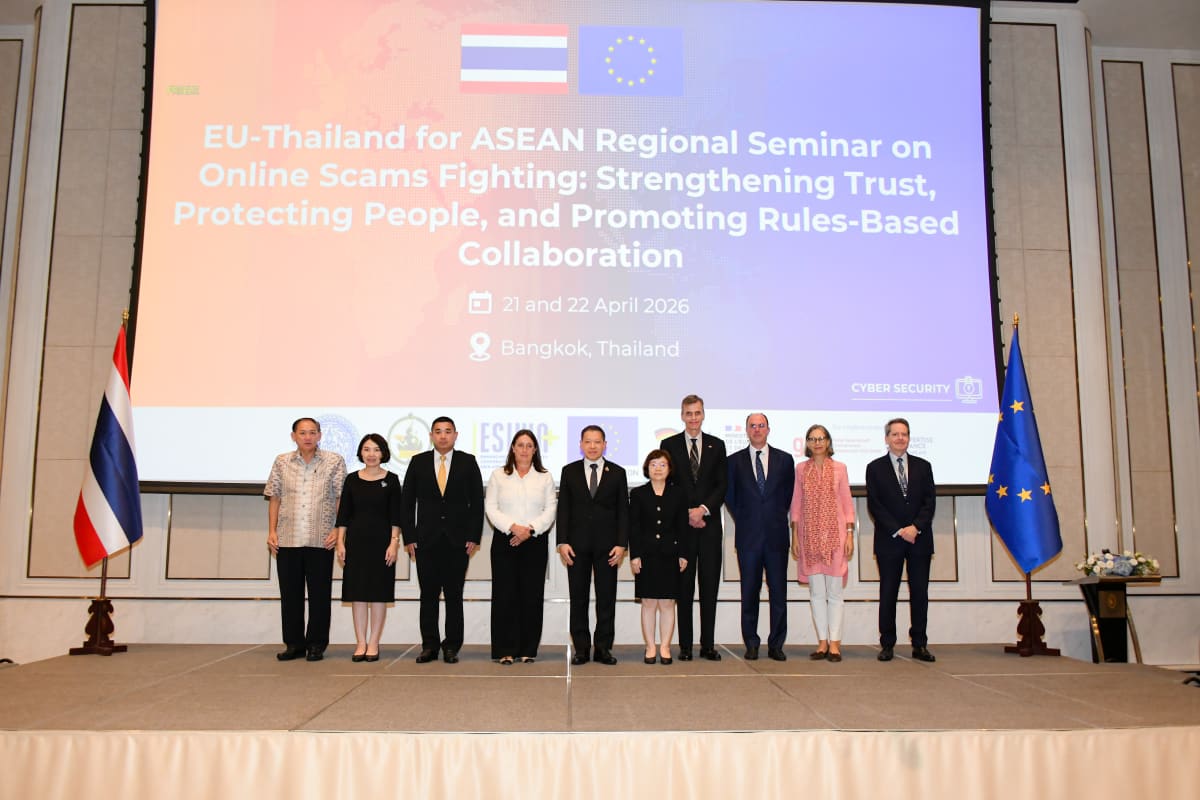
Government leaders, law enforcement experts, and international organizations met in Bangkok this week for a groundbreaking two-day seminar on defeating online scams. The European Union, Thailand, and ASEAN member states came together with one clear goal: stop cyber criminals from exploiting vulnerable people across borders.
The April 21-22 gathering brought together representatives from financial authorities, civil society groups, and organizations including the UN Office on Drugs and Crime. They focused on practical solutions rather than just talk, mapping out how nations can work together to disrupt fraud networks that steal billions and destroy lives.
"Cyber-enabled scams are evolving quickly, but our cooperation can move faster," said Luisa Ragher, EU Ambassador to Thailand. The message was clear: criminals work across borders, so law enforcement must too.
Thailand's Special Envoy Sarun Charoensuwan highlighted what's really at stake. "Online scams are not only criminal threats; they are also a challenge to public trust, economic security and regional stability," he explained. When people lose faith in digital systems, entire economies suffer.
The seminar tackled four critical areas: investigating and prosecuting cyber fraud, protecting victims and vulnerable populations, preventing scams through public awareness, and building partnerships that cross regional boundaries. Each pillar supports the others, creating a comprehensive shield against digital crime.
The Ripple Effect: This partnership addresses a crisis affecting millions across Southeast Asia and beyond. Scam networks don't just steal money; they exploit vulnerable people, including victims of human trafficking forced to run fraud operations. By coordinating responses across nations, this initiative protects both financial security and human rights.
The collaboration builds on previous Thailand-EU efforts, including an August 2025 seminar on digital safety and a February 2026 visit to Thailand's Anti-Online Scam Operation Center. Those meetings laid groundwork for the kind of information sharing and capacity building that makes cross-border prosecutions possible.
Participants emphasized that fighting cybercrime must respect the rule of law and human rights. Effective action doesn't require choosing between security and freedom; it requires both working together.
The EU supports this work through projects like ESIWA+, which facilitates expertise exchanges and capacity building across the Indo-Pacific region. These aren't just meetings; they're creating lasting networks of professionals who can coordinate responses when scammers strike.
When nations choose cooperation over isolation, criminals lose their greatest advantage.
Based on reporting by Google: cooperation international
This story was written by BrightWire based on verified news reports.
Spread the positivity!
Share this good news with someone who needs it


