Exciting Discovery: Giant Virus Reveals Secrets About How Life Began on Earth
Scientists in Japan have discovered a fascinating new giant virus that could help unlock the mystery of how complex life evolved on our planet. The ushikuvirus offers compelling evidence that viruses may have played a foundational role in creating the cells that make up all plants, animals, and humans.
In a breakthrough that's capturing the attention of scientists worldwide, researchers from Tokyo University of Science have discovered an extraordinary new virus that could rewrite our understanding of life's origins. Named the "ushikuvirus" after the picturesque Lake Ushiku in Japan where it was found, this giant virus is opening exciting new windows into one of science's greatest mysteries.
Professor Masaharu Takemura, who has dedicated over two decades to understanding how viruses shaped life on Earth, led the groundbreaking research alongside colleagues from Japan's National Institute of Natural Sciences. Their findings, published in the Journal of Virology, provide compelling support for a fascinating idea: that viruses weren't just passengers in life's journey, but may have been architects of complex life itself.
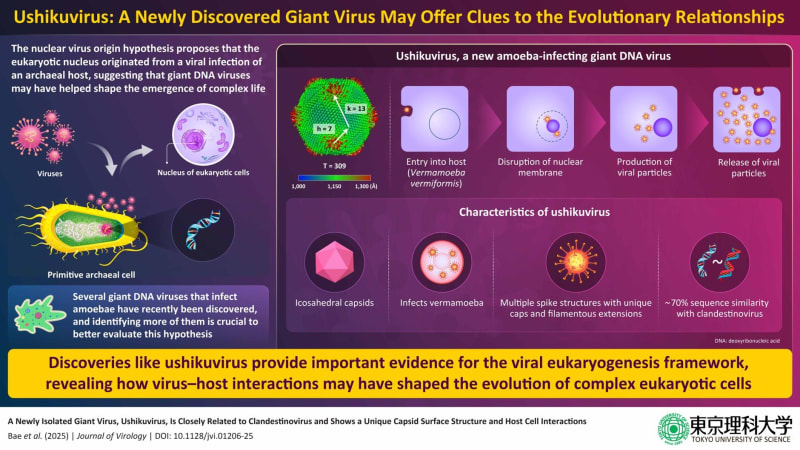
The discovery centers on what scientists call the "viral eukaryogenesis hypothesis"—an elegant theory suggesting that the nucleus of our cells, the command center that makes complex life possible, may have originated from ancient viruses. Imagine this: billions of years ago, a large DNA virus infected a simple microorganism. Rather than destroying its host, the virus settled in for the long term, eventually becoming the nucleus that defines all complex life today, from towering redwoods to blue whales to humans.
What makes ushikuvirus particularly special is how it bridges our understanding between different types of giant viruses. These remarkable entities, first discovered in 2003, challenge our traditional definitions of life. The newly found ushikuvirus infects amoebas and displays unique characteristics that provide missing puzzle pieces in the evolutionary story. It features distinctive spike structures with special caps and filamentous extensions, creating what researchers describe as a treasure trove of biological information.
The research team, including promising graduate students Jiwan Bae and Narumi Hantori, observed something remarkable: when ushikuvirus infects its host, it causes the amoeba cells to grow unusually large. Unlike some related viruses that work within the existing cell nucleus, ushikuvirus disrupts the nuclear membrane to reproduce—a behavior that helps scientists understand how different viral strategies evolved over time.
Professor Takemura's enthusiasm is infectious. "Giant viruses can be said to be a treasure trove whose world has yet to be fully understood," he explains. "One of the future possibilities of this research is to provide humanity with a new view that connects the world of living organisms with the world of viruses."
This discovery reminds us that science continues to reveal wonder in unexpected places. While giant viruses exist all around us in the environment, isolating and studying them remains challenging, making each new discovery precious. The ushikuvirus represents not just another species catalogued, but a key that could unlock doors to understanding our own cellular origins.
As researchers continue studying how these viruses interact with their hosts and evolve over time, we're gaining invaluable insights into the deep history of life on Earth. This work exemplifies how curiosity-driven science, patient observation, and international collaboration can illuminate the fundamental questions that unite all humanity: Where did we come from? How did life begin? And what role did these microscopic marvels play in creating the diversity of life we celebrate today?
More Images


Based on reporting by Phys.org
This story was written by BrightWire based on verified news reports.
Spread the positivity! 🌟
Share this good news with someone who needs it
More Good News
 🚀 Innovation
Scientists Make Exciting Progress Toward Unlocking the Universe's Greatest Secrets
 🚀 Innovation
Einstein's Legacy Shines Brighter: Scientists Confirm Physics Genius Was Right Again
 🚀 Innovation
Amazing Discovery: Ancient Bees Found Creative Homes in Fossil Bones
Joke of the Day
Why did the librarian get kicked out of class?
Explore Categories
Quote of the Day
"Do not go where the path may lead, go instead where there is no path and leave a trail."
— Ralph Waldo Emerson