Scientists Make Exciting Progress Toward Unlocking the Universe's Greatest Secrets
Researchers at Texas A&M University are developing groundbreaking detector technology that could finally reveal what makes up 95% of our universe. Their innovative work brings us closer than ever to understanding dark matter and dark energy, promising to revolutionize our knowledge of cosmic forces.
Imagine standing at the threshold of humanity's greatest discovery. That's exactly where scientists find themselves today as they make remarkable progress in detecting the mysterious forces that shape our cosmos.
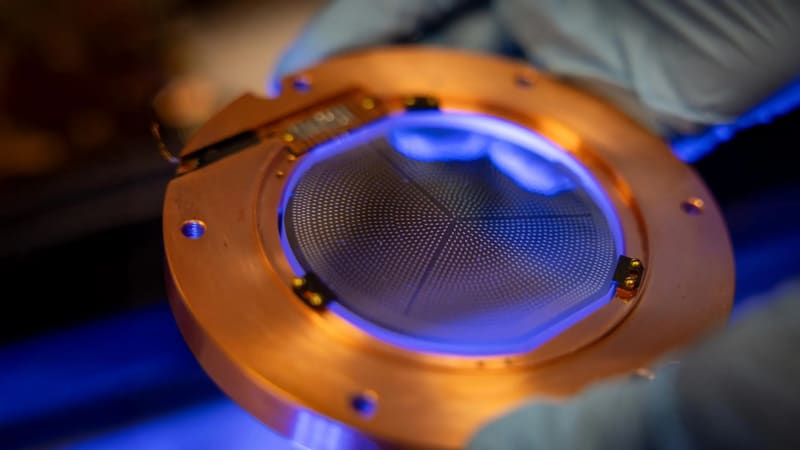
Dr. Rupak Mahapatra and his team at Texas A&M University are pioneering extraordinarily sensitive detector technology that could finally unveil the secrets of dark matter and dark energy. These invisible components make up an astonishing 95% of everything that exists, yet they've remained tantalizingly out of reach—until now.
The research team's innovative approach combines advanced semiconductor detectors with cryogenic quantum sensors, creating instruments so precise they can detect particle interactions that occur just once in years or even decades. This technological marvel represents a quantum leap forward in our ability to observe the invisible architecture of the universe.
What makes this work particularly exciting is how it builds on decades of scientific achievement. Mahapatra has spent 25 years advancing the SuperCDMS experiment, which has conducted some of the world's most sensitive dark matter searches. In 2014, his team introduced voltage-assisted calorimetric ionization detection, a breakthrough that opened entirely new avenues for exploring previously undetectable particles.
Think of dark matter as cosmic glue that holds galaxies together, while dark energy acts as an accelerator, pushing the universe to expand faster and faster. While we can't see them directly, their effects are written across the cosmos in the movement of galaxies and the structure of space itself.
The team's latest work, featured in the prestigious journal Applied Physics Letters, showcases participation in TESSERACT, a leading global dark matter detection experiment. Texas A&M stands among an elite group of institutions working on this cutting-edge project, demonstrating the university's commitment to pushing the boundaries of human knowledge.
Mahapatra uses a wonderful analogy to describe our current understanding: "It's like trying to describe an elephant by only touching its tail. We sense something massive and complex, but we're only grasping a tiny part of it." But unlike the parable, scientists are rapidly developing the tools to see the whole elephant.
The implications of this research extend far beyond academic interest. Successfully detecting dark matter would fundamentally transform our understanding of physics and could lead to technologies we can't yet imagine. The ultra-sensitive detection methods being developed might find applications in fields ranging from medical imaging to national security.
What's particularly hopeful is the collaborative nature of this quest. Mahapatra emphasizes that no single experiment will provide all the answers. Instead, researchers worldwide are combining different strategies—direct detection, indirect detection, and collider searches—each piece contributing to a comprehensive picture.
As these sophisticated detectors continue gathering data in laboratories around the world, we're moving closer to answering fundamental questions about existence itself. The universe is revealing its secrets, one carefully measured interaction at a time, and dedicated scientists are there to listen.
Based on reporting by Google News - Science
This story was written by BrightWire based on verified news reports.
Spread the positivity! 🌟
Share this good news with someone who needs it
More Good News
 🚀 Innovation
Hubble Discovers 'Cloud-9': Rare Cosmic Wonder Confirms How Universe Works
 🚀 Innovation
Astronomers Discover Cloud-9: A Cosmic Fossil That Unlocks Universe's Secrets
 🚀 Innovation
Berkeley Lab Scientists Use AI to Fill Crucial Gaps in Scientific Images
Joke of the Day
Why did the dog apply for a job at the bank?
Explore Categories
Quote of the Day
"The greatest thing you'll ever learn is just to love and be loved in return."
— Moulin Rouge (from the film, popularized by Ewan McGregor)