Family Raises $1M to Build Global Research Community for Rare Disease
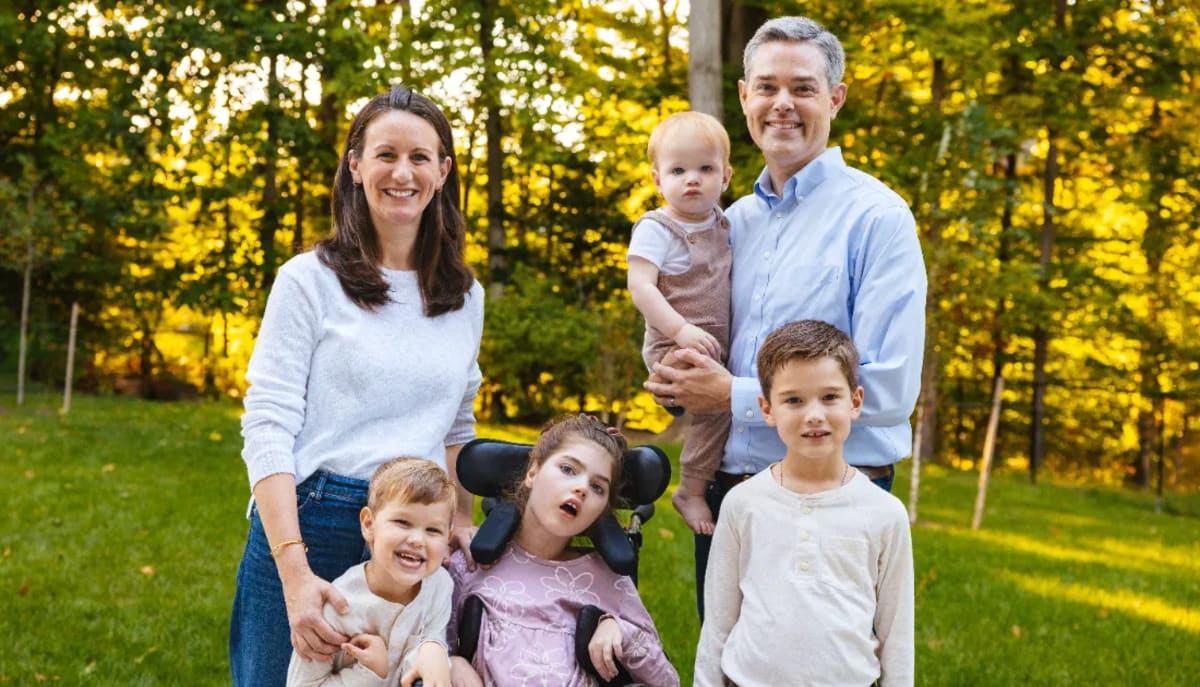
When their daughter Madeleine was diagnosed with GNAO1, a rare neurological disorder, Emily and Stephen Bell turned their search for answers into a global research foundation. What started as funding for one project now connects 500 families and powers groundbreaking science at the University of Miami.
Madeleine Bell was just 5 weeks old when her symptoms began, but it took more than a year to get a diagnosis. When doctors finally identified GNAO1, a rare genetic neurological disorder, her parents discovered almost nothing existed to help them understand what lay ahead.
"You turn to Dr. Google, and it turned up a handful of medical papers," Stephen Bell said. "At the time, doctors and scientists really didn't know much about the condition."
At 11 years old, Madeleine cannot speak, requires a feeding tube, and lives with seizures and severe movement challenges. Her parents describe her as physically like a four-month-old, but with a beautiful smile that lights up their world despite the daily struggles.
Instead of accepting the silence around their daughter's condition, the Bells launched the Bow Foundation. They initially planned to support just one research project, but conversations with other affected families expanded their vision into something much bigger.
Today, the foundation connects roughly 500 families worldwide and has directed more than $1 million to researchers advancing the science of GNAO1. They host an annual conference bringing together experts from around the globe and create connections between investigators who might never have met.
"One of the biggest scientific things that's happened is we've actually got people interested in the condition," Emily Bell said. "We actually have people researching, connecting and collaborating."
Among those researchers is Dr. Kirill Martemyanov, chair of the Department of Physiology and Biophysics at the University of Miami Miller School of Medicine. He'd been studying GNAO1 for nearly two decades when a family from the Bow Foundation reached out in 2018, transforming his abstract research into something deeply personal.
"GNAO1 causes this devastating pediatric disorder and makes the connection of what you are studying out of abstract curiosity to the real world," Dr. Martemyanov said. "The things that you've been studying are no longer abstract."
His recent study in Movement Disorders revealed how specific mutations affect different brain regions, disrupting neural circuits responsible for movement and seizure activity. The findings helped explain why symptoms vary so widely between patients and demonstrated that targeting these pathways with drugs could improve symptoms in preclinical models.
The Ripple Effect
The Bow Foundation's impact extends far beyond funding research papers. It's creating what the Bells call "a better landing zone" for newly diagnosed families who don't know where to turn.
Instead of isolated parents searching desperately online, families now find an active community, research updates, and direct connections to scientists who care. The foundation has transformed GNAO1 from an obscure condition into one with growing scientific attention and collaborative momentum.
For Emily and Stephen, the timeline remains uncertain. They don't know if Madeleine will see a treatment in her lifetime, but they're building the infrastructure to make it possible for her and hundreds of other children.
What began as two frightened parents facing an impossible diagnosis has become a global movement turning curiosity into collaboration and desperation into hope.
More Images


Based on reporting by Google: scientific discovery
This story was written by BrightWire based on verified news reports.
Spread the positivity!
Share this good news with someone who needs it