Fermilab Powers AI Cloud to Speed Scientific Breakthroughs
America's particle physics lab is using decades of data expertise to fuel the Genesis Mission, a new AI-powered research platform that could cut discovery time from years to months. Researchers across the country can now tap into powerful storage systems to accelerate everything from battery development to fusion energy.
Imagine asking a computer to find the 10 best materials for next-generation batteries and getting science-backed answers in hours instead of months. That future just got closer thanks to Fermilab, America's particle physics laboratory, which is now powering the backbone of a revolutionary AI research platform.
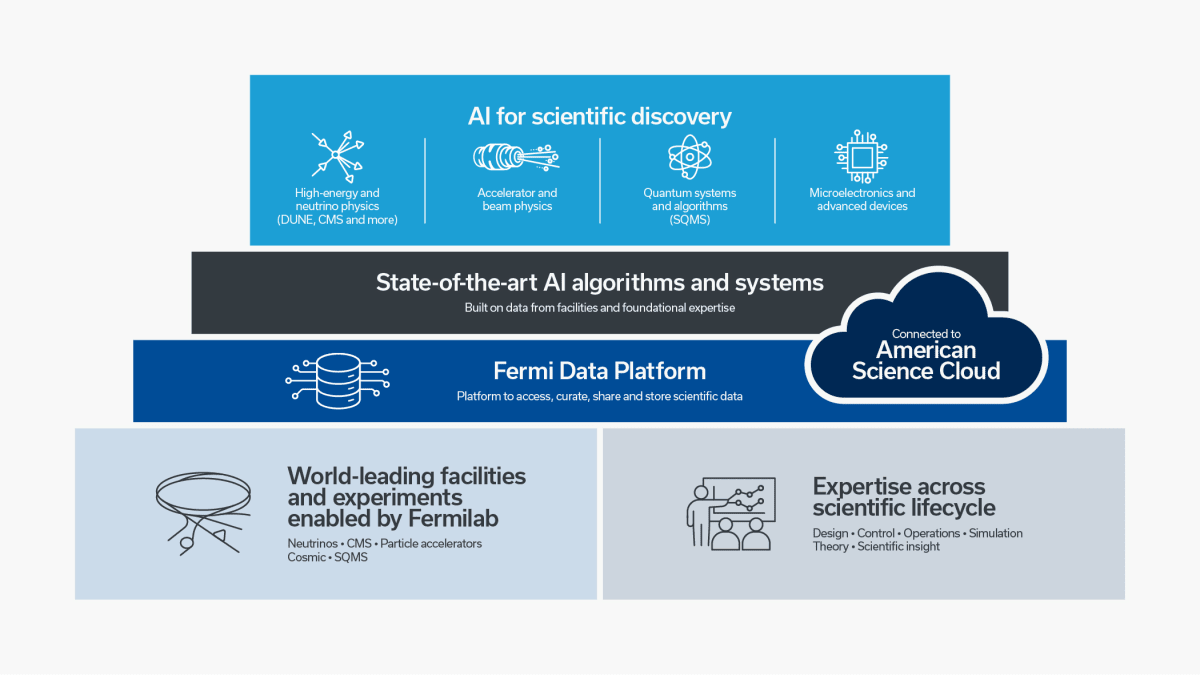
The U.S. Department of Energy's Genesis Mission is building the American Science Cloud, an AI-driven system designed to supercharge scientific discovery across every field imaginable. At its heart sits the Fermi Data Platform, a massive storage system built on thousands of hard drives that already manages some of the world's most complex scientific datasets.
Fermilab brings decades of expertise handling enormous amounts of information from experiments like CERN's Large Hadron Collider and cutting-edge neutrino research. Now that institutional knowledge is helping researchers nationwide access petabytes of scientific data quickly and efficiently, making it ready for AI analysis.
The platform doesn't just store information. It organizes raw scientific data from instruments and detectors, adding crucial structure that machine learning models need to work effectively.
The Ripple Effect
The American Science Cloud connects scientific expertise from national laboratories, universities, and industry partners into one integrated system. Researchers can describe what they need, and AI tools automatically search publications, run simulations, filter results, and present refined answers for further investigation.
This isn't about replacing scientists. Humans still ask the questions and evaluate the answers. The system simply handles the time-consuming middle steps, freeing researchers to focus on insights that matter most.
The potential applications span disciplines from high-energy physics to materials science to fusion energy research. A materials scientist could query promising battery compounds. A physicist could explore theoretical predictions. A biologist could analyze protein structures. All using the same AI-enhanced infrastructure.
"Data is the common denominator behind major scientific endeavors, and AI is fundamentally data-driven," said Chin Guok, who leads partner integration for the American Science Cloud. The Fermi Data Platform can support both training AI models and running them on large scientific datasets.
Because Fermilab already had robust infrastructure in place, researchers moved quickly to offer storage and data access tools engineered for the repeated, active use that AI research demands. The lab is also preparing for future needs, including data from the upcoming Deep Underground Neutrino Experiment.
This partnership allows researchers to leverage Department of Energy resources more seamlessly, building a foundation where the next breakthrough could come not from one lab working alone, but from AI connecting insights across the entire scientific community for the benefit of everyone.
Based on reporting by Google: scientific discovery
This story was written by BrightWire based on verified news reports.
Spread the positivity!
Share this good news with someone who needs it