Fire Tornadoes Burn 95% of Oil Spills in Texas A&M Test
Scientists just proved that spinning fire whirls can clean up ocean oil spills twice as fast as traditional methods while producing 40% less toxic smoke. This breakthrough could transform how we protect coastlines and marine life from future disasters.
Scientists have turned one of nature's most destructive forces into a powerful cleanup tool that could save our oceans from oil disasters.
Researchers at Texas A&M University just completed the first large-scale experiment showing that fire whirls, those tornado-like flames that spiral upward, can burn off oil spills faster and cleaner than anything we've tried before. The results surprised even the scientists themselves.
The spinning vortex acts like a natural turbocharger, pulling in oxygen and creating flames that burn hotter and more efficiently than regular fires. In their tests, the fire whirls consumed up to 95% of the fuel and produced 40% less soot than traditional burn methods.
Dr. Elaine Oran, who leads the project funded by the Bureau of Safety and Environmental Enforcement, calls this the beginning of a new era in oil spill response. "This is the first time anyone has conceived using fire whirls for oil spill remediation," she said.
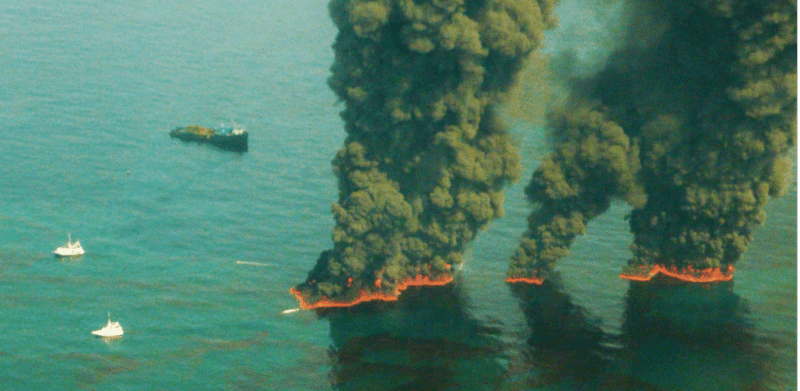
Right now, when oil spills happen offshore, responders face a tough choice. They can let the oil spread and damage marine ecosystems, or they can light it on fire. Traditional controlled burns create massive plumes of black smoke, release toxic particles into the air, and leave behind a layer of unburned sludge floating on the water.
Fire whirls change that equation completely. They burn through crude oil nearly twice as fast, which means cleanup crews could stop spills before they reach sensitive coastlines and marine habitats. The spinning motion breaks down the particles that create thick smoke, dramatically reducing air pollution during emergency operations.
The technique works like a massive incinerator, vaporizing almost all of the oil before it can form toxic tar on the ocean's surface. That means fewer dead marine animals, cleaner water, and healthier coastal ecosystems after a spill.
The 2010 Deepwater Horizon disaster showed us how devastating oil spills can be. That catastrophe killed 11 people, destroyed thousands of marine animals, and severely damaged ocean habitats across the Gulf of Mexico. Having a faster, cleaner response tool could prevent future tragedies from reaching that scale.
The Bright Side
The research team, which includes Dr. Qingsheng Wang of Texas A&M and Dr. Michael Gollner of UC Berkeley, knows they haven't solved every challenge yet. Fire whirls only reach peak efficiency under carefully controlled conditions. Wind speed, airflow, and oil thickness all need to fall within a specific range that researchers call the "Goldilocks zone."
But that's exactly what makes this discovery so exciting. With further development, scientists hope to create mobile systems that could be deployed directly over oil spills. These systems would control the conditions needed to transform destructive fires into efficient, cleaner-burning fire whirls.
"We are looking at environmental disasters like oil spills and identifying ways to remediate them in faster, greener and more sustainable ways," Oran explained. The team sees this as just the beginning of harnessing chaotic natural forces as precise restoration tools.
The technology could transform oil spill response from a prolonged emergency into a rapid-response operation that protects both our air and our oceans.
Based on reporting by Google News - Ocean Cleanup
This story was written by BrightWire based on verified news reports.
Spread the positivity!
Share this good news with someone who needs it