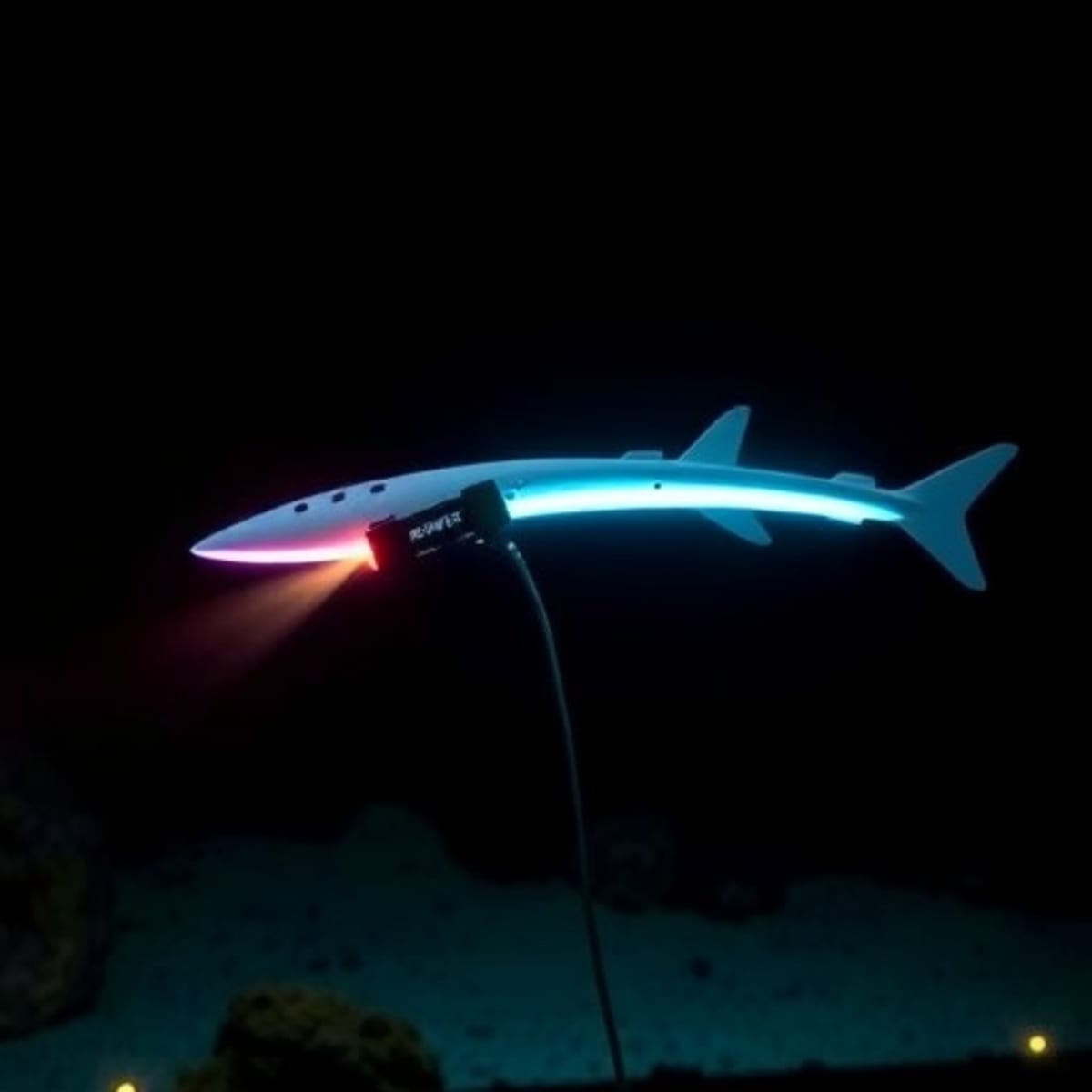
Fish-Inspired Robots Promise Agile Underwater Rescue
Scientists decoded how the black ghost knifefish swims backward and hovers using wave-like fin motions. Their findings are helping engineers design nimble underwater robots for rescue missions and ocean exploration.
A strange fish that swims backward without turning around just inspired the next generation of underwater rescue robots.
The black ghost knifefish has puzzled scientists for years with its uncanny ability to glide through water in any direction while barely moving its body. Unlike regular fish that use tail fins to push forward, this freshwater species ripples its long belly fin in waves to move up, down, forward, and even backward with remarkable precision.
Researchers recently cracked the code behind this extraordinary swimming style using high-speed cameras and computer simulations. They discovered the fish's belly fin contains dozens of tiny ray structures that contract and relax in perfectly timed waves. These waves create controllable bursts of water thrust that can change direction almost instantly.
The fin works like a biological propeller that can reverse on command. By adjusting the frequency and size of each wave, the fish can hover motionless against strong currents, slip through tight spaces, or retreat from danger without the clumsy body turns most swimmers need. This flexibility comes from a clever balance between the fin's stiffness and flexibility, allowing it to bend efficiently without collapsing under water pressure.
The Ripple Effect
Engineers are already using this biological blueprint to build smarter underwater vehicles. Traditional underwater robots rely on propellers that struggle in cramped or cluttered environments like shipwrecks, coral reefs, or flooded disaster zones. A robot mimicking the knifefish's fin could navigate these challenging spaces with unprecedented grace.
The research team created a detailed database mapping exactly how each fin movement creates specific thrusts and turns. This roadmap gives robotics engineers everything they need to replicate the knifefish's agility in machines. Early prototypes are focusing on soft, flexible materials that can recreate the wave motion while withstanding ocean pressures.
These bio-inspired robots could transform underwater search and rescue operations, allowing machines to slip through debris fields where survivors might be trapped. They could also revolutionize environmental monitoring, gliding silently through sensitive ecosystems without disturbing marine life. Scientists envision fleets of knifefish-inspired vehicles exploring shipwrecks, inspecting underwater infrastructure, and mapping ocean floors with minimal energy consumption.
The breakthrough even hints at smarter robot brains. Researchers observed that the knifefish adjusts its fin movements in real time based on water conditions, suggesting future robots could learn to adapt their swimming style automatically when encountering obstacles or currents.
Nature's 400-million-year head start on engineering continues to offer solutions we're only beginning to understand.
More Images


Based on reporting by Google: robotics innovation
This story was written by BrightWire based on verified news reports.
Spread the positivity!
Share this good news with someone who needs it