Floating Bamboo Shelters Power Coastal Reforestation
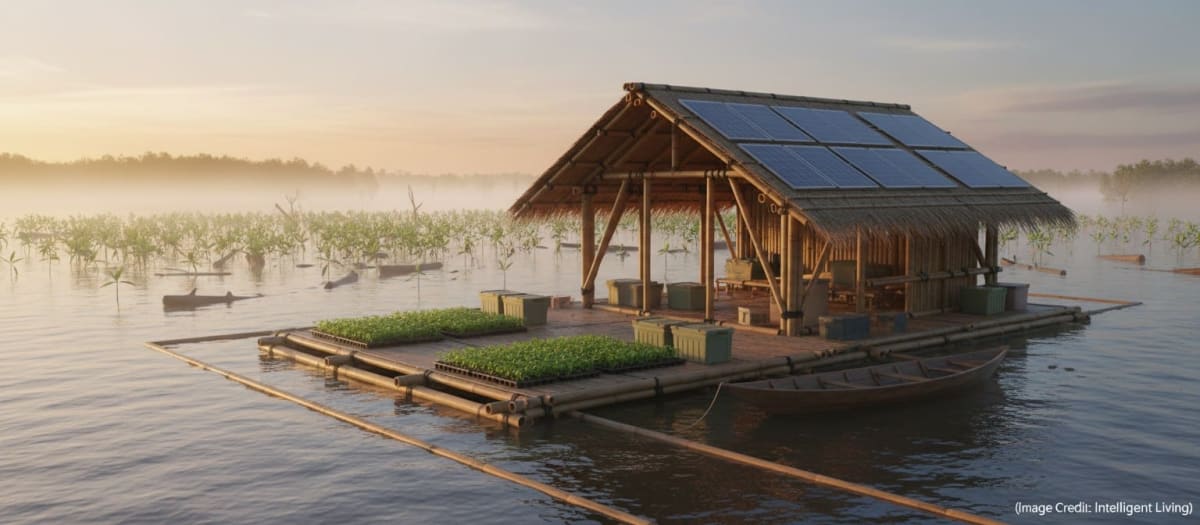
Flood-zone restoration crews are getting a game-changing tool: floating bamboo shelters with solar panels that turn rising water into usable workspace. These lightweight, modular basecamps keep reforestation projects running even when seasonal floods wash away roads and dry ground.
When floodwater arrives, most construction stops. But a new generation of floating bamboo shelters is turning that problem into a solution for coastal reforestation teams working where land and water constantly trade places.
The concept is beautifully simple. Lightweight bamboo structures sit on buoyant platforms, topped with solar panels that power equipment and communications. Instead of fighting seasonal floods or waiting months for water to recede, restoration crews can keep working right through the wet season.
The timing couldn't be better. Global forests are still disappearing at roughly 10 million hectares per year, with delta regions facing a double threat of rising seas and sinking land. Reforestation teams often work in remote, humid areas where roads vanish underwater and finding dry ground to store seed trays becomes a daily struggle.
One project lead described the challenge perfectly: keeping equipment dry and radios charged when the basecamp itself keeps flooding. Traditional stilted structures fail when soil dissolves beneath them or storm surges exceed every previous record. Clearing new land for camps only creates more erosion in fragile landscapes that desperately need restoration.
The floating shelters solve this by treating water as a surface rather than an obstacle. When access roads disappear, boats become highways. A basecamp that repositions along waterways works like a mobile operations node, following the work instead of forcing crews to commute impossible distances.
Bamboo brings serious engineering advantages beyond its eco-friendly reputation. It's locally available in many coastal regions, grows rapidly, and now meets ISO-grade construction standards with predictable strength ratings. The material has crossed from experimental to formal engineering, appearing alongside timber and metal in modern building conversations.
Rooftop solar completes the independence equation. As renewable energy scales up globally, off-grid electricity in flood-prone zones has shifted from fantasy to practical reality. Crews can charge drones for surveying planted areas, run water filtration systems, and maintain communication without waiting for grid extensions that may never arrive.
The Ripple Effect
These floating camps don't just help individual projects succeed. They change what's possible in delta restoration entirely. Mangrove replanting programs that protect coastlines from storm surge can now operate year-round. Teams can access areas previously considered too wet to work, expanding the geography of hope.
The design also respects what it's trying to save. Instead of bulldozing new clearings that compact soil and accelerate erosion, the shelters float above ecosystems trying to recover. It's infrastructure that works with water instead of demanding water leave.
Coastal communities watching saltwater intrusion claim forests that stood for generations now have proof that adaptation doesn't mean retreat. When restoration crews can stay in place through flooding, they send a powerful message: rising water changes the rules, but it doesn't end the game.
Based on reporting by Google News - Reforestation
This story was written by BrightWire based on verified news reports.
Spread the positivity!
Share this good news with someone who needs it

