Florida Team's New Antenna Lets Ocean Robots Talk 730 Meters
Underwater robots usually go silent the moment they dive, but a new antenna inspired by medical implants is letting them chat reliably across ocean distances for the first time. The breakthrough could transform everything from seafloor mapping to rescue missions.
Most underwater robots work blind, cut off from contact the instant they disappear beneath the waves. But researchers at the University of Florida just proved that technology designed for the human body can help machines talk across nearly half a mile of ocean.
The problem has frustrated engineers for decades. Radio waves die within feet of hitting saltwater. Acoustic systems work farther but create noise that harms marine life and distort badly when robots move. Optical links are fast but fail the moment water gets murky or organisms cloud the lens.
The solution came from an unexpected place. Adam Khalifa spent years designing tiny wireless implants before realizing something obvious: the human body is basically lightly salted water. The same physics that let devices communicate inside us could work in the ocean.
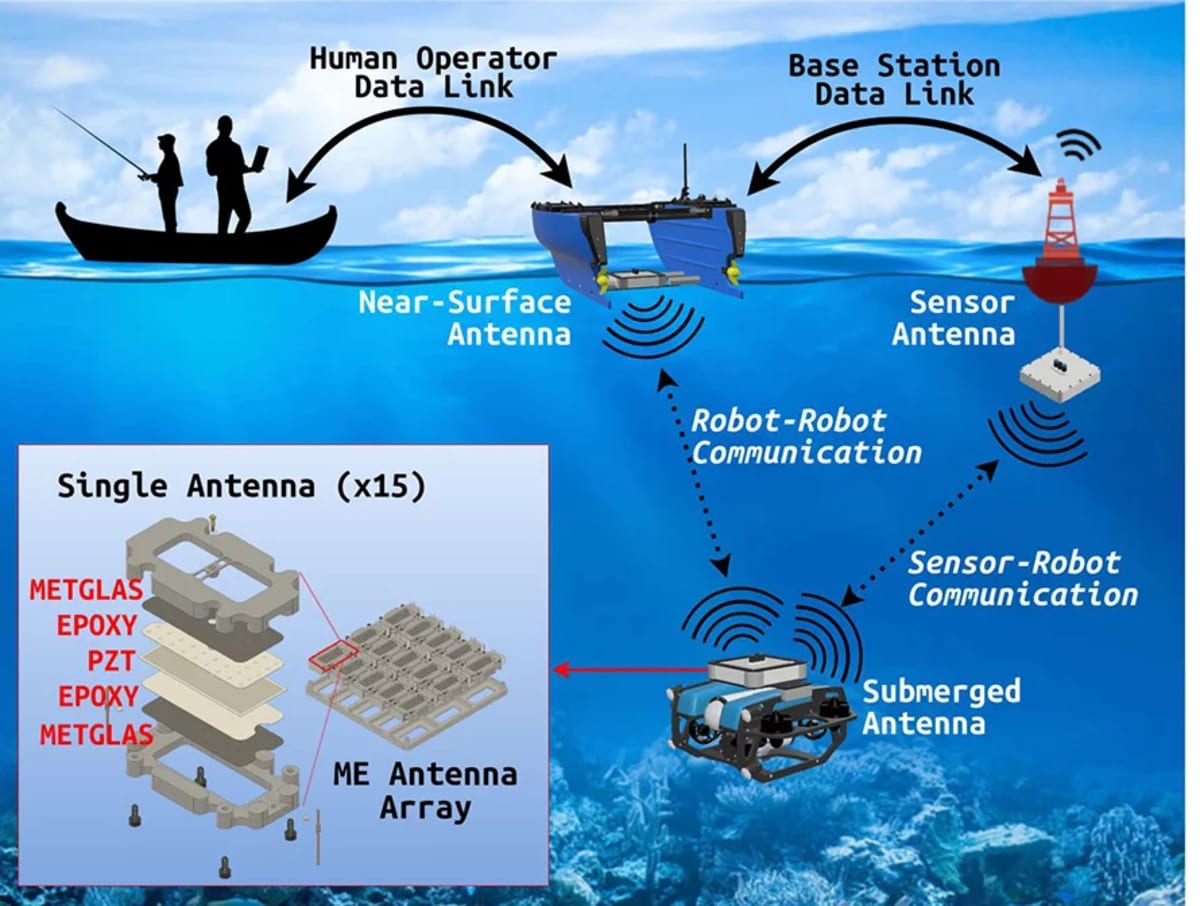
His team built BlueME, a communication system using magnetoelectric antennas borrowed from medical technology. These devices pair two materials that work together like a relay race. A magnetic field squeezes one layer, which then creates voltage in another. Run it backward and you can transmit.
The clever part is how water actually helps. At the frequency BlueME uses, around 36 kHz, wavelengths shrink dramatically when submerged. That compression makes small antennas far more efficient than they'd ever be in air.
The researchers packed 15 antennas into a single array and tested it in Florida lakes and the Gulf Coast. In freshwater, the system worked reliably at 200 meters on just one watt of power. In saltwater, signals reached 730 meters on less than 10 watts, about what a single LED bulb draws.
Performance stayed rock solid regardless of murky water, obstacles, or interference. Data speeds run between 1 and 100 kilobits per second, nowhere near fiber optic rates but fast enough for what matters: letting robots check in every few minutes so operators can adjust missions in real time.
Why This Inspires
This breakthrough represents the first time magnetoelectric antennas have worked outdoors at scale. The team achieved it on a shoestring budget, proving the concept before seeking larger funding.
The applications stretch across ocean science. Fleets of robots could coordinate during seafloor mapping missions. Search and rescue teams could maintain contact with submersibles in disaster zones. Marine researchers could monitor ecosystems without surfacing equipment that disrupts wildlife.
"We demonstrated these results with very limited initial resources," Khalifa says. With proper development, the possibilities expand dramatically.
The team has filed for a patent and is planning trials on full-size autonomous vehicles. They're in the very early days of what Islam calls "a very powerful product."
For the first time, underwater robots won't have to choose between diving deep and staying connected.
More Images


Based on reporting by New Atlas
This story was written by BrightWire based on verified news reports.
Spread the positivity!
Share this good news with someone who needs it