Flying Taxi Completes World-First Regulated Test Flight
A British electric aircraft just aced the hardest test in aviation history, proving flying taxis can safely switch from helicopter to airplane mode mid-flight. This breakthrough brings zero-emission air travel closer to your daily commute.
📺 Watch the full story above
Vertical Aerospace just pulled off what many engineers thought would take years longer: their electric flying taxi successfully transitioned from vertical takeoff to horizontal flight and back again, all while regulators watched every second.
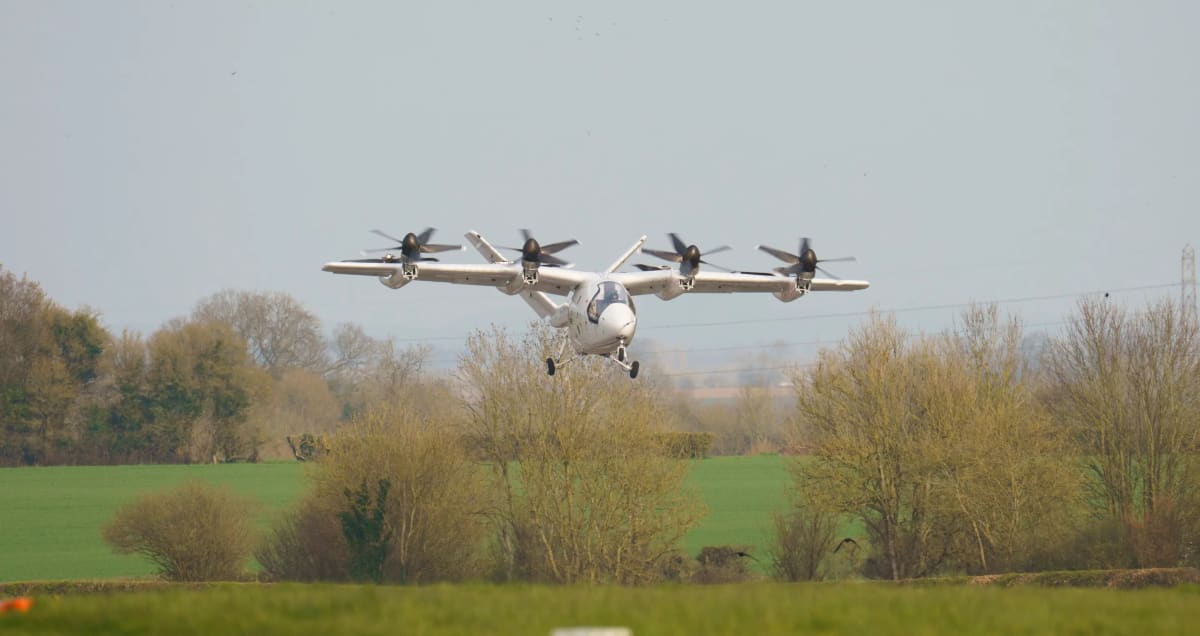
On April 14, Chief Test Pilot Simon Davies flew the full-scale G-EVTA aircraft through the most challenging maneuver in aviation at Cotswold Airport in southwest England. The plane lifted off like a helicopter, tilted its front rotors 90 degrees mid-air, flew like a traditional airplane, then reversed the entire process to land vertically.
What makes this historic isn't just the flight itself. This marks the first time any company has completed this complex transition under official civil aviation oversight, specifically Britain's Civil Aviation Authority. While Joby Aviation flew a similar test last year, Vertical Aerospace is the first to do it with regulators certifying every step meets safety standards for public use.
The aircraft handled the radical aerodynamic changes flawlessly, proving both the design and Honeywell's fly-by-wire systems can maintain stability when physics gets complicated. This successful test completes Phase 4 of their testing program, showing the G-EVTA can operate safely through its entire flight envelope.
The journey to this moment took careful steps. The team conducted tethered hovers in September 2024, vertical maneuvers in February 2025, and horizontal flights covering 250 miles between airports last July. Each test built confidence that the hardest challenge, the transition phase, could be conquered.
The Ripple Effect
This breakthrough ripples far beyond one company's achievement. Vertical Aerospace plans public demonstrations at the Farnborough International Airshow this July, giving the world its first real glimpse of practical urban air mobility.
By 2028, if full certification stays on track, these aircraft could carry a pilot and four passengers at 150 mph over 100-mile routes with zero emissions. Imagine cutting a two-hour ground commute to 20 minutes in the air, all while helping cities reduce carbon footprints and traffic congestion.
The success also validates an entire industry betting billions on electric aviation. With regulatory approval processes now proven possible, other eVTOL manufacturers have a clearer roadmap to follow. That competition will drive innovation faster and bring costs down sooner.
Stuart Simpson, Vertical Aerospace's CEO, captured the magnitude simply: "We're not just participating in this industry, we are helping to define it."
The sky just got a lot closer to becoming everyone's highway.
More Images



Based on reporting by New Atlas
This story was written by BrightWire based on verified news reports.
Spread the positivity!
Share this good news with someone who needs it