Forest School Educates 125 Kids Through Culture for 30 Years
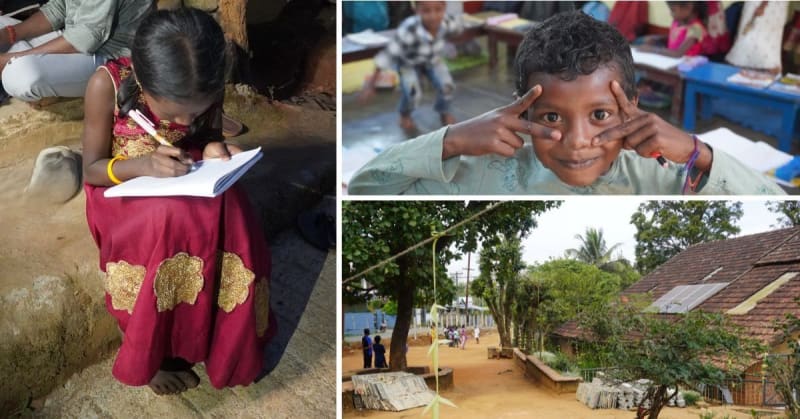
In Tamil Nadu's Nilgiris district, indigenous children learn math with seeds, geometry with leaves, and traditional arts alongside state curriculum. The Vidyodaya School has spent three decades proving that education works best when it honors where students come from.
When teacher Shanthi Kunjan needs a ruler, she reaches for a stick. When it's time for math class, seeds become coins. After 25 years at Vidyodaya School, she's mastered the art of teaching through the forest itself.
The school serves 125 students from four indigenous communities in Tamil Nadu's Gudalur region. These groups, recognized by India's government as Particularly Vulnerable Tribal Groups, have watched their children struggle in traditional classrooms for generations.
Vidyodaya took a different approach. Children who already know every plant and animal in their forest don't need textbooks about distant ecosystems. They need teachers who build on what they bring from home.
The school weaves indigenous knowledge into every subject. Art class means weaving baskets from bamboo and making jewelry from coconut shells. Science lessons draw from The Food Book, which documents local medicinal plants, edible tubers, and traditional honey collection methods.
Morning assemblies rotate through science videos, storytelling sessions, and indigenous songs and dances. Every Friday, children perform traditional dances passed down through their communities.
The journey started unexpectedly in 1990 when Ramdas Bhaskaran and Rama Sastry moved to Gudalur. They began homeschooling their own children using hands-on activities instead of rote memorization. Neighborhood kids loved the approach and kept showing up.
In 1995, 200 indigenous elders gathered for a community meeting. They asked the couple to transform their small learning center into a proper school where traditions could survive alongside modern education. The Viswa Bharati Vidyodaya Trust was born, taking its first batch of 36 students in 1996.
Today, the state board affiliated school runs from kindergarten through fifth grade. Education is completely free for first generation learners. Lunch boxes contain ragi porridge, eggs, and sprouts to combat malnutrition, which affects 40 percent of young children in vulnerable communities according to UNICEF.
The Ripple Effect
Parents who never attended school themselves now watch their children master both traditional knowledge and mainstream academics. The model proves that honoring culture doesn't mean abandoning progress. It means recognizing that children learn best when education feels like home.
Community involvement runs deep, with elders teaching traditional skills and parents participating in school decisions. The curriculum doesn't force indigenous children into rigid academic boxes. Instead, it expands those boxes to fit real life.
Shanthi explains the philosophy simply: these children arrive already knowing the forest intimately. Smart teaching means starting there, not erasing it.
Three decades in, Vidyodaya stands as proof that the best education doesn't replace a child's world but builds bridges from it.
More Images
%2Fenglish-betterindia%2Fmedia%2Fmedia_files%2F2026%2F02%2F11%2Falternative-schooling-7-2026-02-11-18-55-21.jpg)
%2Ffilters%3Aformat(webp)%2Fenglish-betterindia%2Fmedia%2Fmedia_files%2F2026%2F02%2F11%2Falternative-schooling-2026-02-11-18-36-56.jpg)
%2Ffilters%3Aformat(webp)%2Fenglish-betterindia%2Fmedia%2Fmedia_files%2F2026%2F02%2F11%2Falternative-schooling-1-2026-02-11-18-39-55.jpg)
Based on reporting by The Better India
This story was written by BrightWire based on verified news reports.
Spread the positivity!
Share this good news with someone who needs it