Four Embry-Riddle Grads Win Prestigious NSF Fellowships
Four Embry-Riddle graduates earned National Science Foundation Graduate Research Fellowships this year, the university's highest number ever. They're now pursuing breakthrough research in everything from quantum computing to exploding stars.
Four graduates from Embry-Riddle Aeronautical University just earned one of the most competitive honors in American science, and they're already making waves in their fields.
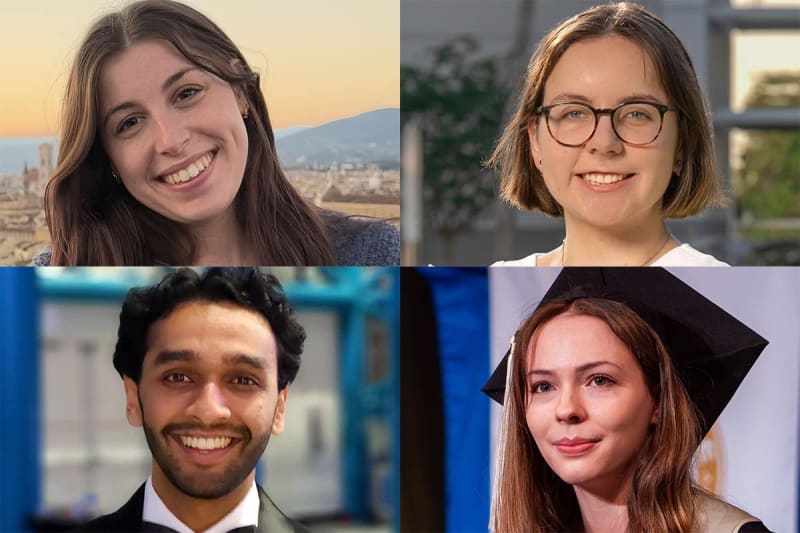
Alexandra Newcomb, Erin Motherway, Vikas Patel, and Hailey Murray each won National Science Foundation Graduate Research Fellowships this year. That's a record for the university, and it happened during a year when the NSF cut total awards from over 2,000 to just 1,500.
The fellowship gives each student $37,000 per year for three years, plus $16,000 for tuition. But the real prize is freedom.
"Because the fellowship funds me as an individual, I can pursue the research I find most impactful," said Newcomb, who's now working on using artificial intelligence to improve software security. She published three scientific papers as an undergraduate and credits her undergraduate research experience for preparing her.
Motherway, a first-generation college student, is studying blue straggler stars at the University of Wisconsin-Madison. These unusual stars look younger than they should be because they steal mass from companion stars. Understanding them could help scientists predict supernovae and gravitational waves.
"It allows me to take intellectual risks rather than always following the safe path," Motherway said about her fellowship. She got hands-on experience with Embry-Riddle's 1-meter telescope, which gave her skills she's using today.
Patel joined Stanford's Intelligent Systems Laboratory, where he's developing better ways to land spacecraft on other planets and manage urban air taxis. He said the fellowship made it easier to match with his dream research lab since funding was no longer an obstacle.
Murray is tackling quantum cryptography at Cornell University. As an undergraduate, she co-authored a paper challenging Einstein's theory of relativity as it relates to black holes. Now she's working on making future communications unhackable using quantum physics.
The Ripple Effect
These four students represent more than individual achievement. They show what happens when universities invest in undergraduate research and mentorship. Each graduate credited their professors and hands-on lab experience for preparing them to compete at the highest level.
Their work spans protecting computer systems, understanding stellar evolution, advancing space exploration, and securing future communications. These aren't just academic exercises. They're solving real problems that will affect millions of lives.
The fellowships also create opportunity beyond the recipients themselves. By freeing these researchers from funding constraints, the NSF allows them to explore risky ideas that might lead to breakthrough discoveries.
This record-breaking year proves that world-class science education isn't limited to Ivy League schools. With the right support and opportunities, students anywhere can reach the pinnacle of their fields.
Based on reporting by Google News - Researchers Find
This story was written by BrightWire based on verified news reports.
Spread the positivity!
Share this good news with someone who needs it