France's Nuclear Plants Now Bend to Solar Power
French nuclear reactors have completely reversed their operating pattern in just six years. They now power down at midday when European solar energy peaks, marking a historic shift in how Europe's energy grid works.
For nearly 40 years, France's nuclear reactors hummed along at steady power all day, only dimming at night when people went to sleep. Now those same reactors are doing something remarkable: they're stepping aside at noon to make room for sunshine.
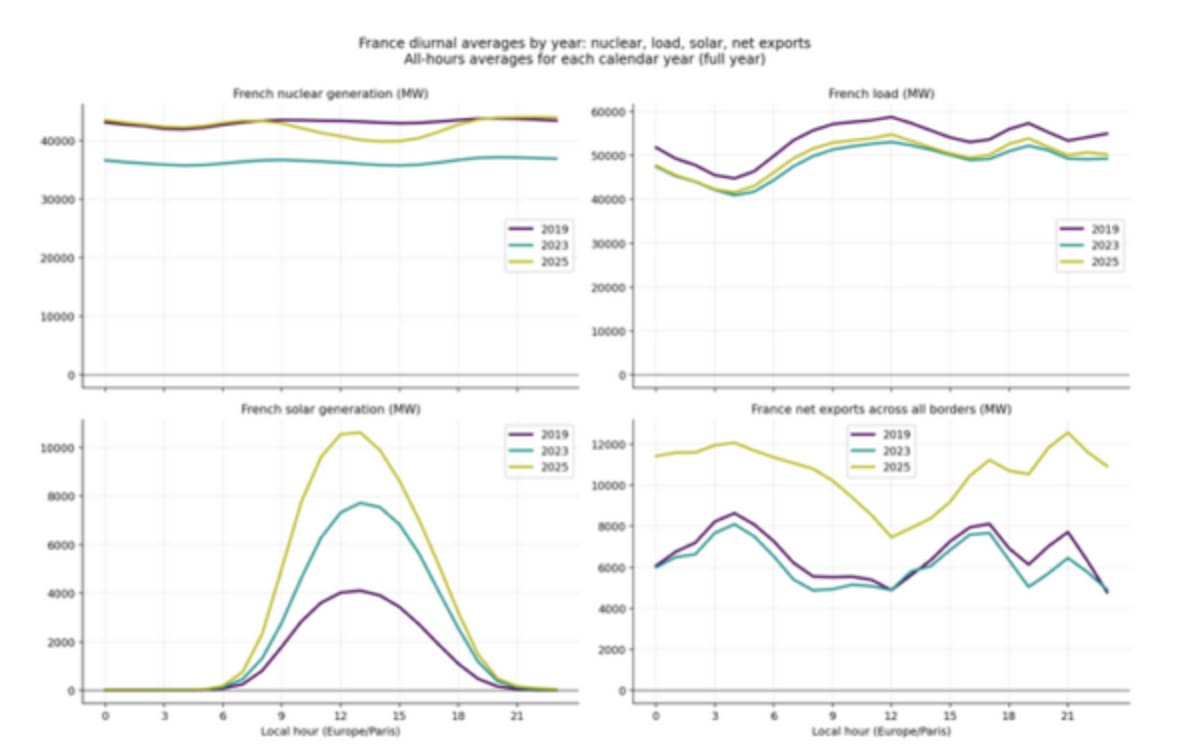
The numbers tell an astonishing story. Between 2019 and 2025, French nuclear plants increased the gap between their midday and evening output from 582 megawatts to 4,426 megawatts during spring and summer months. That's nearly ten times larger.
This isn't a technical problem. It's a sign that renewable energy is winning on pure economics.
When the sun shines brightest across Europe, solar panels now produce so much cheap electricity that it makes more sense to dial back expensive nuclear power. French reactors reduced their output by 33 terawatt-hours in 2025, more than double the 15 terawatt-hours they reduced in 2019.
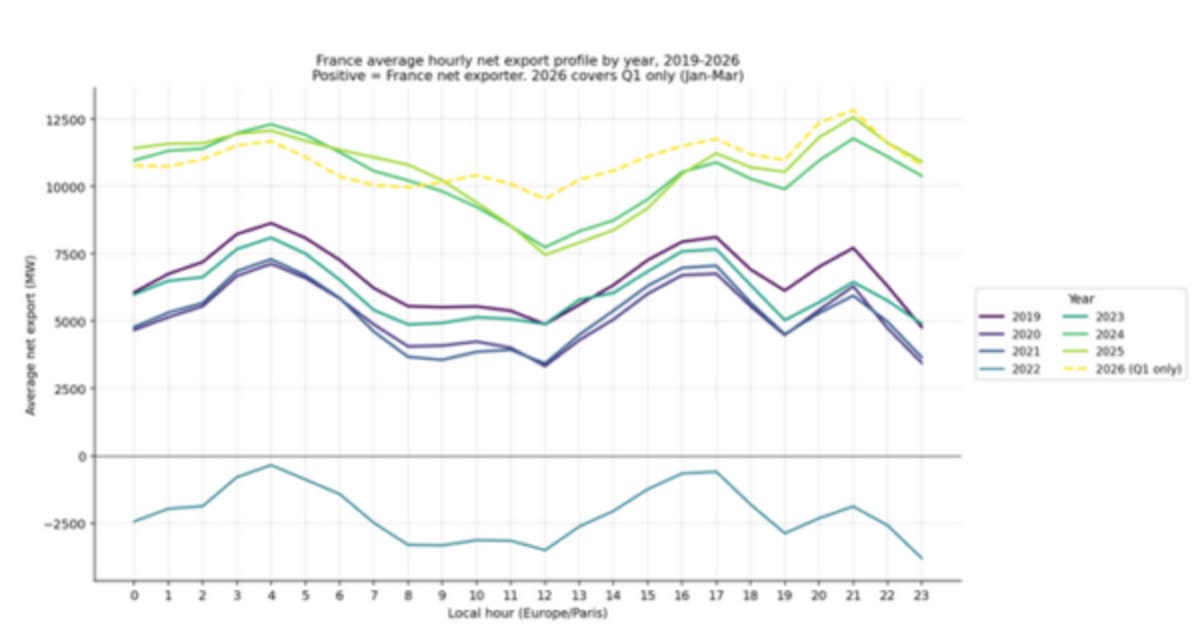
The transformation shows up most clearly in France's relationships with neighboring countries. Through 2021, France exported power to Spain almost constantly. Now the exchange flows both ways, balancing out nearly even in 2025.
Spain's solar boom means it often has cheaper electricity than France during sunny afternoons. France still exported a record 92.3 terawatt-hours overall in 2025, enough to power a country the size of Belgium for a year.
The Ripple Effect
This shift proves that renewable energy has reached a tipping point in Europe. Solar power isn't just supplementing traditional energy sources anymore. It's actually changing how nuclear plants operate, something energy planners thought wouldn't happen until the late 2020s.
The pattern appeared first along France's border with Spain, where solar installations grew rapidly. Now it's spreading to other connections as more European countries add solar capacity. Italy still imports heavily from France, but analysts expect that relationship to evolve as Italian solar expands.
France imports electricity during only 1.5 percent of hours, and when it does, those hours now signal abundance rather than scarcity. In 2025, the average import price was just 33 euros per megawatt-hour, the lowest since markets opened, with about half those hours seeing negative prices.
Energy forecasters who built models assuming nuclear plants would run flat all day now need to redraw their plans. The future of European energy arrived years ahead of schedule, powered by panels tilted toward the sun.
More Images

Based on reporting by PV Magazine
This story was written by BrightWire based on verified news reports.
Spread the positivity!
Share this good news with someone who needs it