Germany Helps Poland Build Shield for Peace in Eastern Europe
German soldiers are working alongside Polish forces to build a massive defensive barrier along NATO's eastern border, turning World War II enemies into modern-day partners protecting peace. The 800-kilometer East Shield represents one of the strongest symbols yet of European unity in the face of threats.
When German combat engineers started placing concrete anti-tank obstacles near the Polish-Russian border last June, they weren't just building defenses. They were helping heal one of history's deepest wounds.
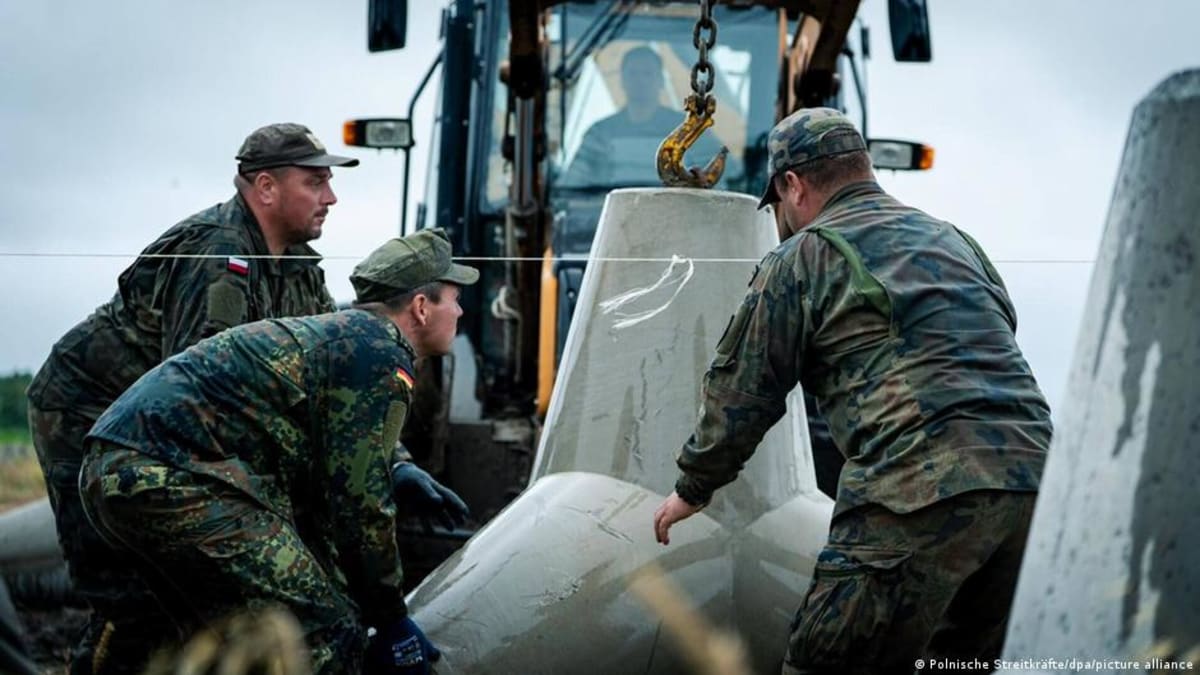
Around 40 German sappers have spent the past six weeks installing more than a kilometer of defensive barriers near Budry, Poland, just meters from the Russian border. The soldiers work with specialized equipment to position massive concrete blocks called Czech hedgehogs, designed to stop tanks in their tracks.
Polish General Stanislaw Czosnek inspected the work last Thursday and praised the German team's "excellent job." His German counterpart, General Tito Gante, emphasized the mission's purpose: "We want to maintain peace with a credible deterrent."
The collaboration is part of Poland's East Shield project, an 800-kilometer defensive system launched in 2024 along its borders with Russia and Belarus. Polish Prime Minister Donald Tusk has called it "truly an investment in peace" meant to protect NATO's eastern flank.
Poland now dedicates nearly 5% of its GDP to defense, the highest percentage among all NATO members at 46 billion euros in 2026. The country has purchased advanced weapons systems and accelerated construction of the East Shield since Russia's 2022 invasion of Ukraine shook its sense of security.
The German contingent will remain until October, rotating to different sections of the barrier as construction progresses. Their current work near Budry features three rows of anti-tank obstacles backed by deep ditches, with space designed for rapid mine deployment if needed.
The Ripple Effect
The true power of this mission extends far beyond concrete and steel. Polish analyst Lukasz Jasinski notes the "politically symbolic significance" of German soldiers defending Poland's border. "Poland wants to convince Germany and other partners that Poland's eastern border is also the external border of the EU and NATO," he told reporters.
This partnership would have seemed impossible decades ago. Germany and Poland, once bitter World War II enemies, have steadily built military cooperation since the Cold War ended. Poland joined NATO in 1999, cementing institutional ties. In 2003, Germany sold Poland MiG-29 fighter jets for one euro each.
Today, German Patriot air defense systems protect Polish skies with their crews, and German fighter jets patrol Polish airspace. The two nations signed a comprehensive defense agreement in June 2026, formalizing what has become one of Europe's strongest military partnerships.
Not everyone in Poland welcomes German soldiers on their soil. The conservative Law and Justice Party sometimes invokes World War II memories for political purposes. But the soldiers working side by side near Budry tell a different story about Europe's future.
As backhoe loaders lift the final defensive blocks into place, they're building more than a barrier against potential threats—they're constructing a foundation for lasting peace through friendship.
Based on reporting by DW News
This story was written by BrightWire based on verified news reports.
Spread the positivity!
Share this good news with someone who needs it