Germany's Court of Auditors Declares the Supposed Inevitability of Hydrogen Over
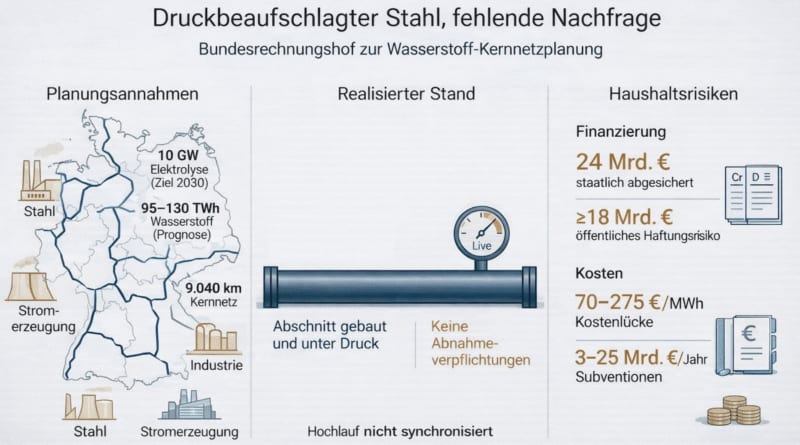
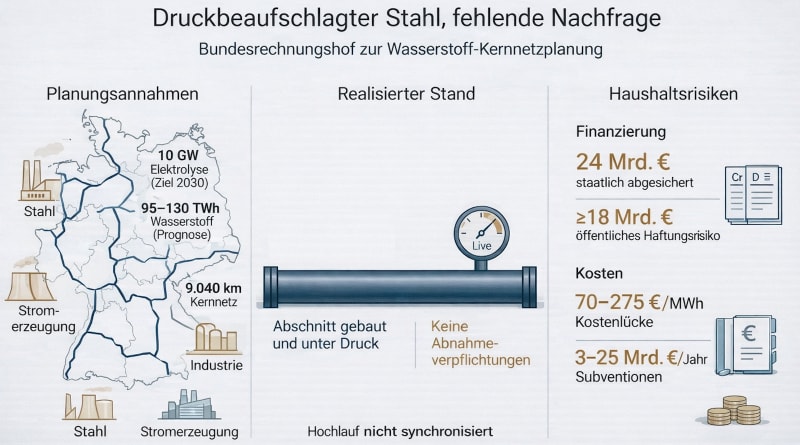
Germany's Federal Court of Auditors released a special report in October 2025 evaluating the government's hydrogen strategy against legal requirements. The report concludes that despite billions in funding (€4.3 billion in 2024, over €3 billion in 2025), the hydrogen strategy fails to meet criteria for energy security, affordability, environmental compatibility, climate neutrality, and fiscal soundness. Key Points: - Domestic electrolyzer capacity target was 10 GW by 2030, but less than 0.2 GW operational by 2025, now expecting less than 5 GW by 2030 - Germany projected import demand of 47.5-91 TWh, but global green hydrogen production with final investment decisions for 2030 is only about 63 TWh total - Industrial demand hasn't materialized: one of four funded steel projects already dropped out, hydrogen-capable power plant capacity reduced from 23.8 GW to 7.5 GW by 2040 - Germany approved a 9,040 km hydrogen core network with 87 GW withdrawal and 101 GW feed-in capacity by 2032, but supply is late, demand uncertain, and infrastructure too early - Financing structure creates direct public liability up to €24 billion through KfW loan guarantee, with federal government bearing at least 76% of remaining shortfall (over €18 billion) if network utilization fails - Interim financing costs estimated at €5-16.3 billion by 2055 depending on utilization and interest rates --- # BrightWire Article TITLE: Germany Hits Reset on Energy Strategy After Audit SUMMARY: Germany's independent budget watchdog just delivered a wake-up call that could save taxpayers billions and accelerate the country's clean energy transition. The Federal Court of Auditors found a better path forward after reviewing the nation's hydrogen plans.
📺 Watch the full story above
Germany just got some tough love that might be exactly what it needed. The country's Federal Court of Auditors reviewed the government's massive hydrogen investment plan and found a costly mismatch between ambition and reality.
Here's what they discovered: Germany planned to import enough green hydrogen to power a huge chunk of its economy by 2030. The problem? The world isn't producing anywhere near that much yet. Germany would need to secure three quarters of the entire global supply, which auditors called unrealistic rather than ambitious.
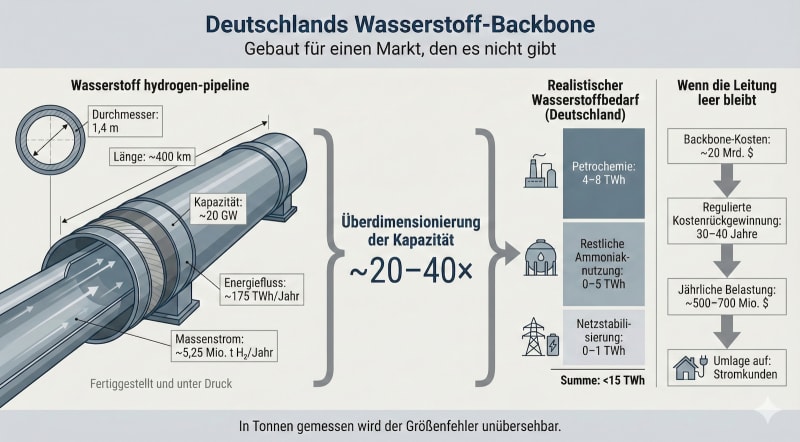
The numbers tell the story. Germany invested €4.3 billion in 2024 and over €3 billion in 2025 to build a 9,040 kilometer hydrogen pipeline network. But the demand that was supposed to justify those pipes never showed up. Steel plants that promised to use hydrogen are backing out. Power plants that were supposed to run on hydrogen got scaled back by two thirds.
Meanwhile, the actual hydrogen production isn't materializing either. Germany aimed for 10 gigawatts of production capacity by 2030 but has less than 0.2 gigawatts running today. The revised estimate? Maybe 5 gigawatts if everything goes perfectly.
The auditors found that continuing the current path risks up to €24 billion in public liability, with taxpayers potentially on the hook for over €18 billion if the infrastructure sits empty.
But here's the genuinely good news buried in this sobering report. Germany now has a clear picture of what's not working, delivered by an independent authority that both sides of the political aisle respect. The auditors aren't saying abandon hydrogen entirely. They're calling for a reality check and a Plan B that better aligns investment with actual supply and demand.
THE BRIGHT SIDE
This kind of honest accounting is rare and valuable. Many countries pour billions into energy infrastructure based on optimistic projections, then quietly absorb the losses years later when nobody's watching. Germany is course correcting in real time, with full transparency about what went wrong and why.
The report gives German policymakers permission to redirect resources toward solutions that can actually deliver on climate goals without breaking the budget. That might mean more investment in direct electrification, better battery storage, expanded renewable generation, or right-sized hydrogen projects that match real demand.
Getting energy policy wrong is expensive, but catching the mistake before you've built out the entire system? That's the kind of mid-course correction that protects both taxpayers and the climate.
Germany's willingness to acknowledge what's not working opens the door to finding what will.
More Images


Based on reporting by CleanTechnica
This story was written by BrightWire based on verified news reports.
Spread the positivity!
Share this good news with someone who needs it