Google's AI Predicts Weather Down to 5km Resolution
Google DeepMind just released an AI weather model that beats every competitor and predicts rain 60% better than before. WeatherNext 3 will soon power forecasts across Google Search, Maps, and Gemini with hourly updates.
Getting caught in unexpected rain could soon be a thing of the past, thanks to a breakthrough in artificial intelligence that's changing how we predict weather.
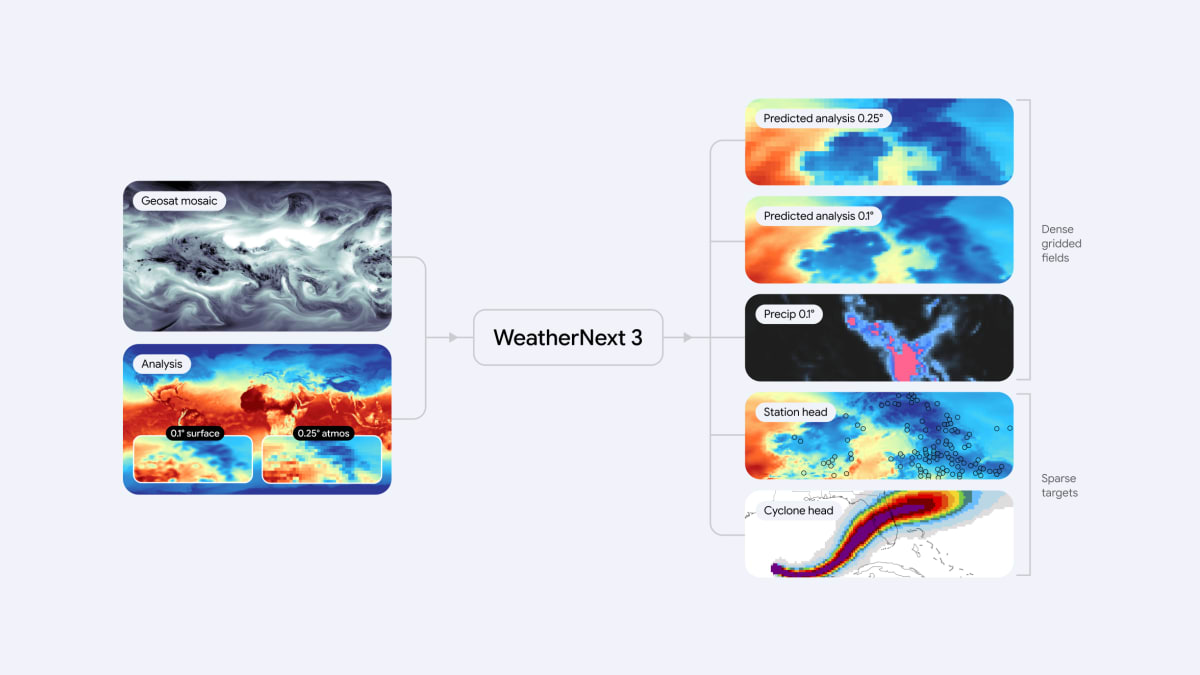
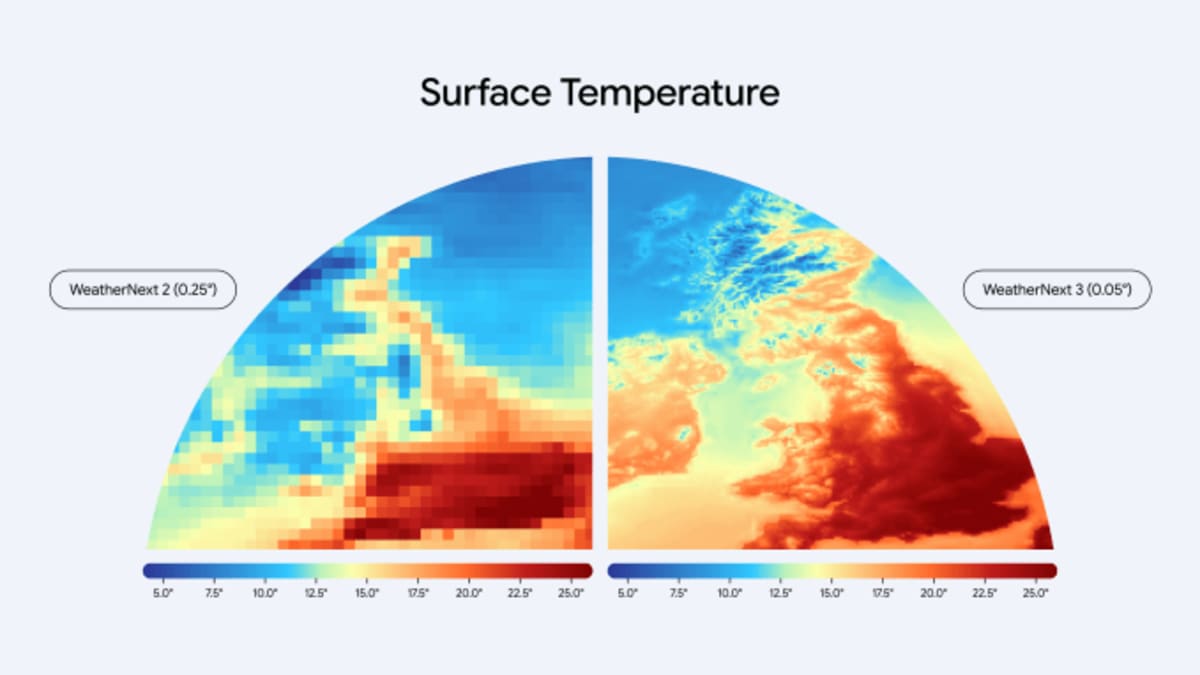
Google DeepMind and Google Research just released WeatherNext 3, an AI model that outperforms every other weather forecasting system tested, including traditional government supercomputers from the U.S. National Weather Service and Europe's meteorology center. The model predicts weather patterns down to just 5 kilometers, three times more precise than its predecessor.
The improvement in rain forecasting is especially impressive. WeatherNext 3 is 60% better at predicting precipitation than the previous version, and it delivers forecasts every hour instead of every six hours.
Traditional weather forecasts rely on government supercomputers that cost millions and take hours to crunch through complex physics equations. AI models like WeatherNext 3 learn patterns from decades of weather data and make predictions in minutes at a fraction of the cost.
"Weather is chaotic, and so small differences really start to perturb massively," said Ferran Alet, a DeepMind research scientist. "Machine learning targets the problem we are really solving, which is approximate noisy physics from incomplete information."
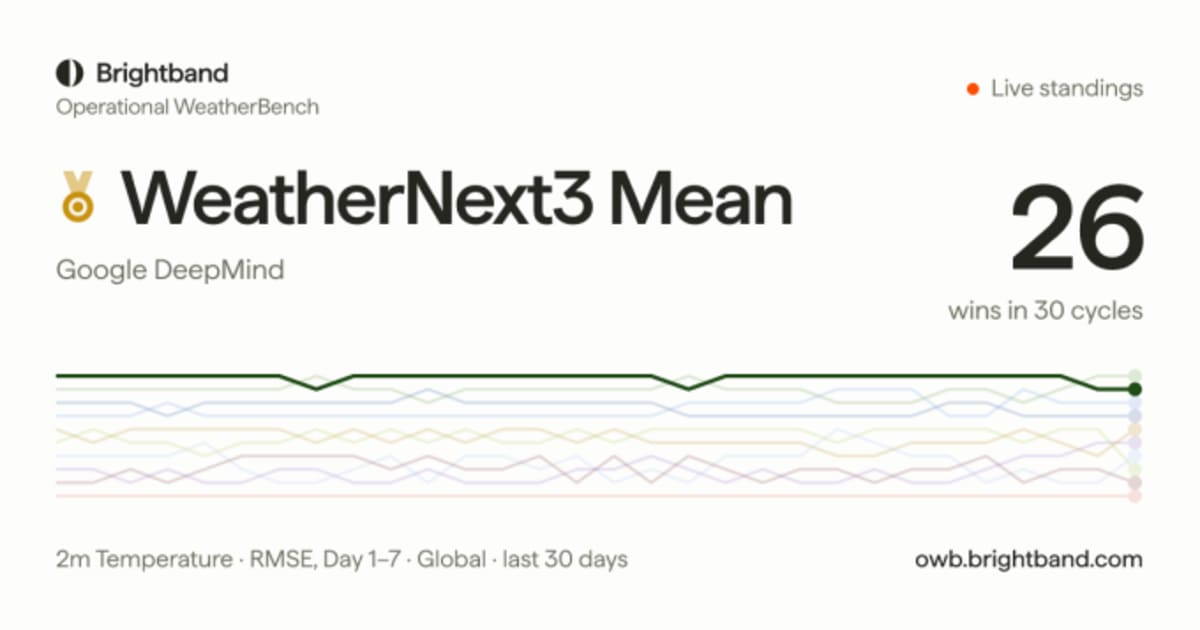
The model already ranks first on Operational WeatherBench, a tool that compares AI forecasts from Google, Microsoft, Nvidia, and European weather agencies. It measures accuracy on temperature, wind speed, and humidity across thousands of predictions.
Google plans to integrate WeatherNext 3 into products millions of people use daily. Starting soon, the AI will power weather information in Google Search, Google Maps, and the Gemini assistant.
The technology works by ingesting real-time satellite data every hour and predicting conditions at specific weather stations. This approach connects forecasts directly to ground-truth measurements, making them more reliable for everyday decisions like whether to grab an umbrella.
The Ripple Effect
The speed and low cost of AI weather forecasting could transform lives far beyond checking if you need a jacket. In developing countries where expensive sensors and supercomputers are out of reach, accurate forecasts have been a luxury few can afford.
Better weather predictions help farmers improve crop yields by knowing exactly when to plant and harvest. Renewable energy projects can plan more effectively when they know precisely how much wind and sun to expect. Bill Gates recently highlighted AI weather forecasting as one of the technology's most important benefits for developing nations.
European and U.S. weather agencies are already incorporating AI models into their official forecasts. The technology is making high-quality weather information accessible to regions that desperately need it.
More accurate forecasts mean better preparation for everything from daily commutes to major storms. When weather predictions become more precise and frequent, communities can protect lives and property more effectively.
The future of weather forecasting is here, and it's bringing clearer skies for everyone.
More Images


Based on reporting by TechCrunch
This story was written by BrightWire based on verified news reports.
Spread the positivity!
Share this good news with someone who needs it