Grain-Sized Chip Detects Disease Using AI and Light
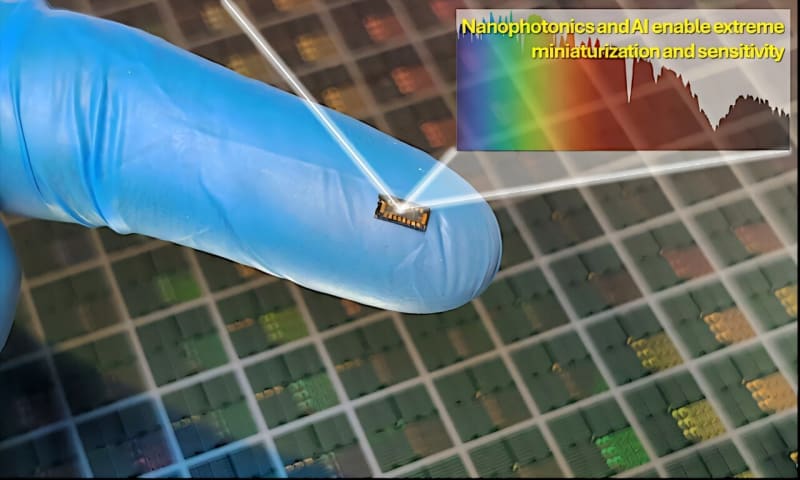
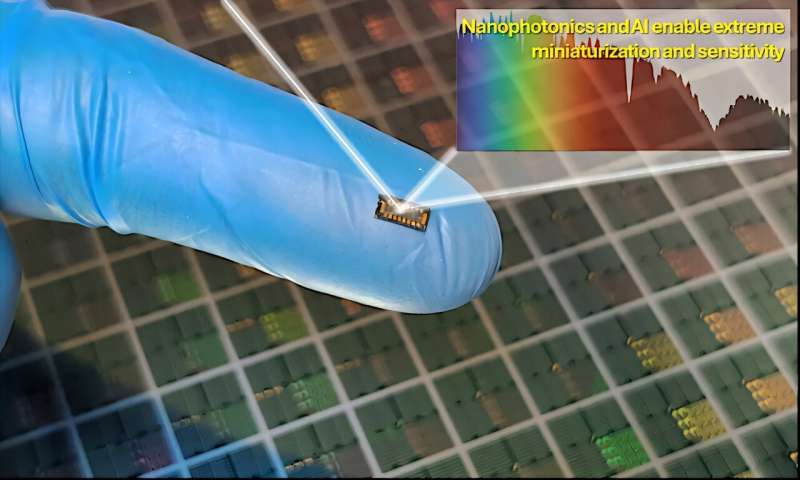
Scientists at UC Davis created a spectrometer smaller than a grain of sand that uses AI to detect diseases, test food quality, and spot pollution. The breakthrough replaces room-sized lab equipment with a chip that fits on your fingertip.
For the first time, doctors and scientists can analyze chemical signatures of diseases, contaminated food, and pollutants using a sensor smaller than a millimeter instead of bulky machines that fill entire rooms.
Researchers at the University of California Davis have developed a revolutionary chip that performs complex light analysis previously possible only with expensive laboratory spectrometers. The device, reported in Advanced Photonics, combines specially textured silicon sensors with artificial intelligence to read the chemical fingerprints in both visible and near-infrared light.
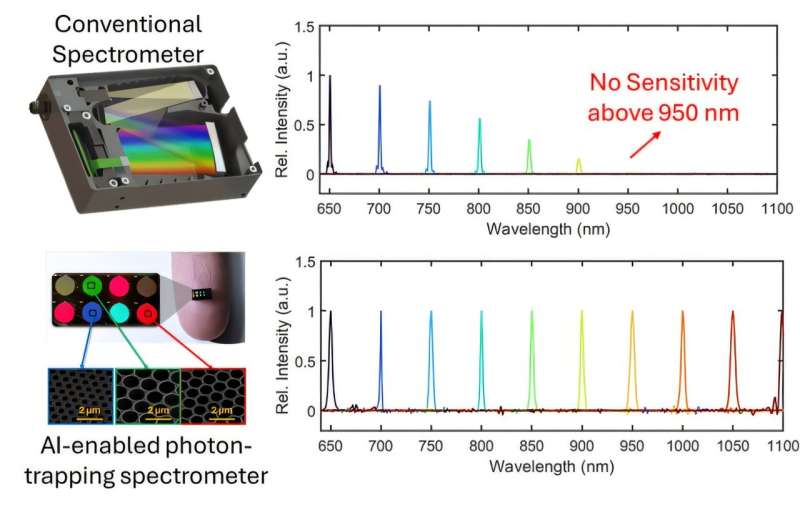
Traditional spectrometers work like prisms, spreading light into rainbow colors across long distances to measure each wavelength. That physics requirement made miniaturization nearly impossible for decades.
The UC Davis team abandoned that approach entirely. Instead of separating colors physically, they created 16 tiny silicon detectors, each engineered with unique surface textures that respond differently to incoming light. Think of it like giving specialized taste buds a mixed drink, where each bud samples something different about the flavor.
The real magic happens in the second breakthrough: artificial intelligence. A neural network trained on thousands of light samples learned to reverse-engineer the original spectrum from those 16 mixed signals. The AI achieves 8-nanometer precision, rivaling equipment thousands of times larger.
The surface textures solve another critical problem. Standard silicon sensors perform poorly with near-infrared light, which penetrates human tissue and is essential for medical imaging. The team's photon-trapping textures force infrared light to bounce within the silicon layer instead of passing through, dramatically boosting absorption.
The chip also captures ultrafast measurements of photon lifetime, revealing fleeting interactions between light and matter that traditional instruments miss entirely.
The Ripple Effect spreads far beyond the laboratory. Doctors could soon use smartphone-sized devices to diagnose diseases at bedsides or in remote clinics without access to major medical centers. Food safety inspectors might scan produce instantly at farms or grocery stores. Environmental scientists could deploy thousands of these sensors to create real-time pollution monitoring networks across cities.
The 0.4-square-millimeter footprint opens possibilities that were science fiction just years ago. The chip maintains accuracy even with significant electrical noise, making it practical for mass production in consumer electronics.
Medical diagnostics stand to benefit enormously since near-infrared light reveals information about blood oxygen, glucose levels, and tissue health without invasive procedures. The chip's ability to work in portable devices means faster diagnoses in emergency situations where every second counts.
Environmental monitoring could become as common as weather tracking, with sensors detecting air and water quality changes before they become health hazards. Agricultural applications include rapid soil analysis and crop health assessment without sending samples to distant labs.
This technology transforms what was once a specialized scientific instrument into something as accessible as a camera in your phone.
More Images
Based on reporting by Phys.org
This story was written by BrightWire based on verified news reports.
Spread the positivity!
Share this good news with someone who needs it