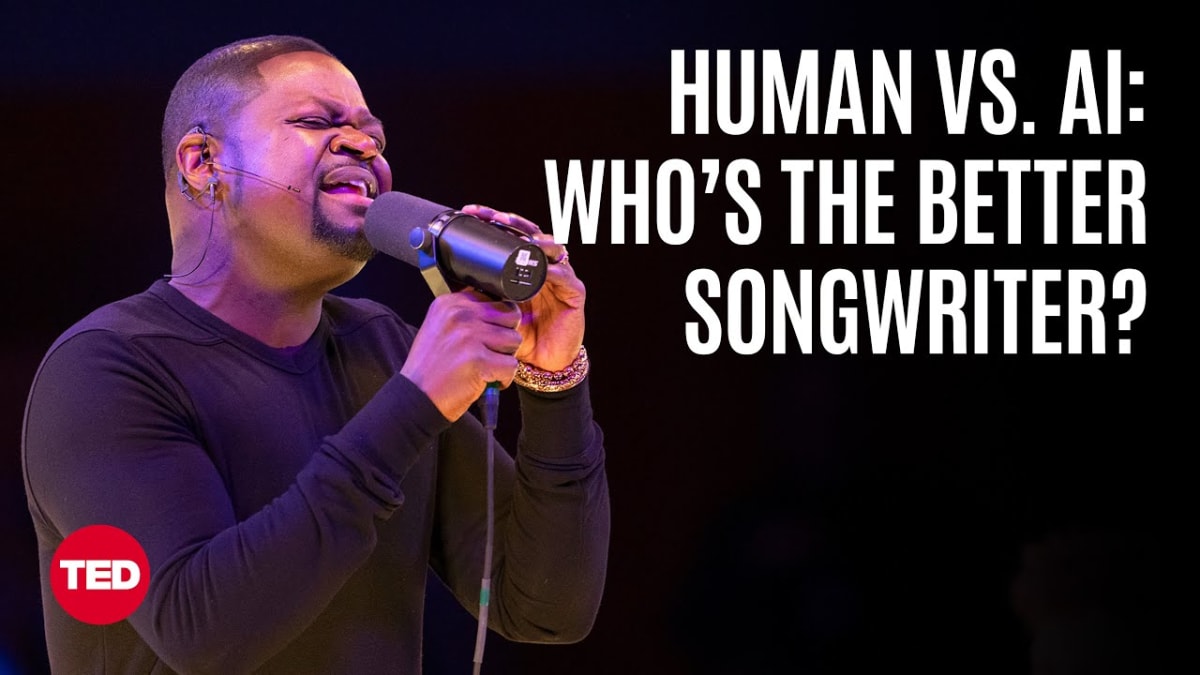
Grammy Songwriter Battles His AI Twin Live on Stage
Legendary hitmaker Jason "Poo Bear" Boyd faced off against an AI version of himself in a live songwriting competition at TED, testing whether machines can move audiences like humans do. The result surprised everyone, including Boyd himself.
Can artificial intelligence write a song that touches your heart the way a human artist can? Grammy-winning songwriter Jason "Poo Bear" Boyd decided to find out by battling his own digital clone on stage.
Boyd has written chart-topping hits for Justin Bieber, Usher, and Jennifer Lopez. At TEDNext 2025, he sat down with journalist Elise Hu to discuss how AI is transforming the music industry in real time.
Then came the showdown. Boyd performed an original song he'd written specifically for the event. His AI twin, trained on his songwriting style, generated its own track on the spot.
The audience watched as two versions of the same creative mind went head to head. One powered by decades of human emotion, heartbreak, and joy. The other powered by algorithms and pattern recognition.
Boyd didn't shy away from the technology. Instead, he embraced the question everyone in the music world is quietly asking: will machines eventually create songs that move us more than musicians can?
Musician Sasha Sirota joined Boyd on stage to bring both songs to life. The performance turned an abstract debate about AI's creative capabilities into something audiences could hear and feel for themselves.
Why This Inspires
Boyd's willingness to compete against his own AI clone shows remarkable courage and curiosity. Rather than fearing what AI might mean for artists, he's exploring how to work alongside it. His experiment gives the entire creative industry a roadmap for facing technological change with openness instead of resistance.
The live battle format transformed a complicated conversation about artificial intelligence into an accessible, entertaining demonstration. Now thousands of people who never thought about AI's role in music have a personal reference point for understanding its possibilities and limitations.
This isn't about whether AI will replace human creativity. It's about artists like Boyd asking the hard questions publicly, testing the boundaries, and showing others how to navigate an uncertain future with confidence and grace.
The future of music might include AI collaborators, but Boyd's stage presence proved one thing algorithms can't replicate: the connection between a performer and a live audience remains uniquely, powerfully human.
Based on reporting by TED
This story was written by BrightWire based on verified news reports.
Spread the positivity!
Share this good news with someone who needs it