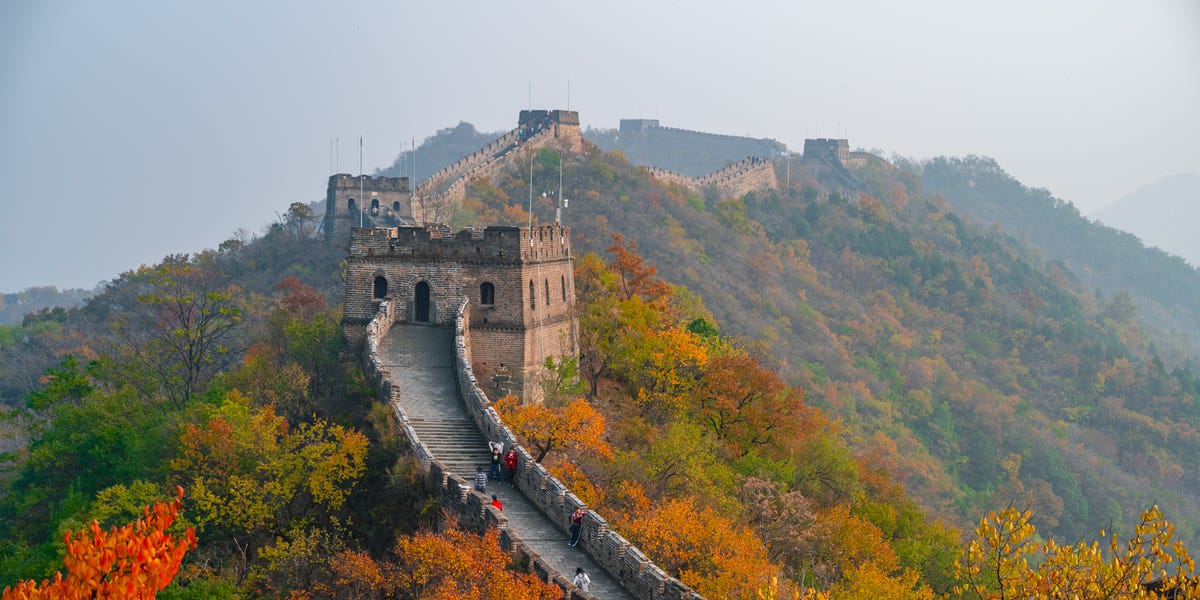
Great Wall Dig Uncovers 400-Year-Old Cannon and 28 Turquoise Gems
Archaeologists restoring China's Great Wall near Beijing found a 247-pound Ming Dynasty cannon from 1632, revealing forgotten stories of soldiers who once defended the ancient fortress. The discovery transforms our understanding of daily life on the world's most famous wall.
Deep inside a crumbling watchtower on China's Great Wall, archaeologists just uncovered a treasure that's been waiting nearly 400 years to tell its story.
A brick-by-brick restoration project at the Jiankou section near Beijing revealed a 35-inch cannon weighing 247 pounds, still bearing the inscription "Chongzhen Year 5" from 1632. The weapon shows striking similarities to European artillery from the same era, offering the first physical proof that Chinese and Western military engineers shared technology across continents centuries ago.
"This provides crucial physical proof of Chinese-Western military technology exchange," said Shang Heng, associate research fellow at the Beijing Institute of Archaeology. The cannon fit perfectly within battery platforms found on the watchtowers, suggesting weapons of this style were standard defense equipment during the Ming Dynasty.
But the real magic came from what archaeologists found in the storage rooms where soldiers once lived. Watchtower 118 contained a heated brick bed and stove, showing exactly how troops stayed warm during bitter winter nights. Investigators discovered animal bones from both domesticated and wild species, revealing what meals looked like on the wall.
One brick inscription stopped researchers in their tracks. "Nothing but alcohol or worry; three years of toil turned my hair white," read the message, likely carved by an exhausted wall builder. That single sentence transformed cold brick and mortar into a very human story of hardship and perseverance.
The excavation also unearthed 28 turquoise artifacts originating from mines in Hubei, Henan, and Shaanxi provinces. This discovery maps out ancient trading routes across northern China, showing the Great Wall wasn't just a military barrier but a hub of commerce and cultural exchange.
Researchers found evidence of crops and medicinal plants, painting a picture of soldiers who farmed, cooked, traded, and healed themselves while defending their homeland. Two additional brick inscriptions revealed weight specifications that completely upended previous theories about Ming-era kiln operations.
The Ripple Effect
This discovery reaches far beyond a single cannon or a handful of turquoise stones. Every artifact pulls back the curtain on daily life in one of history's most famous fortifications, showing us that the Great Wall was never just about keeping enemies out.
The soldiers stationed there created communities. They built heated beds for comfort, traded goods across provinces, and even took time to scratch their frustrations into wet bricks. Analysis of the mortar revealed a sophisticated mixture of high-magnesium lime with plant fibers, demonstrating engineering knowledge that still impresses modern researchers.
"These findings transform the Great Wall from a cold military structure into a living historical landscape integrating defense, cultural exchange, and daily life," Heng explained. The landscape has barely changed in centuries, making future excavations even more promising for understanding how people lived, worked, and connected across ancient China.
The restoration work continues, and each section promises more windows into the past waiting to be opened.
More Images


Based on reporting by Google: archaeological discovery
This story was written by BrightWire based on verified news reports.
Spread the positivity!
Share this good news with someone who needs it