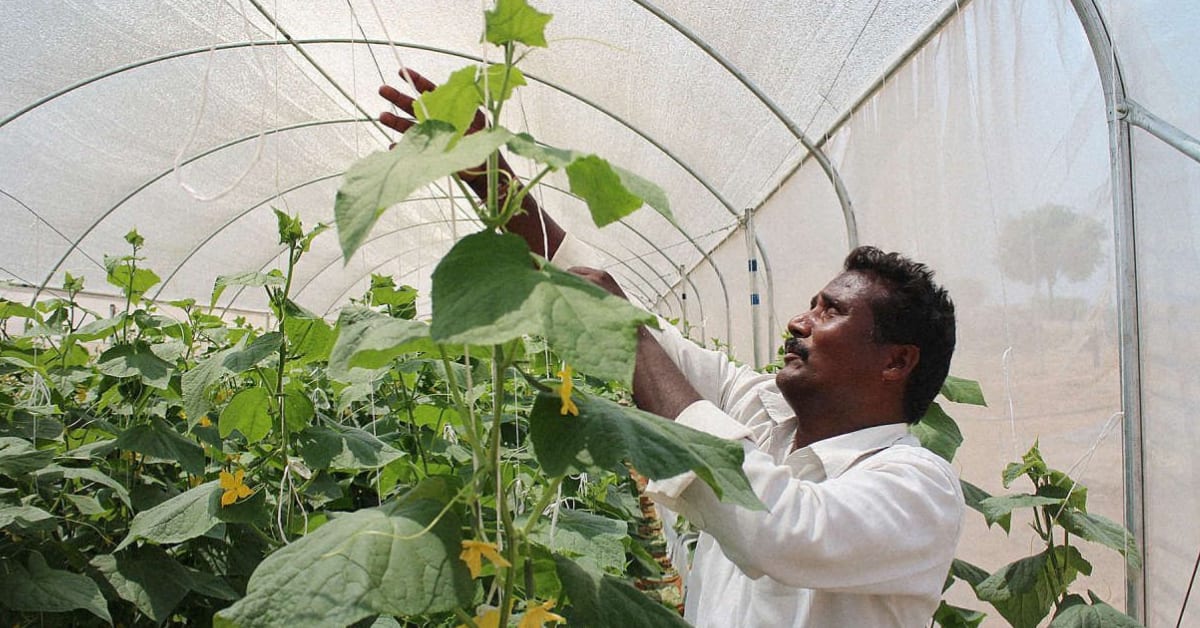
Greenhouse-in-a-Box Saves 98% Water for Small Farmers
After seeing a farmer eating mud because his crops failed, entrepreneur Sathya Raghu Mokkapati spent years developing an affordable greenhouse that protects small farmers from climate disasters. The invention uses 98% less water and shields crops from pests and extreme weather.
At 17, Sathya Raghu Mokkapati asked a farmer in his village why he was eating mud. The man's answer haunted him for years: "My crops failed. My stomach doesn't know my pockets are empty."
That moment of witnessing hunger caused by a single failed harvest stayed with Sathya. It eventually sparked an idea that would help thousands of small farmers protect their livelihoods from increasingly unpredictable weather.
In 2015, Sathya and three co-founders launched Kheyti, an agricultural startup focused on helping farmers who couldn't afford to lose even one season of crops. They developed the Greenhouse-in-a-Box, a compact structure designed specifically for farmers working small plots of land.
The greenhouse creates a protective barrier around crops, shielding them from the three biggest threats farmers face today. Inside the structure, temperatures drop by 2 to 4 degrees Celsius, protecting plants from heat stress during scorching summers.
The system also cuts pest attacks by 90%, meaning farmers lose far less of their harvest to insects. Most remarkably, it uses 98% less water than traditional open-field irrigation, a critical advantage in regions where rainfall has become unreliable.
Sathya explains the concept simply: "We build houses to live in safety and to protect ourselves from environmental factors like heat, rain, insects. Likewise, a greenhouse helps plants thrive."
Traditional greenhouses cost far more than most small farmers can afford. Kheyti designed their version to fit within reach, offering a 320-square-meter model for around 200,000 rupees (about $2,400) and a larger 462-square-meter version for approximately 335,000 rupees (about $4,000).
Farmers don't just receive the structure and figure things out alone. Kheyti provides guidance on which crops work best in the greenhouse, when to plant them, and how to manage cultivation inside the controlled environment.
Why This Inspires
Climate change creates enormous challenges that no single farmer can solve. But Kheyti's approach shows how practical solutions can give people more control over the immediate conditions that determine whether their next crop succeeds or fails.
For smallholder farmers, one bad spell of weather can mean the difference between feeding their families and going hungry. The Greenhouse-in-a-Box doesn't eliminate risk entirely, but it dramatically reduces the chance that a single heat wave, dry spell, or pest outbreak will destroy months of hard work.
A teenager's question about why someone would eat mud led to a solution now protecting farmers across India. That conversation planted a seed that grew into something much larger: hope that farming can become more resilient, even as the climate becomes less predictable.
More Images
%2Fenglish-betterindia%2Fmedia%2Fmedia_files%2F2026%2F08%2F12%2Fkheyti-greenhouse-in-a-box-2026-08-12-18-29-06.png)

%2Ffilters%3Aformat(webp)%2Fenglish-betterindia%2Fmedia%2Fmedia_files%2F2026%2F08%2F12%2Fkheyti-greenhouse-in-a-box-2026-08-12-18-54-56.png)
%2Ffilters%3Aformat(webp)%2Fenglish-betterindia%2Fmedia%2Fmedia_files%2F2026%2F08%2F12%2Fkheyti-greenhouse-in-a-box-2026-08-12-19-00-41.png)
Based on reporting by The Better India
This story was written by BrightWire based on verified news reports.
Spread the positivity!
Share this good news with someone who needs it