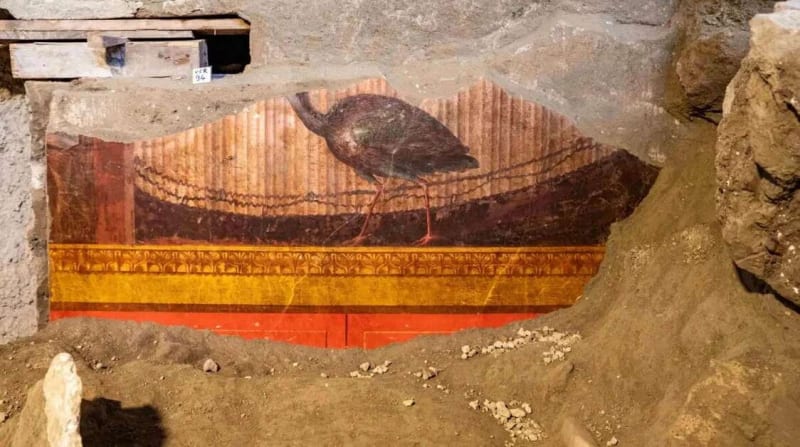
Hidden Treasures Emerge: Nero's Wife's Villa Reveals Stunning Peacock Frescoes in Pompeii
Archaeologists uncover stunning frescoes in Nero's wife's villa near Pompeii, revealing intricate Roman artistic and architectural techniques. The discovery offers unprecedented insights into ancient imperial lifestyle and design.
In the shadow of Mount Vesuvius, archaeologists have uncovered breathtaking artistry that whispers stories of ancient Roman luxury, revealing secrets within the Villa di Poppea that have remained hidden for nearly two millennia.
The villa, believed to have belonged to Poppaea Sabina—the second wife of Emperor Nero—continues to astound researchers with its exquisite details. Located in Oplontis, near Naples, this extraordinary property contains 103 documented rooms, with recent conservation efforts focusing on its western wing, where remarkable frescoes have emerged from volcanic time's embrace.
One particularly stunning discovery is the newly christened Hall of the Peacock, featuring a vibrant wall depicting two male peacocks rendered in rich, delicate pigments. Alongside this ornate imagery, researchers found another fascinating fresco portraying Pappus, a classic character from Roman Antellan Farce—a comedic theatrical figure known for being an easily tricked, aging fool desperately attempting to appear youthful.
Archaeological teams have meticulously mapped additional spaces within the villa, including several small cubicula—intimate chambers that surprisingly serve as the historical ancestors to our modern office cubicles. These rooms showcase remarkable decorative elements, including intricate stucco artwork, frescoed walls, painted vaults, and elegant floor mosaics.
Gabriel Zuchtriegel, director of the Archaeological Park of Pompeii, emphasized the significance of these discoveries, noting that the findings offer promising research perspectives about villa design and human interactions with natural environments. Groundbreaking techniques, including casting volcanic ash cavities, revealed precise garden layouts, demonstrating how Roman architects carefully planned even their landscape designs.
Conservationists are now delicately preserving the villa's stunning Egyptian blue pigments, ensuring these ancient artistic treasures remain vibrant for future generations to marvel at and study. The Villa di Poppea continues to be a window into the sophisticated world of Roman imperial life, revealing layer after layer of historical complexity with each careful investigation.
Based on reporting by Good News Network
This story was written by BrightWire based on verified news reports.
More Good News
 🚀 Innovation
Ancient Peruvian Trophy Head Reveals Resilience of Individual with Rare Birth Condition
 🚀 Innovation
Scientific Breakthroughs Unravel Ancient Human Stories Through DNA and Preservation
 🚀 Innovation