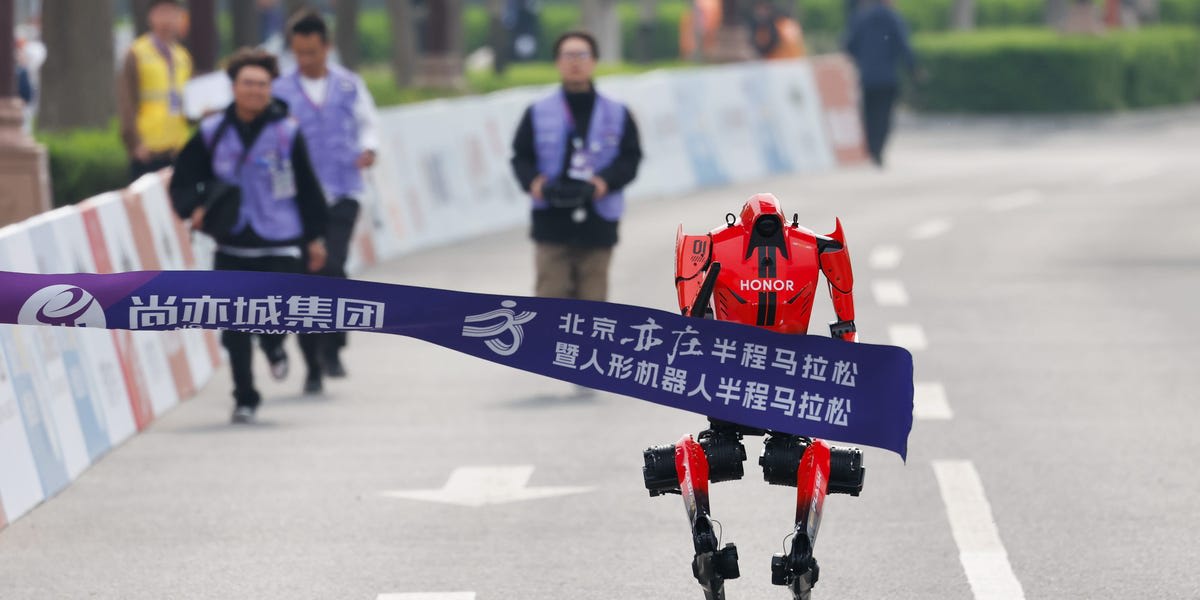
Honor Robot Breaks Half-Marathon Record in 50 Minutes
A Chinese robot just ran a half-marathon faster than any human ever has, clocking 50 minutes and 26 seconds in Beijing. The race also delivered plenty of laughs as robots tumbled, crashed, and needed "stretchers" along the way.
Humanoid robots are getting seriously fast, and the latest proof came from Beijing where an Honor robot just shattered expectations by completing a half-marathon in under 51 minutes.
The robot finished in 50 minutes and 26 seconds at Sunday's race, beating the current human world record of 57 minutes and 20 seconds set by Uganda's Jacob Kiplimo last month. That's a stunning leap forward from last year's inaugural robot race, when the fastest finisher needed 2 hours and 40 minutes to complete the course.
More than 100 teams showed up this year, up from just 20 in 2023. The surge in participation shows how quickly China's robotics industry is advancing.
But speed wasn't the only story. The race delivered moments of pure comedy that had social media buzzing.
One robot face-planted at the starting line, breaking into pieces with limbs scattered across the track. Staff rushed over with a stretcher to gather the parts, treating the mechanical runner like an injured athlete.
The winning Honor robot veered into a barricade near the finish line but recovered to cross on its own. Engineers jogged behind clutching control devices, struggling to keep pace with their creation.
Videos of robots stumbling, twitching, and crashing into barriers went viral across Instagram and X. The mishaps highlighted how far humanoid robotics still has to go, even as the technology makes remarkable strides.
The Bright Side
These tumbles and technical hiccups aren't setbacks. They're part of the learning process, much like XPeng CEO He Xiaopeng said after his company's robot fell during a February showcase: it's like "children learning to walk."
China has invested heavily in humanoid robotics, integrating AI systems and pushing the boundaries of what these machines can do. Even Tesla CEO Elon Musk acknowledged in January that his biggest competition for the Optimus robot would likely come from China.
The Beijing race proved that robotics development isn't just happening in labs anymore. It's moving into real-world challenges where engineers can test their creations against actual conditions and learn from every stumble.
Each fall teaches designers something new about balance, each crash reveals weaknesses in durability, and each malfunction points toward the next improvement. The robots that struggled through this year's race are already informing next generation's designs.
The gap between last year's slowest finisher and this year's record-breaking winner shows how quickly progress happens when engineers get to see their work perform in challenging conditions. What seemed impossible 12 months ago just became routine.
Based on reporting by Google: marathon world record
This story was written by BrightWire based on verified news reports.
Spread the positivity!
Share this good news with someone who needs it