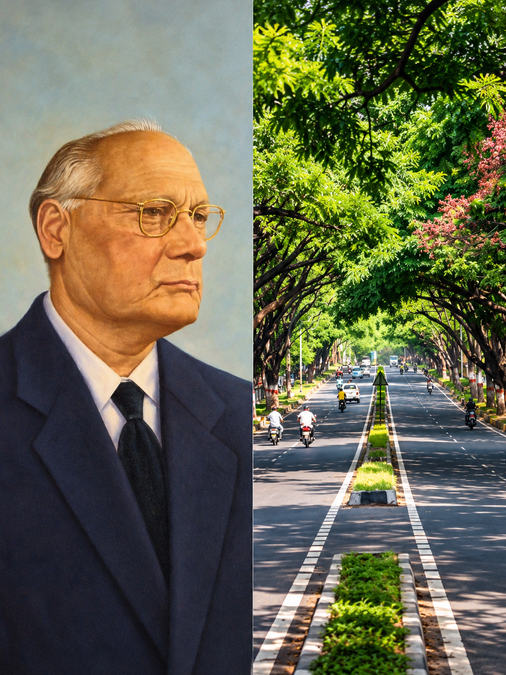
How One Man Became Punjab's 'Sixth River' After Partition
M.S. Randhawa transformed post-Partition Punjab from scorched earth into India's agricultural powerhouse, then filled Chandigarh with roses and art. His legacy earned him a title reserved for forces of nature.
Punjab flows with five rivers, but locals say it had a sixth: a botanist-turned-civil servant who rebuilt an entire state from the ashes of Partition.
M.S. Randhawa was born in Zira, Punjab in 1909 and studied botany before joining the Indian Civil Service in 1934. Nothing in that quiet academic beginning hinted he'd one day be called "Punjab Da Chhewan Dariya," the Sixth River of Punjab.
Then came 1947. As Deputy Commissioner of Delhi during Partition, Randhawa witnessed some of India's darkest days. But instead of turning away, he returned to Punjab to rebuild what violence had destroyed.
His first innovation was Murabbabandi, a system that reorganized scattered farmland into larger, logical plots. Suddenly tractors could move efficiently through fields. Modern agriculture became possible where chaos had reigned.
Randhawa didn't stop at land reform. He pushed for tube wells to irrigate dry earth, built roads connecting isolated villages, and championed farming techniques that would eventually make Punjab India's breadbasket. By 1955, he was Vice-President of the Indian Council of Agricultural Research, feeding a hungry nation.
In 1966, he became Chandigarh's first Chief Commissioner. Working alongside legendary architects Le Corbusier and Pierre Jeanneret, Randhawa insisted that concrete and geometry weren't enough. He planted gulmohar and jacaranda trees along every boulevard. He created the iconic Rose Garden, ensuring the planned city would bloom.
But perhaps his most surprising passion was preserving what progress often destroys. Randhawa traveled through Punjab's villages and hills, documenting folk art and Pahari miniature paintings before they disappeared. He built cultural institutions to house these treasures, understanding that feeding bodies meant nothing if souls went hungry.
The Ripple Effect
Randhawa's vision rippled across generations in ways he never lived to see. The agricultural systems he established still feed millions. The trees he planted now shade grandchildren who never knew his name. The folk art he preserved connects modern Indians to roots that Partition tried to sever.
His work proved that rebuilding after tragedy requires more than bricks and seeds. It demands someone who sees how roads, roses, and folk paintings all flow together, nourishing the same soil.
The government awarded Randhawa the Padma Bhushan in 1972, but Punjab gave him something rarer: a place among the rivers that define the land itself. When a region compares you to the forces that shaped its very geography, you've done more than build a legacy.
One man, armed with botany knowledge and unstoppable hope, became a river that still flows through Punjab today.
Based on reporting by The Better India
This story was written by BrightWire based on verified news reports.
Turn Today’s Good News Into Action
Generate a simple, meaningful 2-minute act of kindness you can do today and log your ripple effect.
Spread the positivity!
Share this good news with someone who needs it