Hubble Discovers 'Cloud-9': A Cosmic Time Capsule From the Dawn of the Universe
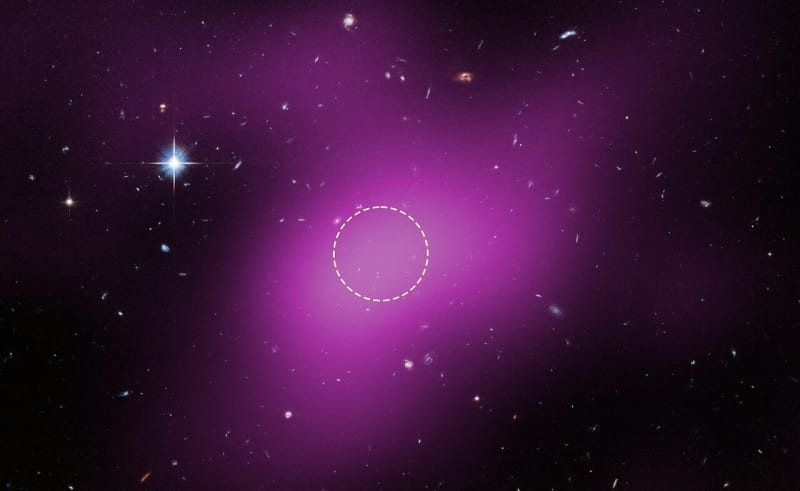
Scientists using the Hubble Space Telescope have made an exciting discovery—a pristine cloud from the early universe that offers a rare window into how galaxies form. This "failed galaxy" called Cloud-9 is helping researchers unlock mysteries about dark matter and cosmic evolution.
In a thrilling breakthrough that's opening new doors to understanding our cosmos, astronomers using the NASA/ESA Hubble Space Telescope have discovered something never seen before: a pristine relic from the universe's infancy that has remained virtually unchanged for billions of years.
Nicknamed "Cloud-9," this remarkable object represents an entirely new category of astronomical discovery. It's essentially a time capsule—a starless cloud of gas and dark matter that scientists believe is a building block of galaxy formation that simply never finished the job. And that's exactly what makes it so valuable to science.
"This is a tale of a failed galaxy," explains principal investigator Alejandro Benitez-Llambay of Milano-Bicocca University with evident enthusiasm. "In science, we usually learn more from the failures than from the successes. In this case, seeing no stars is what proves the theory right."
For years, scientists theorized that such objects—called Reionization-Limited H I Clouds, or RELHICs—should exist somewhere in the universe, but finding one proved incredibly challenging. Cloud-9's discovery confirms that these cosmic fossils are real, offering researchers an unprecedented opportunity to study the raw materials and conditions of the early universe.
What makes Cloud-9 particularly fascinating is its composition. This compact, spherical cloud contains hydrogen gas equivalent to about one million times the mass of our Sun. But the real surprise lies in what surrounds that gas: approximately five billion solar masses of dark matter. This makes Cloud-9 an extraordinary natural laboratory for studying the mysterious dark matter that makes up most of the universe's mass but remains invisible to our telescopes.
"This cloud is a window into the dark Universe," says team member Andrew Fox enthusiastically. The discovery gives scientists a rare chance to observe dark matter's effects in a relatively simple, isolated environment—something that's usually impossible when studying complex, star-filled galaxies.
The breakthrough came through remarkable international collaboration. Cloud-9 was first detected three years ago by China's Five-hundred-meter Aperture Spherical Telescope (FAST), with confirmation from American facilities including the Green Bank Telescope and Very Large Array. But only Hubble's Advanced Camera for Surveys could definitively prove that this cloud contains no stars whatsoever—the key evidence needed to confirm its unique nature.
Lead author Gagandeep Anand of the Space Telescope Science Institute emphasizes the importance of Hubble's contribution: "With Hubble's Advanced Camera for Surveys, we're able to nail down that there's nothing there"—and that absence of stars is exactly what makes this discovery so significant.
Located near the spiral galaxy Messier 94, Cloud-9 sits in what researchers call a "sweet spot." It's massive enough to hold together against cosmic forces, yet not quite massive enough to have collapsed and formed stars. This delicate balance has preserved it as a pristine sample of primordial matter.
The discovery promises to be just the beginning. Scientists anticipate that Cloud-9 is likely one of many such objects waiting to be found, each offering fresh insights into galaxy formation, dark matter physics, and the conditions of the early universe. As Rachael Beaton of STScI poetically notes, "Among our galactic neighbors, there might be a few abandoned houses out there"—and finding them will help complete our understanding of cosmic history.
Based on reporting by Reddit - Space
This story was written by BrightWire based on verified news reports.
Spread the positivity! 🌟
Share this good news with someone who needs it
More Good News
 🚀 Innovation
Astronomers Discover Cloud-9: A Cosmic Fossil That Unlocks Universe's Secrets
 🚀 Innovation
Astronomers Discover 'Cloud-9' Object That Could Unlock Dark Matter's Mysteries
 🚀 Innovation
NASA's Roman Space Telescope: A Triumph of Science, On Time and Under Budget
Joke of the Day
Why did the dog apply for a job at the bank?
Explore Categories
Quote of the Day
"The greatest thing you'll ever learn is just to love and be loved in return."
— Moulin Rouge (from the film, popularized by Ewan McGregor)