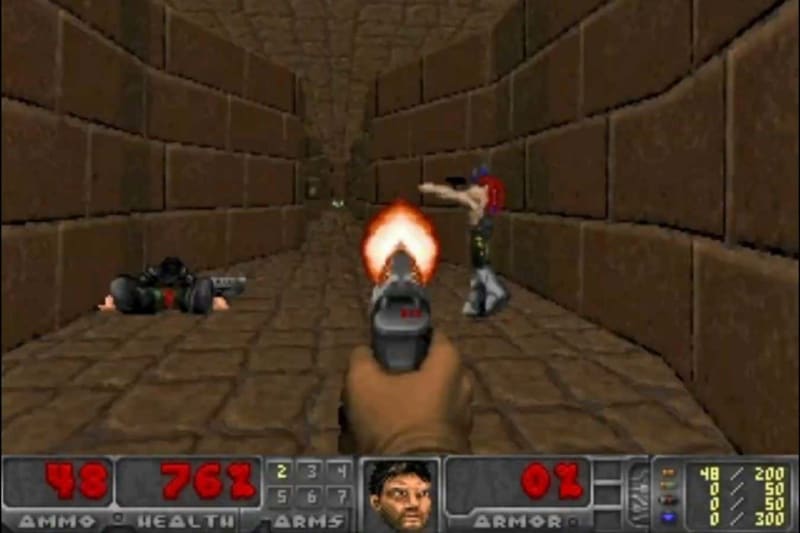
Human Brain Cells Learn to Play Doom in Just One Week
Living human neurons grown on a computer chip mastered the classic video game Doom in seven days, marking a massive leap toward biological computers that could one day control robotic limbs. The breakthrough shows that brain cells can handle complex, real-time decisions far faster than traditional AI.
A clump of 800,000 living human brain cells just learned to play Doom, and it only took a week.
Scientists at Australian company Cortical Labs grew real neurons on a microelectrode chip that sends and receives electrical signals. An independent developer named Sean Cole then used simple Python code to teach these living cells how to navigate the iconic 1990s shooter game.
What makes this achievement remarkable isn't just that brain cells can play video games. It's how quickly they learned compared to traditional computer systems.
Back in 2021, the same company spent years teaching similar neuron chips to play Pong. This time, thanks to new programming tools, Cole accomplished something far more complex in just days with no specialized biology training.
"It's this accessibility and this flexibility that makes it truly exciting," says Brett Kagan of Cortical Labs. The chip used only a quarter as many neurons as the Pong experiment but tackled a vastly more complicated task.
The neurons didn't play at championship level. Their performance beat random button mashing but fell far short of skilled human gamers. Still, they grasped the game's mechanics faster than silicon-based machine learning systems typically do.
Scientists are careful to note these chips aren't mini brains. "Yes, it's alive, and yes, it's biological, but really what it is being used as is a material that can process information in very special ways that we can't recreate in silicon," Kagan explains.
The Ripple Effect
This advance brings biological computers significantly closer to practical real-world uses. Researchers at the University of Reading are already working on similar technology to control robotic arms, a challenge that requires the same kind of complex, real-time decision making that Doom demands.
"What's exciting here is not just that a biological system can play Doom, but that it can cope with complexity, uncertainty, and real-time decision-making," says Andrew Adamatzky at the University of the West of England. Those capabilities mirror exactly what future biological computers will need for tasks like precision surgery or assisting people with paralysis.
The fact that someone outside the core research team could achieve this breakthrough in days rather than years suggests the technology is maturing rapidly. As newer learning algorithms improve, these neuronal chips should perform even better.
Scientists still don't fully understand how the neurons "see" the screen without eyes or know what's expected of them. But the jump from Pong to Doom represents genuine progress toward computers that combine the best of both worlds: the adaptability of living tissue with the precision of electronics.
More Images



Based on reporting by New Scientist
This story was written by BrightWire based on verified news reports.
Spread the positivity!
Share this good news with someone who needs it