Humans Return to Lunar Space After 52 Years
Four astronauts aboard NASA's Artemis 2 mission crossed into the moon's gravitational sphere on April 6, becoming the first humans to reach lunar space since 1972. Tonight, they'll break the distance record for human spaceflight.
For the first time in more than half a century, humans are traveling through the moon's neighborhood again.
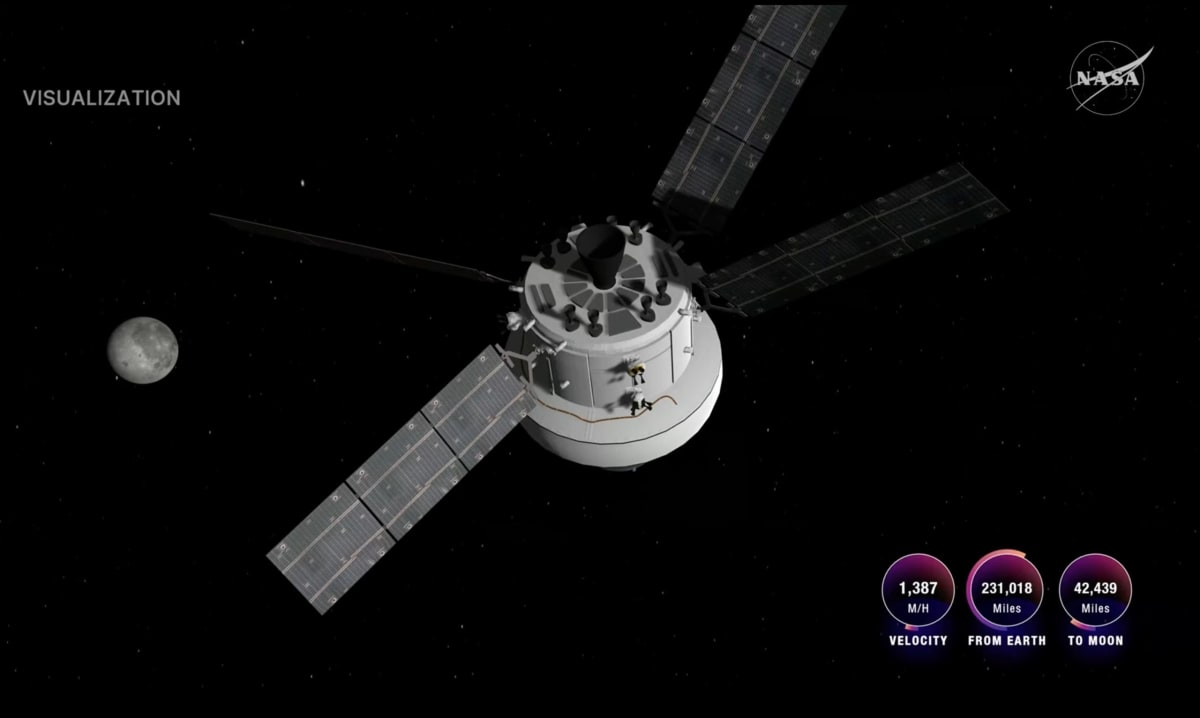
Four astronauts crossed into lunar space early Sunday morning aboard NASA's Artemis 2 mission, arriving at 12:37 a.m. EDT when their Orion capsule reached the moon's sphere of influence about 39,000 miles from the lunar surface. The crew includes NASA astronauts Reid Wiseman, Victor Glover, and Christina Koch, plus Canadian Space Agency astronaut Jeremy Hansen.
They're the first people to enter this region since Apollo 17's three astronauts made the journey in December 1972. That's 52 years of waiting for humanity's return to deep space.
The mission won't land on the moon or even orbit it. Instead, Orion will loop around the far side this evening in a historic flyby that pushes the boundaries of human exploration further than ever before.
During tonight's closest approach at 7 p.m. EDT, the crew will set a new distance record for human spaceflight. They'll reach 252,757 miles from Earth, surpassing the Apollo 13 astronauts who traveled 248,655 miles from home in April 1970.
The astronauts aren't just sightseeing on this journey. They're studying the moon's terrain and geology, gathering data that will help future missions prepare for lunar landings.
They'll also witness something most of us never will: a total solar eclipse viewed from beyond the moon. It's a celestial show that won't be visible from Earth.
Why This Inspires
This mission represents more than breaking records or checking boxes on a flight plan. It shows that humanity is actively returning to deep space exploration after decades of staying closer to home.
The Artemis program is building the foundation for sustainable lunar exploration and eventually missions to Mars. Every data point collected, every system tested, and every mile traveled brings us closer to establishing a lasting human presence beyond Earth.
The moon's gravity will now do its part, slinging Orion back toward Earth for a Friday splashdown off San Diego's coast. After 10 days in space, the crew will return with knowledge that pushes our species forward.
After more than 50 years away, we're back where we belong: reaching beyond our world to explore the cosmos.
More Images

Based on reporting by Space.com
This story was written by BrightWire based on verified news reports.
Spread the positivity!
Share this good news with someone who needs it