IIT Madras Releases World's Most Detailed Brain Atlas
Indian scientists just mapped the human brainstem in unprecedented detail and made it free for anyone in the world to use. The breakthrough could transform how doctors diagnose and treat brain conditions.
Scientists in India just gave the world an extraordinary gift: the most detailed 3D map of the human brainstem ever created, available free to anyone with an internet connection.
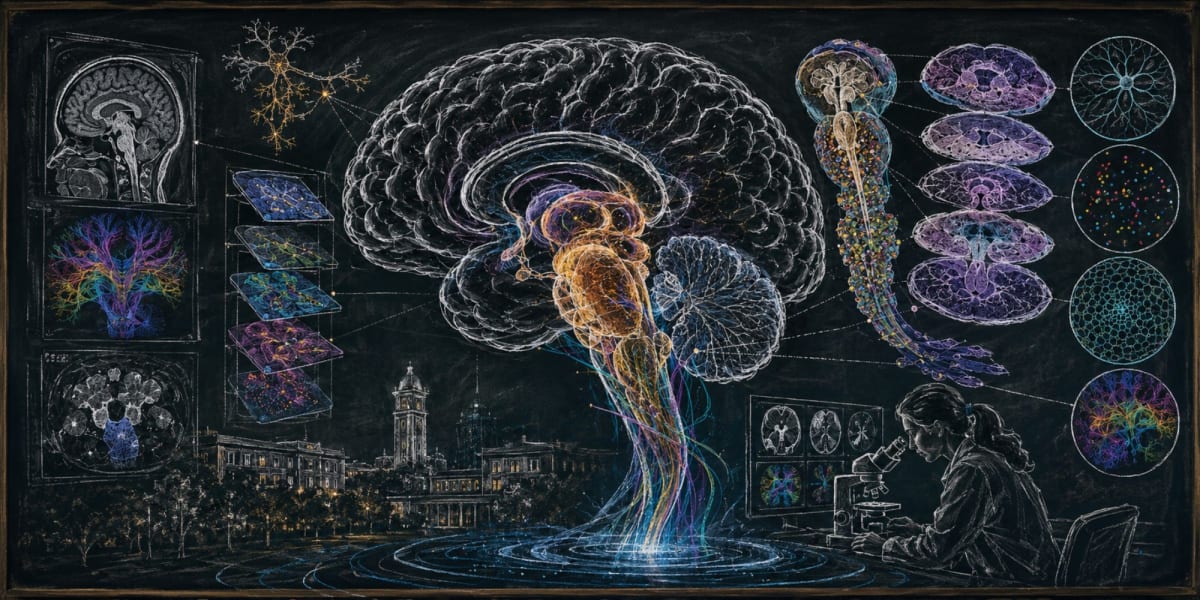
The Indian Institute of Technology Madras unveiled ANCHOR, a groundbreaking atlas that maps the brainstem down to individual cells. The team spent years reconstructing more than 200 structures from hundreds of tissue slices, creating a resource that spans human development from before birth through adulthood.
The brainstem may be thumb-sized, but it controls everything that keeps us alive: breathing, sleep, heart rate, and nearly all movement signals between brain and body. Despite its importance, it's remained one of the brain's least understood regions because of its incredibly dense and complex architecture.
ANCHOR changes that with stunning precision. The researchers used eight different staining techniques across more than 500 tissue sections to identify different cell types, then integrated MRI and microscopy data into a single navigable 3D model. Scientists and doctors can now explore this vital brain region in ways that were simply impossible before.
The timing matters. When brainstem injuries or diseases occur, knowing exactly which cell populations are affected can mean the difference between effective treatment and guesswork. Neurologists worldwide can now reference ANCHOR to better understand what's happening in their patients' brains.
The project launched at the BRICS Neuroscience Symposium in June 2026, drawing praise from scientific leaders across continents. Prof. Ajay Kumar Sood, India's Principal Scientific Adviser, highlighted how the openly available maps could prove critical for diagnosing brainstem lesions.
Prof. Mu-Ming Poo from the Chinese Academy of Sciences, joining virtually, called starting with the brainstem "a wise choice" and celebrated the team's rapid progress. He noted this is just the beginning of a longer journey.
Why This Inspires
What makes this achievement truly special isn't just the scientific brilliance behind it. It's the decision to share it freely with the world.
In an era when scientific breakthroughs often get locked behind paywalls and institutional barriers, IIT Madras chose a different path. Any researcher in Mumbai, medical student in São Paulo, or neurologist in rural Kansas can access the same cutting-edge brain maps. Knowledge that took years to build is now available to anyone who needs it.
The team at IIT Madras's Sudha Gopalakrishnan Brain Centre isn't stopping here either. They're working toward mapping the entire human brain at cellular resolution across different life stages and diseases, including Alzheimer's, dementia, and rabies.
For patients and families dealing with brainstem conditions, this atlas represents something profound: the hope that comes when scientists work together, share openly, and push the boundaries of what we understand about the human body.
The atlas is live now at anchor.humanbrain.in, waiting for the next breakthrough it will help make possible.
More Images



Based on reporting by YourStory India
This story was written by BrightWire based on verified news reports.
Spread the positivity!
Share this good news with someone who needs it