India and South Korea Double Trade Goal to $50B by 2030
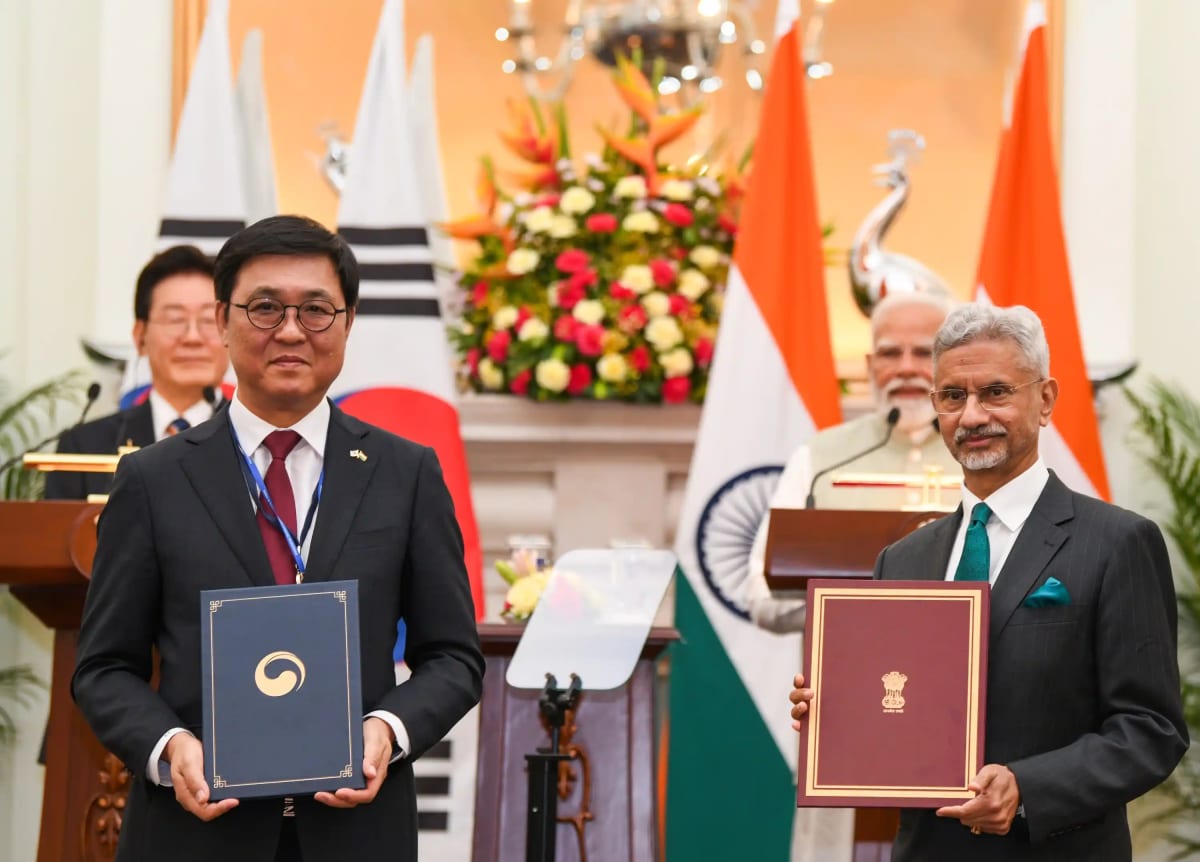
India and South Korea are transforming their partnership into a technology powerhouse, pledging to nearly double trade to $50 billion by 2030. The landmark state visit brings over 150 Korean executives to build semiconductors, ships, and AI innovation together.
Two of Asia's rising powers just turned a handshake into a high-tech future that could reshape global supply chains.
South Korean President Lee Jae-myung's first state visit to India in April 2026 marked a new chapter for both nations. What started as a trade relationship is now evolving into a strategic alliance focused on semiconductors, artificial intelligence, and advanced manufacturing.
The numbers tell the story. Both countries committed to boosting bilateral trade from $27 billion today to $50 billion by 2030. But this isn't just about buying and selling more goods.
Over 150 executives from Samsung, Hyundai, LG, and SK Group joined the delegation, signaling serious investment plans. Korean companies are planning to build industrial townships in India, creating hubs for electronics, batteries, and engineering that mirror Korea's successful manufacturing clusters back home.
The semiconductor partnership stands out as particularly promising. India wants to become a major player in chip testing, packaging, and assembly. Korea already leads the world in high-end chip production, making it the perfect partner to help India plug into global tech supply chains.
Shipbuilding represents another frontier. Korea builds more commercial ships than any other country, while India aims to become a regional ship repair and manufacturing hub. Together, they could design vessels in Seoul and build them in Indian shipyards, strengthening both economies and India's maritime security.
The timing matters too. Both nations want to reduce their reliance on China for critical technologies and manufacturing. By partnering with each other, they're creating alternatives that make their economies more resilient against global disruptions.
The Ripple Effect
This partnership extends far beyond the two countries involved. For Korea, India serves as a gateway to the Global South, offering connections across Africa, West Asia, and Southeast Asia where Korean companies want to grow.
For India, Korea provides access to cutting-edge technology with fewer strings attached than partnerships with Western nations often bring. The relationship respects both countries' desire for genuine co-development rather than one-sided technology transfers.
New structures support these ambitions. The two nations launched an Economic Security Dialogue to coordinate on protecting sensitive technologies. They also created an Industrial Cooperation Committee and an India-Korea Financial Forum to keep momentum going beyond presidential visits.
The partnership reaches into artificial intelligence, space infrastructure, and green energy too. Both countries recognize that economic security and national security now overlap, especially when it comes to protecting advanced technologies that have both civilian and defense applications.
For the Indo-Pacific region, this alliance adds stability. Two democratic, market-driven economies are choosing deeper cooperation over competition, showing that Asian nations can build prosperity together without picking sides in great power rivalries.
This tech-driven partnership proves that the future belongs to countries willing to share knowledge and build together.
More Images
Based on reporting by Regional: south korea technology (KR)
This story was written by BrightWire based on verified news reports.
Spread the positivity!
Share this good news with someone who needs it