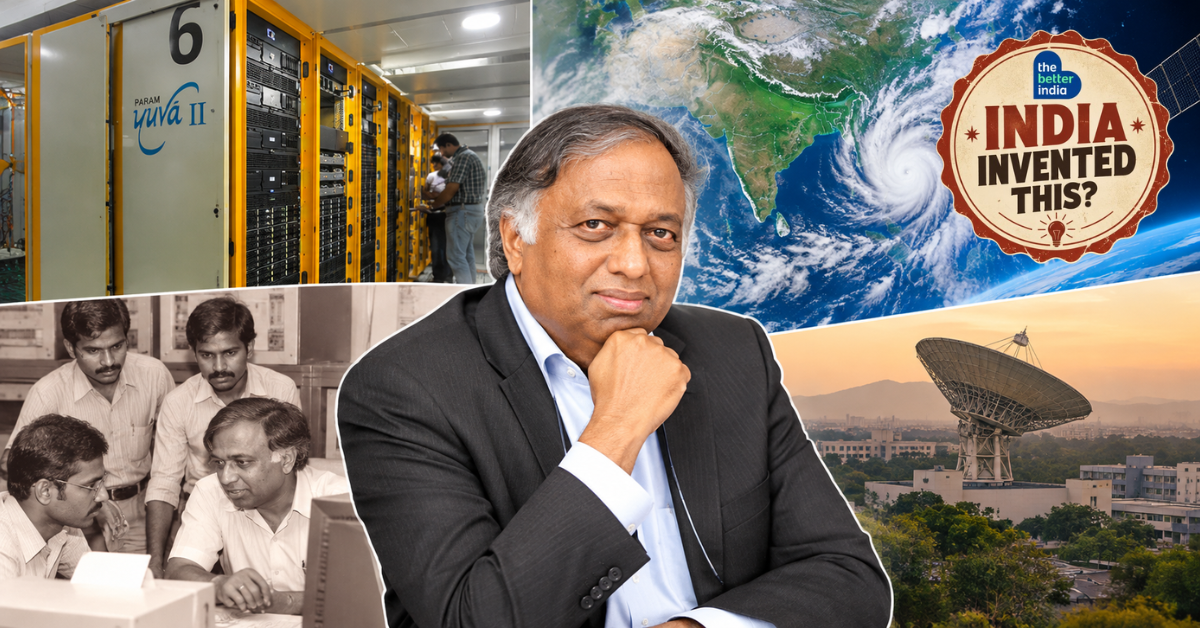
India Built Its Own Supercomputer After US Said No
When the United States denied India access to supercomputer technology in the 1980s, scientist Vijay Bhatkar and his team built PARAM 8000, achieving one billion calculations per second. Their 1991 breakthrough launched India's journey to computing independence.
When the United States refused to sell India a supercomputer in the late 1980s, one scientist decided his country would build its own instead.
Vijay Bhatkar, an electronics and computer scientist, faced an enormous challenge. India needed supercomputing power for weather forecasting, helping farmers prepare for changing conditions, and advancing scientific research. But the technology was restricted due to potential military applications.
In 1987, the Indian government asked Bhatkar to lead an ambitious project. The Centre for Development of Advanced Computing opened in Pune in 1988, tasked with developing what seemed nearly impossible: a homegrown supercomputer built with limited resources and no access to the restricted technology.
Bhatkar's team chose a clever approach called parallel processing. Instead of one processor tackling a massive problem alone, multiple processors work on different parts simultaneously, then combine their results. It's like dividing a huge math problem among several people instead of asking one person to do it all.
Building the system meant creating both hardware and software from scratch. The processors needed to communicate efficiently, coordinate their work, and share data seamlessly. Every component had to function as part of a complete system designed around India's own technological capabilities.
In 1990, the first prototype emerged. The following year, C-DAC unveiled PARAM 8000, capable of one billion floating-point operations per second. These calculations involving decimal numbers gave scientists the computing power needed for demanding simulations and numerical modeling.
The name PARAM comes from the Sanskrit word for "supreme." Its arrival proved India could develop cutting-edge technology despite international restrictions.
The Ripple Effect
PARAM 8000 sparked a computing revolution across India. The breakthrough inspired successive generations of PARAM systems, each more powerful than the last. Today, these supercomputers support weather forecasting, climate research, drug discovery, and complex engineering simulations across the country.
The project transformed India from a country denied access to technology into a nation capable of building its own advanced computing systems. C-DAC continues developing supercomputing capabilities, training new generations of scientists and engineers in high-performance computing.
What began as a response to technological denial became a story of self-reliance and innovation. India now ranks among nations with indigenous supercomputing capabilities, all because one team refused to accept "no" as an answer.
More Images




Based on reporting by The Better India
This story was written by BrightWire based on verified news reports.
Building Something New? Try the BrightWire Tech Stack Advisor
Compare modern frameworks, cloud hosting, and AI tools tailored to your project budget and scale.
Spread the positivity!
Share this good news with someone who needs it

