India Releases Captive-Bred Bustards Into Desert Wild
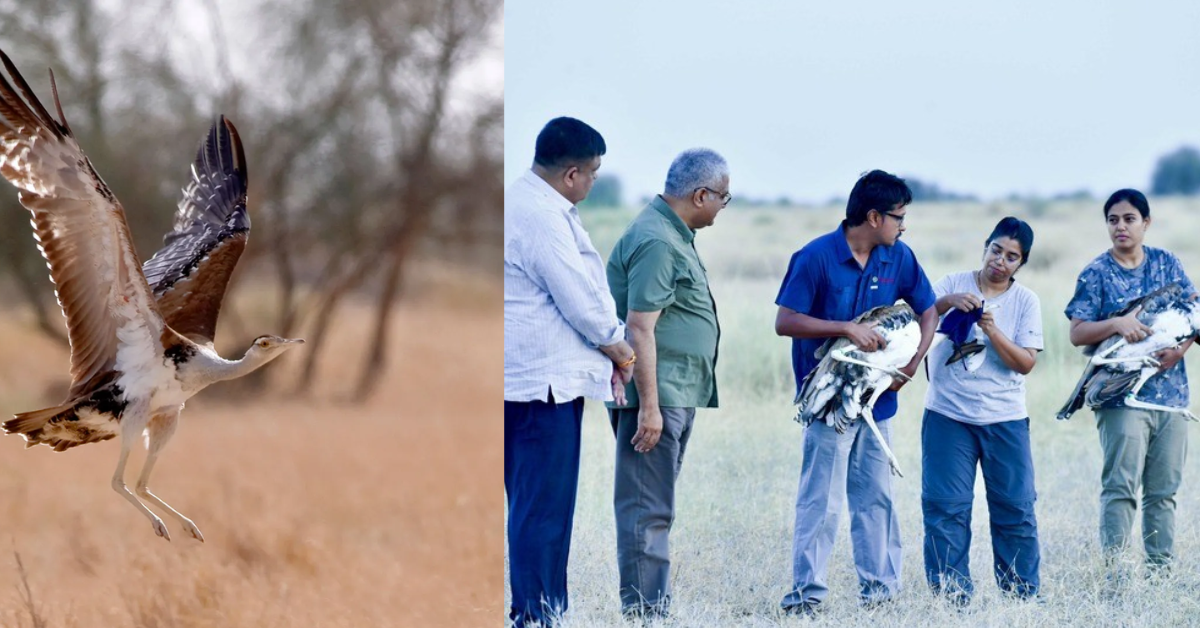
Two critically endangered Great Indian Bustards took flight in Rajasthan's Desert National Park, marking the first rewilding test of India's decade-long captive breeding program. Scientists fitted them with satellite tags to track whether birds raised by humans can learn to survive on their own.
After nearly a decade of careful breeding and preparation, two male Great Indian Bustards spread their wings over Rajasthan's desert for the first time as truly wild birds. These weren't rescued animals returning home but captive-bred birds entering a world they'd never known, equipped only with satellite tags and the instincts conservationists hope will keep them alive.
The release marks a turning point for one of India's most threatened species. With only a small wild population remaining, the Great Indian Bustard has teetered on the edge of extinction for years.
India's answer has been patience and science. Since 2019, conservationists collected eggs from wild nests, incubated them artificially, and raised the chicks by hand. The breakthrough came in March 2023 when a chick hatched from eggs laid by captive parents, proving these magnificent birds could breed in human care.
The program has since flourished. Facilities in Ramdevra and Sam now house 97 bustards: 40 from wild eggs and 57 born in captivity. Last year alone, 24 chicks survived, followed by 29 more in 2026.
But raising a bird is the easy part. Teaching it to survive is the real challenge.
Dr. Tushna Karkariya, lead veterinarian for the project, explains that young bustards stay with their mothers for four to five months while researchers watch their growth and muscle development. Only when a bird shows it's physically ready does the team fit it with a radio tag and consider release.
The two males released this week didn't go straight from their pens to the desert. They first spent time in a special rewilding aviary at Ramdevra, a large pillar-free structure that gave them space to fly, build strength, and experience conditions closer to wild life without the full dangers.
This "soft release" approach creates a bridge between captivity and freedom. The satellite tags now tracking their movements will tell researchers where they go, what they eat, and whether the lessons of the aviary translate to real survival.
Why This Inspires
Conservationists know the odds aren't perfect. These birds must learn to find food and avoid predators without human help, and early mortality rates may be high. But with each release, scientists gather data that improves the process for the next generation.
The program has already identified 11 birds ready for eventual release from the current population. As more adapt and survive, the knowledge base grows, and so does the possibility of a truly wild population recovering.
This isn't just about two birds. It's about proving that a species on the brink can be pulled back through careful science, patient restoration, and the willingness to let nature take the final test.
The desert is ready, the birds are ready, and now India watches to see if a decade of hope can translate into wings that truly know how to fly free.
More Images



Based on reporting by The Better India
This story was written by BrightWire based on verified news reports.
Play Today’s BrightWire Positive Mini Crossword & Word Game
Keep your mind sharp with our free 5-minute uplifting daily crossword and positivity word puzzle.
Spread the positivity!
Share this good news with someone who needs it