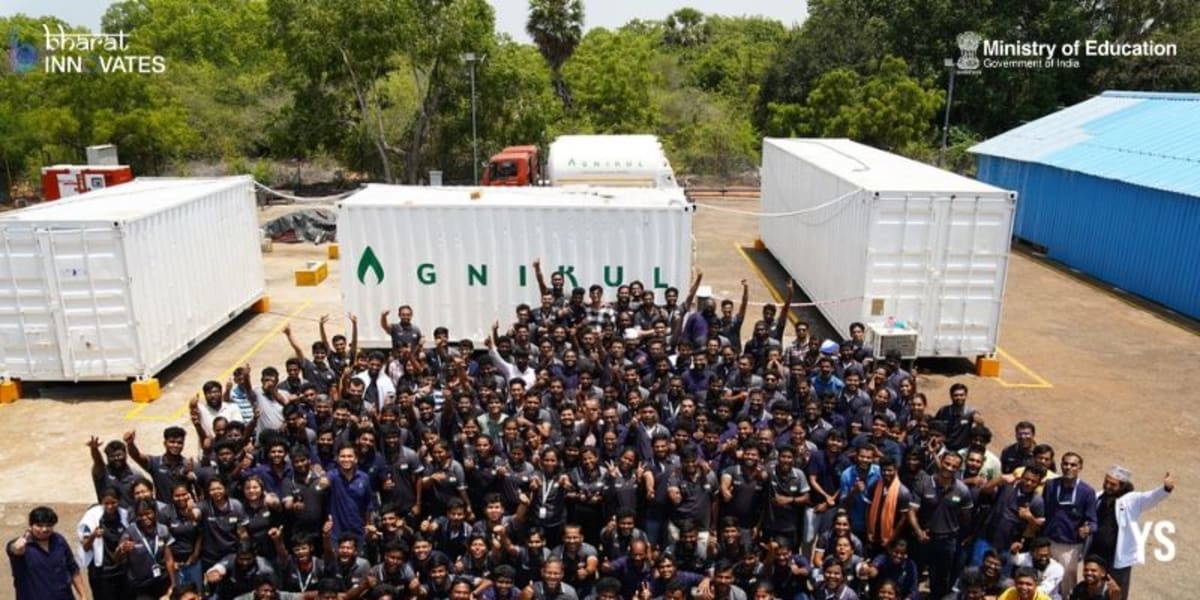
India Startup Launches World's First 3D-Printed Rocket
A Chennai-based startup just proved that small satellite companies no longer have to wait months for a ride to space. Agnikul Cosmos built and launched the world's first rocket powered by a single-piece 3D-printed engine, opening the door to faster, more affordable space access.
Getting a small satellite into orbit used to mean waiting in line behind bigger, wealthier customers, sometimes for months. Agnikul Cosmos, a startup born at IIT Madras, just changed that game completely.
Founded in 2017 by Srinath Ravichandran and Moin SPM, Agnikul set out to solve a problem that frustrated small satellite companies worldwide. Traditional rockets require hundreds of separate engine parts, making them expensive and slow to build. Agnikul took a radically different approach.
The company designed Agnilet, the world's first single-piece 3D-printed semi-cryogenic rocket engine. Instead of assembling hundreds of components, they print the entire engine as one integrated piece, dramatically cutting production time and cost.
On May 30, 2024, at 7:15 AM, their rocket Agnibaan SOrTeD lifted off from India's first private launchpad at Sriharikota. The flight marked three firsts: the world's first launch powered by a 3D-printed engine, India's first semi-cryogenic engine flight, and India's first private launchpad launch.
The rocket climbed to 20 kilometers, completed all mission objectives with a 7-kilogram payload, and splashed down in the Bay of Bengal. Every system worked exactly as designed.
Agnikul didn't just build a rocket. They built India's first private rocket engine factory at IIT Madras Research Park, complete with the country's largest 3D printer and indigenous manufacturing systems.
In 2020, they became the first Indian spacetech startup to partner with ISRO through the IN-SPACe initiative. Earlier this year, Tamil Nadu's government made history by taking the first-ever state equity stake in an Indian space startup, investing Rs 25 crore in Agnikul.
The company has raised $40 million in total funding and reached a valuation exceeding $500 million. Their Agnibaan rocket can carry up to 100 kilograms to a 700-kilometer orbit, with a modular design that uses four to seven engines depending on mission needs.
The Ripple Effect
Agnikul's innovation extends far beyond one successful launch. Their mobile launchpad, mounted on a truck, means rockets can launch from multiple locations instead of just traditional spaceports. Small satellite companies focused on climate monitoring, communications, and earth observation now have a realistic path to space that doesn't require compromise or endless waiting.
The company aims to launch 50 rockets annually by 2028. For an industry where access has always favored the wealthy and patient, that's a revolution. India now ranks fourth globally for university representation in international rankings, with IIT Madras climbing 47 spots. The Bharat Innovates 2026 initiative is showcasing 120 R&D ventures like Agnikul to global investors in France this June.
What started as two founders frustrated by space industry bottlenecks has become proof that Indian innovation can lead worldwide. Space just got more accessible, one 3D-printed engine at a time.
More Images




Based on reporting by YourStory India
This story was written by BrightWire based on verified news reports.
Spread the positivity!
Share this good news with someone who needs it