India Unearths 68M-Year-Old Egg Within an Egg Fossil
Scientists in India discovered an extremely rare dinosaur fossil showing one complete egg nested inside another, proving ancient reptiles shared reproductive traits with modern birds. The 68-million-year-old find from Madhya Pradesh rewrites what we know about the dinosaur-bird connection.
Deep in the ancient rock layers of Madhya Pradesh, India, paleontologists have unearthed a fossil that challenges everything we thought we knew about dinosaur reproduction.
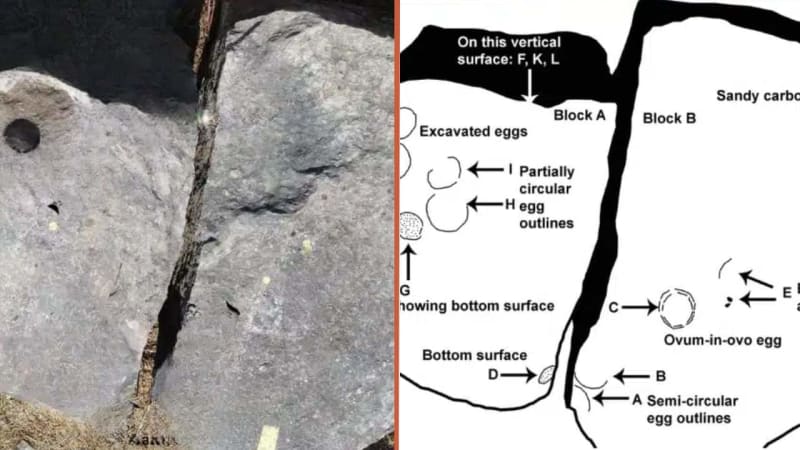
The discovery is extraordinary: a 68-million-year-old dinosaur egg containing another complete egg inside it. Two distinct shells, one nested perfectly within the other, separated by a clear gap that proves this wasn't an accident of fossilization.
Scientists from the Indian Institute of Technology Roorkee and the Geological Survey of India led the research team. They examined hundreds of fossilized eggs from the Lameta Formation before identifying this singular specimen.
The egg likely belonged to a titanosaur, one of the massive long-necked herbivores that once roamed India in vast herds. These gentle giants created enormous nesting colonies across what is now central India, leaving behind some of the world's richest dinosaur breeding sites.
Here's what makes this finding remarkable: until now, this "egg within an egg" condition had only been observed in modern birds. In living birds, it's called ovum-in-ovo, occurring when a developing egg reverses direction in the reproductive tract and gets covered by a second shell.
The condition typically happens due to stress, hormonal imbalance, or illness in birds. These double-shelled eggs rarely hatch successfully.
Finding the same biological quirk in a creature that died out millions of years ago suggests dinosaurs had far more sophisticated, bird-like reproductive systems than scientists previously believed. It strengthens the evolutionary thread connecting ancient dinosaurs to the birds flying outside your window today.
The Ripple Effect
This discovery reminds us that India sits atop an incredible treasure trove of prehistoric life. The Lameta Formation contains hundreds of dinosaur nests, making it one of the planet's most important windows into how these ancient creatures lived, bred, and thrived.
From Gujarat to Maharashtra to Madhya Pradesh, Indian fossil sites continue revealing that this land was once a major dinosaur breeding ground. Recent years have brought the discovery of a one-horned rhino fossil in Tamil Nadu and countless other glimpses into Earth's distant past.
Each fossil tells a story not just of death, but of life: where creatures nested, how they cared for their young, and what challenges they faced. This malformed egg shows that even 68 million years ago, during the Late Cretaceous period when dinosaurs still ruled a very different Earth, life wasn't perfect.
Animals experienced stress, biological disorders, and reproductive complications just as they do today. The titanosaur mother who laid this unusual egg likely never knew how much her difficult moment would teach us millions of years later.
The finding also showcases how collaborative international science continues pushing the boundaries of human knowledge, with Indian and foreign researchers working together to decode ancient mysteries.
One remarkable fossil, smaller than a soccer ball, has opened a new chapter in understanding the intimate details of prehistoric life and strengthened the beautiful story of evolution connecting past to present.
Based on reporting by Google: fossil discovery
This story was written by BrightWire based on verified news reports.
Spread the positivity!
Share this good news with someone who needs it