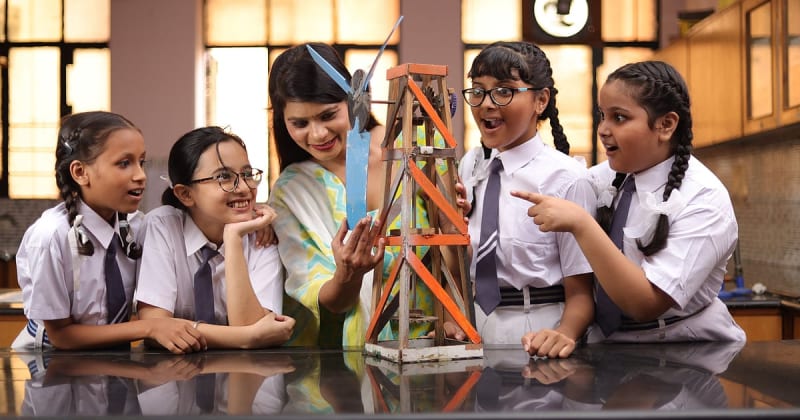
Indian Schools Close Gender Gap in Robotics Labs
When five girls joined a Rajasthan school's robotics lab, one refused to touch the equipment. Six months later, two of them led winning teams in a robotics challenge.
A government school in Rajasthan welcomed 32 students to its first robotics lab, but only five were girls. One refused to even touch the circuit kits, convinced that "circuits are for boys."
Six months later, that same student helped lead her team to victory in a school robotics challenge. Her transformation didn't come from fancy equipment alone, but from teachers who deliberately changed how they assigned tasks.
Across India, thousands of schools now have innovation labs through programs like Atal Innovation Mission. The infrastructure is there, but a surprising pattern keeps emerging: when robotics clubs become voluntary or competitive, girls' participation drops sharply.
In a Madhya Pradesh school, teachers noticed boys monopolizing the lab equipment during open hours. Girls gravitated toward documentation and presentation roles instead of hands-on building.
The school made one simple change: they required every student to rotate through all roles, including wiring, coding, and assembling. Within one term, girls who initially chose "design only" began experimenting confidently with tools.
A Haryana school saw participation jump after inviting a female engineering alumna to mentor students. Her presence shifted perceptions faster than any new robot kit could.
Schools that embedded labs into required curriculum, rather than treating them as optional clubs, saw female participation increase by 20 to 30 percent over two years. The difference wasn't the technology itself, but how schools used it.
The Ripple Effect
The impact goes beyond classroom walls. Parents of an eighth-grade girl in Bengaluru reported that their daughter now talks about pursuing engineering, something she never considered before leading peer training sessions in her school's innovation lab.
Teachers found that connecting projects to real problems like designing smart irrigation systems or safety alerts made girls more comfortable entering technical spaces. Context reduced intimidation and increased ownership.
Research shows girls respond strongly to classroom climate and visible role models. Several schools created girls-only introductory workshops, not to segregate permanently, but to build confidence before forming mixed teams.
The lesson from schools across India is clear: innovation labs can absolutely close gender gaps in STEM. But it requires teacher training, rotational task assignments, mentorship programs, and celebrating problem-solving over speed or aggression.
A Class 8 student who once hesitated to switch on a soldering iron now trains her peers. Infrastructure opened the door, but intentional culture change invited her to walk through it and stay.
Based on reporting by Google News - School Innovation
This story was written by BrightWire based on verified news reports.
Spread the positivity!
Share this good news with someone who needs it