Indian Schools Put Gardening and Democracy With Academics
From Delhi to Auroville, six innovative schools are ditching rigid testing structures to make art, emotional growth, and hands-on learning just as important as math and science. These alternative education models prove that classrooms can nurture creativity and confidence alongside conventional knowledge. #
What if report cards and rankings weren't the point of school at all?
Across India, a growing movement of alternative schools is challenging how we think about education. From multi-age classrooms without grades to curricula that blend music with mathematics, these institutions are proving there's more than one way to learn.
At Mirambika Free Progress School in New Delhi, students move through multi-age classrooms without the pressure of standardized tests or rigid grade levels. Founded on Sri Aurobindo's philosophy of integral education, the school believes learning should unfold naturally and differently for every child.
Formal exams are avoided in early years, giving students space to explore subjects driven by curiosity rather than fear of marks. The focus stays on emotional, physical, intellectual and creative development together instead of treating academics as the only measure of success.
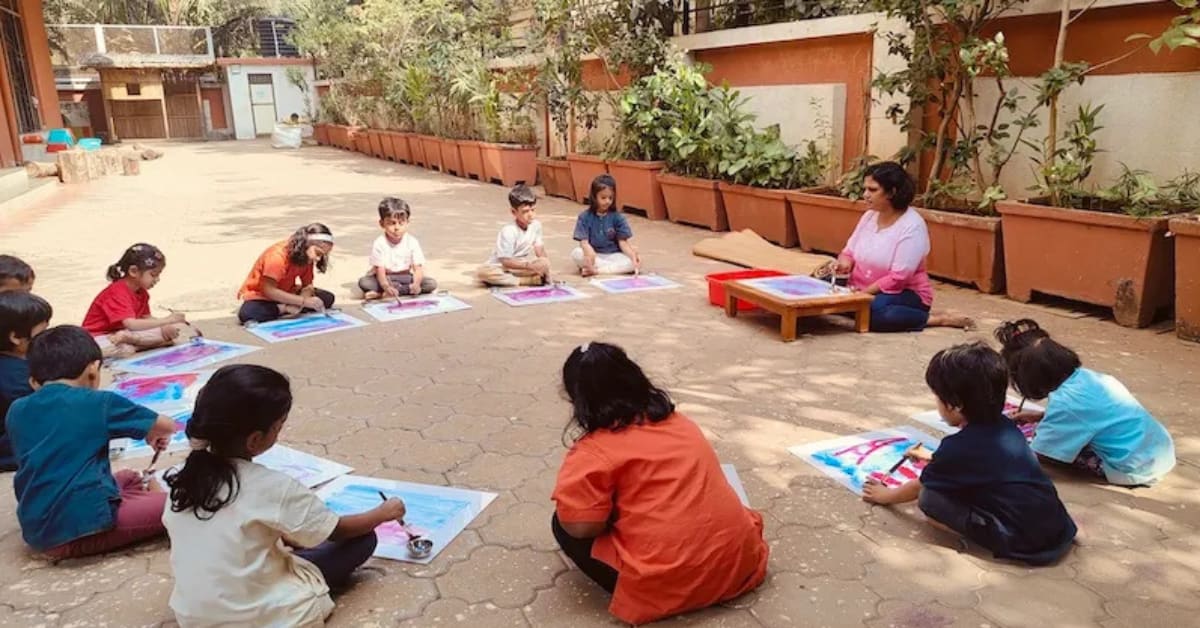
In Mumbai, Tridha Waldorf School takes a different approach to the same goal. Music, art and craft aren't extras but core parts of how students learn science, mathematics and language.
Students engage in hands-on activities like woodworking, gardening, textile art and music alongside their academic work. While they eventually prepare for IGCSE examinations, the journey there prioritizes creative and experiential learning over memorization.
Aarambh Waldorf School in Vasant Kunj follows a similar model, designed to engage what they call the "head, heart and hands." Academic concepts are woven together with art, movement, storytelling and practical activities to make learning more immersive and meaningful.
The curriculum focuses on sensory and experiential learning, where physical activity and artistic expression become part of everyday education. Students develop empathy and social responsibility alongside their academic skills.
The Ripple Effect
These schools represent a quiet but significant shift in Indian education. For years, alternative models inspired by philosophies like Waldorf, Steiner and integral education have been creating spaces where children can learn without constant academic pressure.
Parents get an education system that sees their children as individuals rather than numbers. Teachers find room to teach beyond rigid lesson plans and standardized curricula.
Most importantly, children get learning environments designed to reduce stress and encourage exploration. They can ask strange questions, work at their own pace, build things with their hands, grow food, vote on classroom decisions, and discover what they're truly capable of.
The approach places equal importance on creativity, emotional intelligence, curiosity, collaboration and self-discovery alongside traditional academics. It's not about rejecting knowledge but expanding what learning can look like.
These schools prove that education can nurture the whole child, not just the test-taker.
#
More Images
%2Fenglish-betterindia%2Fmedia%2Fmedia_files%2F2026%2F05%2F13%2Falternative-education-2026-05-13-16-42-39.png)
%2Ffilters%3Aformat(webp)%2Fenglish-betterindia%2Fmedia%2Fmedia_files%2F2026%2F05%2F13%2Falternative-education-2026-05-13-16-46-33.png)
%2Ffilters%3Aformat(webp)%2Fenglish-betterindia%2Fmedia%2Fmedia_files%2F2026%2F05%2F13%2Falternative-education-2026-05-13-16-48-21.png)
Based on reporting by The Better India
This story was written by BrightWire based on verified news reports.
Spread the positivity!
Share this good news with someone who needs it