Indian Soldiers Shaped the ANZAC Uniform We Know Today
When Nehchal Singh discovered his great-grandfather's WWI medals in Melbourne, he uncovered a hidden chapter of Australian military history. Indian soldiers not only served as ANZACs despite racist laws, but left a lasting legacy on every uniform marched on ANZAC Day.
Nehchal Singh played with old war medals as a child in India, never knowing they held the key to his family's extraordinary Australian story.
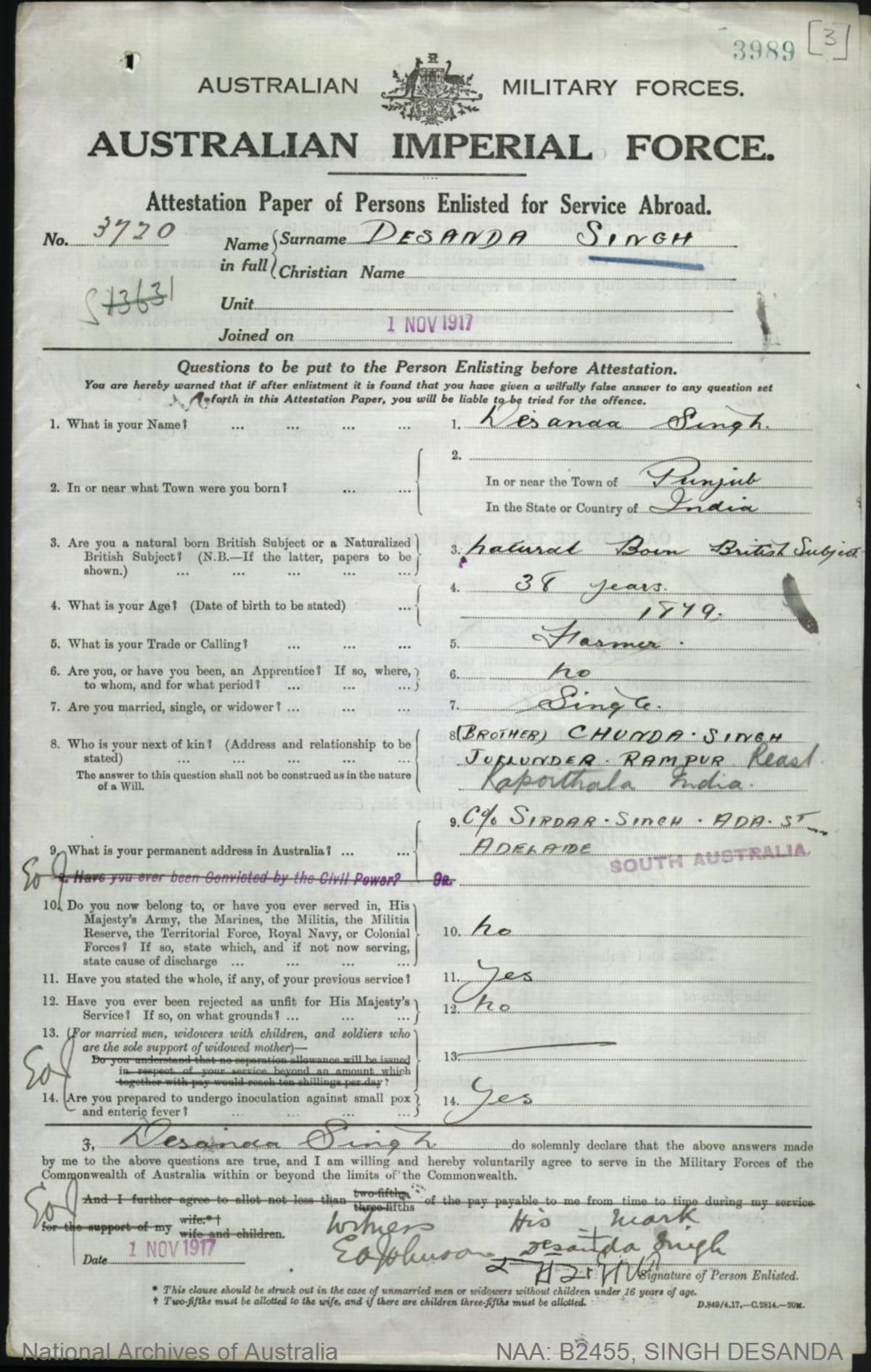
Decades later in Melbourne, he discovered those medals belonged to his great-grandfather, Private Desanda Singh, who served with the Australian Imperial Force during World War I. Despite a 1903 Defence Act explicitly banning anyone "not substantially of European background" from enlisting, Desanda Singh joined the 3rd Light Horse Regiment in 1916.
He was 38 years old, running a successful trading business with a horse and cart in Ceduna, South Australia. He owned a farm and had earned respect in his community. War was a choice, not a necessity.
"He didn't have a need to go to war; he could have potentially died," Nehchal said. "There weren't a lot of people who looked like him in Australia."
As casualties mounted and volunteer numbers dropped, military officers began quietly relaxing the racist restrictions. UNSW historian Peter Stanley estimates about 1,000 Indigenous soldiers served alongside approximately 20 Australians of Indian heritage, including eight men with the Sikh surname Singh.
None served at Gallipoli because the ban was still firmly in place during that campaign. But they fought just as bravely in other theaters of war.
Why This Inspires
The most visible legacy of these Indian soldiers marches in plain sight every ANZAC Day. The puggaree, that distinctive seven-pleated band wrapped around Australia's iconic slouch hat, comes directly from the traditional Indian pagri, or turban.
British soldiers adopted the head wrap in hot climates, and it became standard on Australian uniforms. The seven pleats now represent each state plus the territories.
"Every Australian soldier that marches on ANZAC Day actually wears a turban," said Harjit Singh from the Australian Sikh History Association. What many Australians assume is a recent multicultural addition has actually honored Indian military tradition for over a century.
Today, Sikh soldiers serve openly throughout the Australian Defence Force, from army reservists to senior officers. Flight Lieutenant Kuljit Jassal joined the RAAF in 1988 as the only Sikh woman, adjusting her long hair into regulation buns since turbans weren't yet permitted for women.
"When I joined the military, there was nobody else; I was a trailblazer," she said. "Now I'm thrilled to see a turbaned soldier."
The medals that sparked Nehchal's journey now represent more than family pride—they're proof that Australia's military story has always been more diverse than the history books suggested.
More Images


Based on reporting by ABC Australia
This story was written by BrightWire based on verified news reports.
Spread the positivity!
Share this good news with someone who needs it