India's First Bullet Train Takes Shape in Rural Village
In a small Adivasi village 118 km from Mumbai, massive machines work around the clock building India's first bullet train corridor. The 508-km Mumbai-Ahmedabad project is 92% complete in Gujarat, with workers launching girders seven times faster than the Japanese predicted.
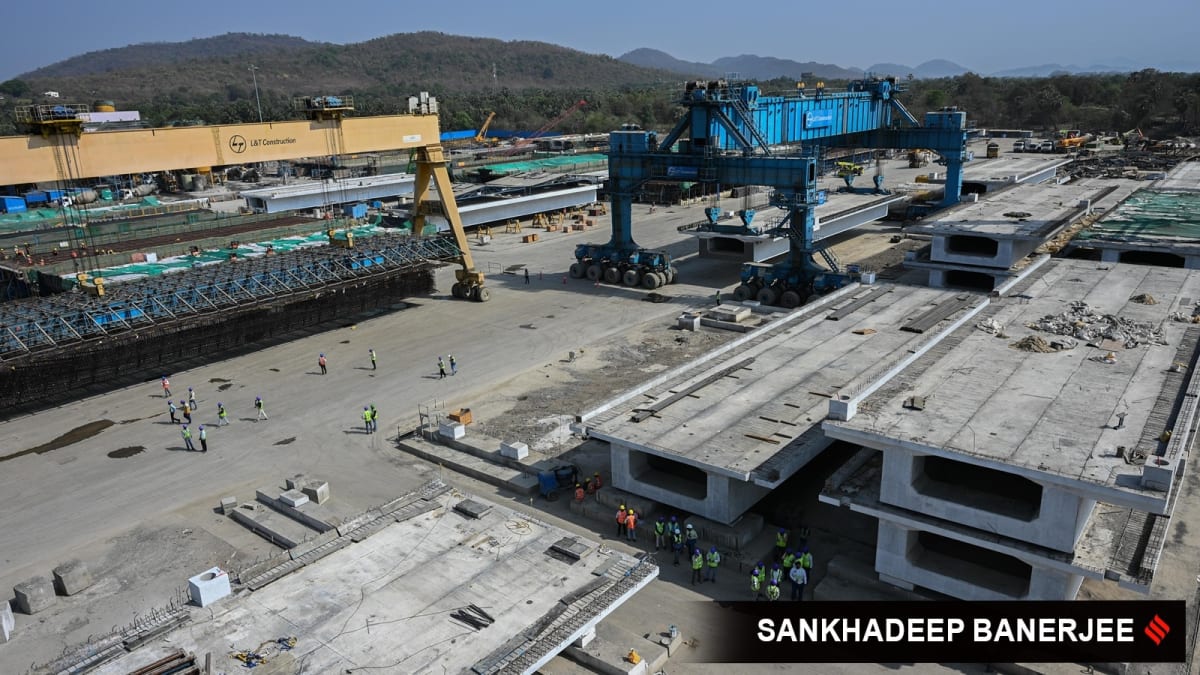
Giant blue machines that look straight out of a Transformer movie now tower over the kutcha houses of Sakhare village in Maharashtra's Palghar district.
The 380-tonne straddle carrier lifts 1,000-tonne concrete girders like they're weightless, placing them on pillars that will carry India's first bullet train. For the Adivasi families who've called this quiet village home for generations, the contrast couldn't be starker.
The 50-acre casting yard is one of nine facilities manufacturing the backbone of the Mumbai-Ahmedabad High Speed Rail corridor. Workers operate 24/7, pouring 65 truckloads of concrete to create each massive girder. By comparison, building a house roof takes just two or three trucks.
Each girder takes 14 days to gain its full strength of 50 megapascals. The secret isn't just the concrete. High-tensile steel wires stretched to near maximum capacity run through each piece, holding everything together like invisible threads of strength.
"We are launching 7-8 times faster than the Japanese," said an L&T official at the site, referring to Japan's bullet train technology that inspired the project. The Sakhare yard alone will produce 527 girders covering 22 kilometers of track.
Of the 508-kilometer project, a stunning 465 kilometers will run on elevated viaducts. That means passengers will essentially ride through the sky for 92% of their journey from Mumbai to Ahmedabad.
Nearly 1,000 employees work at the Sakhare site in coordinated shifts. So far, 8,500 of the required 11,500 girders have been launched across the entire corridor.
The Ripple Effect
The first section from Surat to Bilimora in Gujarat opens in August 2027. The full route should be ready by December 2029, cutting travel time between India's financial capital and its textile hub to just a few hours.
For Sakhare village, the transformation runs deeper than infrastructure. Young engineers and skilled workers now commute to jobs that didn't exist two years ago. The casting yard has become a training ground for advanced construction techniques previously unseen in India outside projects like the Mumbai Trans Harbour Link.
The technical complexity rivals any modern engineering feat. Each girder must be light enough that pillars can support it safely, yet strong enough to hold a train traveling at hundreds of kilometers per hour. Engineers designed them with rectangular openings in the middle, creating a bird-wing shape that balances weight and strength perfectly.
What makes this project special isn't just the speed or scale. It's watching India's most advanced infrastructure project literally rise from the fields of a village where electricity was once unreliable, now powered by machines that never stop.
From the Sahyadri mountains overlooking Sakhare, you can see the white viaducts stretching into the distance, a ribbon of progress connecting rural India to its high-speed future.
Based on reporting by Indian Express
This story was written by BrightWire based on verified news reports.
Spread the positivity!
Share this good news with someone who needs it