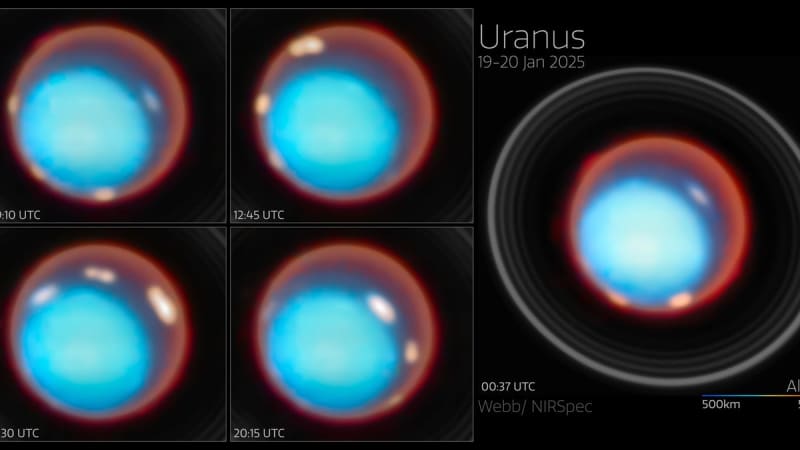
James Webb Captures Stunning 3D View of Uranus Auroras
The James Webb Space Telescope mapped Uranus's glowing pink auroras across a full day, revealing how the ice giant's strange tilted magnetic field shapes its atmosphere. These stunning observations bring us closer to understanding the galaxy's most common type of planet.
Scientists just captured the most detailed view ever of glowing auroras dancing across Uranus, and the images are helping solve mysteries about the most common planets in our galaxy.
The James Webb Space Telescope tracked Uranus for 15 hours in late January 2025, capturing nearly a complete day on the distant ice giant. The observations reveal rosy pink auroras sweeping through the planet's atmosphere, showing how energy moves through different atmospheric layers in stunning 3D detail.
Uranus has been criminally overlooked despite being fascinating. It spins backward like a top lying on its side, has seasons lasting 42 Earth years, and sports a lopsided magnetic field that doesn't line up with its center.
Led by Paola Tiranti, a planetary science student at Northumbria University, the research team published their findings in Geophysical Research Letters on February 19. They mapped temperatures and particle movements in the ionosphere, where auroras form and interact with solar winds and the planet's bizarre magnetic field.
The observations tracked H3+ ions made of three hydrogen nuclei, creating the best three-dimensional map yet of the planet's upper atmosphere. Webb's sensitivity revealed how energy flows upward and showed the influence of that lopsided magnetic field reaching deep into atmospheric layers.
Why studying Uranus matters goes far beyond pretty pictures. Most planetary systems astronomers find around other stars are packed with worlds similar in size and mass to Uranus, making this category probably the most common planet type in the Milky Way.
The observations confirmed one puzzling trend: Uranus's upper atmosphere continues cooling unexpectedly. Webb measured temperatures around 150 degrees Celsius, lower than previous readings, and scientists still don't know why.
Only one spacecraft, Voyager 2, has ever visited Uranus during a brief flyby in January 1986. That mission barely scratched the surface and happened right after a solar storm squashed the planet's magnetic field, limiting what scientists could learn.
Why This Inspires
These auroral detections give scientists their only way to study Uranus's internal magnetic field remotely without sending another spacecraft. For planetary scientist Heidi Hammel, the auroras are the real stars of these images, offering direct glimpses into the planet's invisible magnetic interior that we can't probe any other way.
Understanding how Uranus formed and evolved helps explain how planets develop throughout our galaxy. Webb is now showing us the energy balance of ice giants in unprecedented detail, which researchers need to characterize similar giant planets orbiting distant stars.
While astronomers hope to send another mission to Uranus in coming years, tight budgets and difficult timing for interplanetary travel may push that dream uncomfortably far into the future.
For now, Webb's stunning remote observations are opening windows into a world that holds keys to understanding planetary systems across the cosmos.
More Images

Based on reporting by Google: James Webb telescope
This story was written by BrightWire based on verified news reports.
Spread the positivity!
Share this good news with someone who needs it