James Webb Finds Massive Galaxy That Defies Cosmic Rules
Scientists discovered a giant "Red Potato" galaxy that mysteriously stopped forming stars despite floating in a gas-rich cosmic neighborhood. The James Webb Space Telescope revealed this cosmic puzzle could unlock secrets about how galaxies evolve in the early universe.
Deep in space, the James Webb Space Telescope spotted something that shouldn't exist: a massive galaxy sitting in a cosmic buffet but refusing to eat.
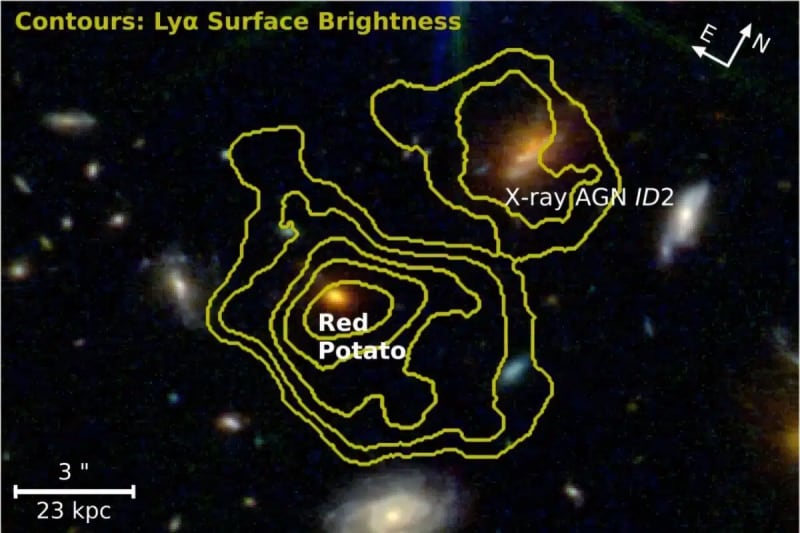
An international team led by Weichen Wang at the University of Milan discovered the "Red Potato," a galaxy 110 billion times the mass of our sun. Located in a region packed with cool gas that normally fuels galaxy growth, this cosmic giant has mysteriously gone quiet, forming barely any new stars.
Most galaxies in gas-rich neighborhoods are like hungry teenagers, constantly gobbling up material to create new stars. The Red Potato breaks all the rules. It's creating just four solar masses worth of stars each year, at least ten times slower than expected for a galaxy its size.
The mystery deepens when you look at what's missing. Using Webb's advanced infrared cameras, scientists found the galaxy contains less than 7 billion solar masses of molecular gas, the fuel needed for star formation. That's shockingly low for such a massive galaxy, like finding an empty gas tank in a Ferrari.
Even more puzzling, the team detected no carbon monoxide or sodium, elements that typically show up in galaxies rich with star-making material. Something has either drained the Red Potato's fuel supply or is blocking it from refilling.
The answer might lie in a nearby cosmic troublemaker. Scientists discovered an X-ray jet shooting out from a neighboring active galactic nucleus, essentially a supermassive black hole throwing a tantrum. This powerful jet appears to be stirring up the gas surrounding the Red Potato, preventing fresh fuel from flowing in.
Why This Inspires
This discovery shows how much we still have to learn about our universe. The Red Potato exists from a time when galaxies were forming rapidly, about 11 billion years ago. Finding one that went quiet so early challenges everything scientists thought they knew about galaxy growth.
The James Webb Space Telescope is barely two years into its mission, yet it's already rewriting cosmic textbooks. Each puzzle it uncovers brings us closer to understanding how galaxies like our own Milky Way came to be.
The Red Potato reminds us that the universe loves to surprise us, and sometimes the most exciting discoveries are the ones that don't make sense yet.
More Images

Based on reporting by Google: James Webb telescope
This story was written by BrightWire based on verified news reports.
Spread the positivity!
Share this good news with someone who needs it
%2Fhttps%3A%2F%2Ftf-cmsv2-smithsonianmag-media.s3.amazonaws.com%2Ffiler_public%2F3f%2F55%2F3f5579c8-c4a7-43a5-bb54-6498478792fd%2Fhelix1940__fitmaxwzk3mcw2ntbd.jpg)