James Webb Reveals Mystery of Early Universe Red Dots
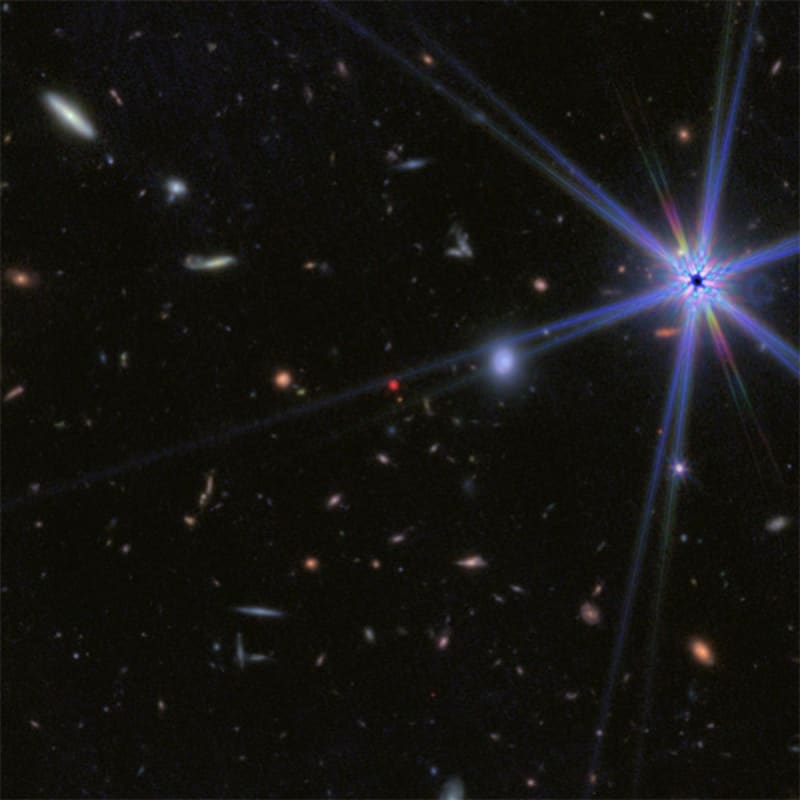
NASA's James Webb Space Telescope has finally solved a cosmic puzzle that stumped scientists for years. Those mysterious "little red dots" scattered across the early universe are actually baby supermassive black holes wrapped in dense gas cocoons.
For years, astronomers stared at images from NASA's James Webb Space Telescope and saw something that didn't make sense. Everywhere they looked in the early universe, bright ruby-red spots appeared, then mysteriously vanished after two billion years.
These "little red dots" became astronomy's biggest head-scratcher. They were too massive to be young galaxies, but they didn't emit the telltale x-rays and radio waves of feeding black holes.
Some scientists worried the discovery might "break cosmology" because nothing in our well-tested theories could explain them. The objects seemed impossibly mature for such a young universe, appearing when space was only a few hundred million years old.
Now researchers at the University of Manchester have cracked the case. A new study published in Nature reveals these mysterious spots are actually young supermassive black holes disguised by thick cocoons of ionized gas.
The cocoons filter the black holes' ultraviolet light, transforming it into visible red light as it passes through. This same shroud blocks the x-rays and radio signals scientists expected to find, making the black holes invisible to traditional detection methods.
Lead researcher Vadim Rusakov explains the cocoons also made these black holes appear heavier than they actually are. When his team corrected for this effect, they found the hidden black holes ranged between 10,000 and 10 million solar masses. That's far smaller than mature supermassive black holes, which can reach billions of solar masses.
The discovery means existing cosmology models don't need rewriting after all. These masses are perfectly reasonable for young black holes in the early universe.
Why This Inspires
This breakthrough shows how persistence and deeper observation can turn cosmic mysteries into exciting discoveries. Three separate research teams reached similar conclusions independently, with complementary studies posted on the same day in March.
MIT astrophysicist Rohan Naidu is so confident in the findings that he's started calling these objects "black hole stars" because they radiate like enormous stars powered by feeding black holes instead of nuclear fusion. They can shine a trillion times brighter than our sun.
The red dots naturally fade away as the growing black holes consume their gas cocoons from the inside out, explaining why they disappear from view after two billion years. Scientists have essentially discovered a brand-new phase in black hole development, capturing these cosmic giants at their youngest observable stage.
What looked like a crisis for cosmology turned into a window into black hole infancy, showing us how these universe-shaping objects begin their lives.
More Images



Based on reporting by Google: James Webb telescope
This story was written by BrightWire based on verified news reports.
Spread the positivity! 🌟
Share this good news with someone who needs it