James Webb Spots Galaxy From 300M Years After Big Bang
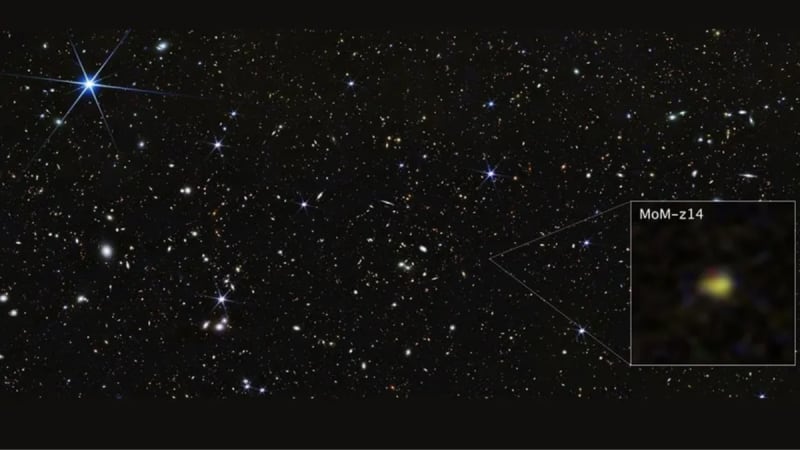
NASA's James Webb Space Telescope just discovered the most distant galaxy ever observed, formed only 300 million years after the universe began. The breakthrough gives scientists an unprecedented window into how the first galaxies took shape in the cosmic dawn.
Imagine seeing a baby photo of the universe itself. That's exactly what scientists accomplished with NASA's James Webb Space Telescope, which just spotted a galaxy from when our cosmos was barely out of infancy.
The telescope discovered the most distant galaxy ever observed, shining from just 300 million years after the Big Bang. For perspective, the universe is 13.8 billion years old, meaning we're looking back across more than 13 billion years of cosmic history.
This discovery pushes back our view of the early universe further than ever before. The ancient galaxy appears as it existed during the cosmic dawn, when the first stars and galaxies were just beginning to illuminate the darkness of space.
James Webb's powerful infrared vision makes these observations possible. Unlike previous telescopes, it can peer through cosmic dust and detect the faint light from these incredibly distant objects, stretched into infrared wavelengths by the universe's expansion.
The telescope hasn't stopped there. Recent observations also uncovered clues about the origins of the universe's first supermassive black holes and helped astronomers map previously hidden dark matter throughout the cosmos.
Scientists captured a stunning infrared image of the Helix Nebula, nicknamed the "Eye of God," revealing new details about dying stars. The telescope even watched a young star forming crystals that could one day become planets, offering insights into how solar systems like our own take shape.
Why This Inspires
These discoveries remind us that humanity's curiosity knows no bounds. Every image from James Webb answers ancient questions while raising exciting new ones about our place in this vast universe.
The telescope represents decades of international collaboration and scientific dedication. Thousands of engineers, scientists, and dreamers worked together to build an instrument capable of revealing the universe's deepest secrets.
Each discovery brings us closer to understanding fundamental questions: How did the first galaxies form? What sparked the creation of supermassive black holes? How common are planetary systems like ours?
The answers reshape our cosmic story and unite us in wonder at the universe we call home.
More Images

Based on reporting by Google: James Webb telescope
This story was written by BrightWire based on verified news reports.
Spread the positivity!
Share this good news with someone who needs it