James Webb Spots Universe's Oldest Supernova Yet
Scientists discovered a massive star explosion from just 1 billion years after the Big Bang, offering a rare glimpse into how the earliest stars lived and died. The supernova, nicknamed Eos after the goddess of dawn, could help explain where the building blocks of life first came from.
Scientists just captured images of a supernova that exploded when our universe was still in its infancy, opening a window into the lives of the very first stars.
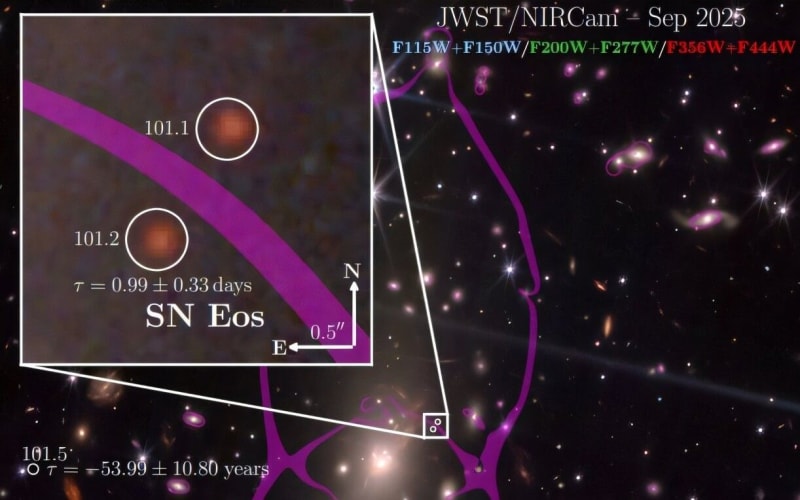
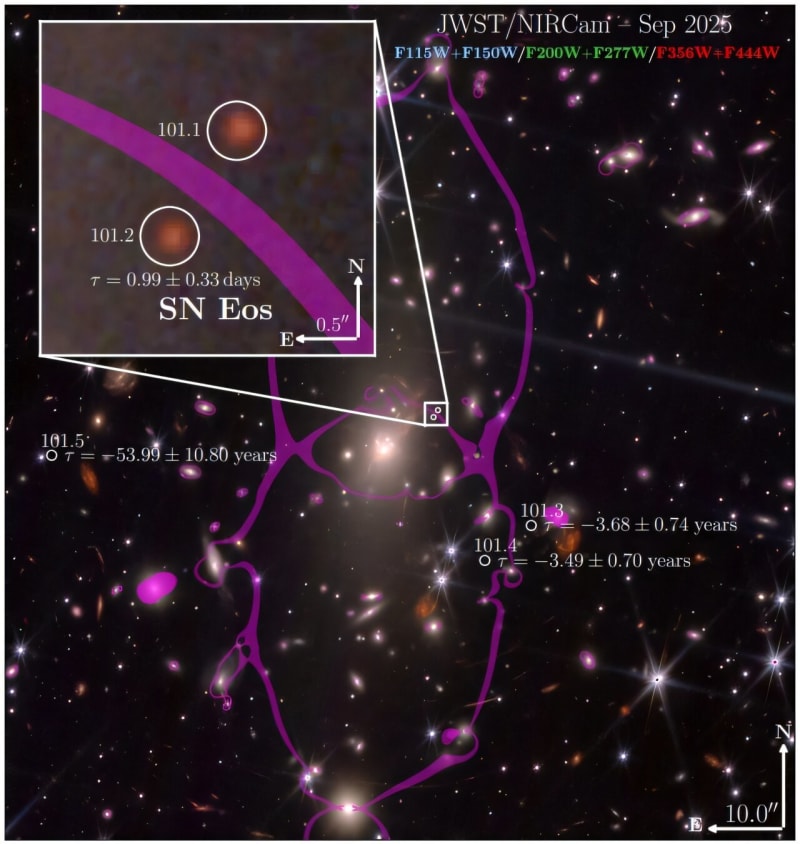
The James Webb Space Telescope spotted the brilliant explosion in September and October 2024, documenting a massive star's death that occurred just 1 billion years after the Big Bang. Researchers named it Eos, after the Greek goddess of dawn, because it represents one of the earliest stellar deaths ever observed.
Finding individual stars from the early universe is incredibly difficult because they're so far away. But when massive stars explode as supernovas, they briefly shine brighter than entire galaxies, giving scientists a chance to study them.
The team used a clever trick called gravitational lensing to spot Eos. When light passes near massive objects like galaxy clusters, their gravity bends and magnifies that light like a cosmic magnifying glass. This made the distant supernova bright enough for Webb's instruments to capture.
The discovery revealed something fascinating about early stars. Eos contained far fewer heavy elements than modern stars like our sun, less than 10% of what we see today. That makes sense because the universe was young and stellar fusion hadn't yet spread heavier elements throughout space.
Why This Inspires
This finding helps answer one of science's biggest questions: where did the elements necessary for life come from? When massive stars explode, they scatter these building blocks across the cosmos, seeding future generations of stars and planets.
Eos is what scientists call a Type II-P supernova, meaning its light stayed bright for an extended period before fading. By analyzing its ultraviolet light, researchers could determine its age and composition, piecing together the story of stellar evolution in the early universe.
The discovery marks progress toward one of the James Webb telescope's core missions: understanding how the first stars lived, died, and shaped the universe we see today. Each early supernova scientists find helps fill in the timeline from the universe's birth to the present day.
Scientists need to observe more ancient supernovas to confirm whether Eos represents typical behavior for early massive stars. But this single discovery proves that Webb can peer far enough back in time to witness the universe's dawn, when the first generation of stars were forging the elements that would eventually make planets and life possible.
More Images



Based on reporting by Live Science
This story was written by BrightWire based on verified news reports.
Spread the positivity!
Share this good news with someone who needs it