James Webb Telescope Finds Birthplace of Space "Buckyballs
Scientists using the James Webb Space Telescope have discovered where mysterious soccer ball-shaped molecules called "buckyballs" are born in space. The finding helps explain how carbon chemistry works in the cosmos and offers clues about how life began.
📺 Watch the full story above
Fifteen years after discovering strange soccer ball-shaped molecules floating in space, astronomers have finally figured out where they come from.
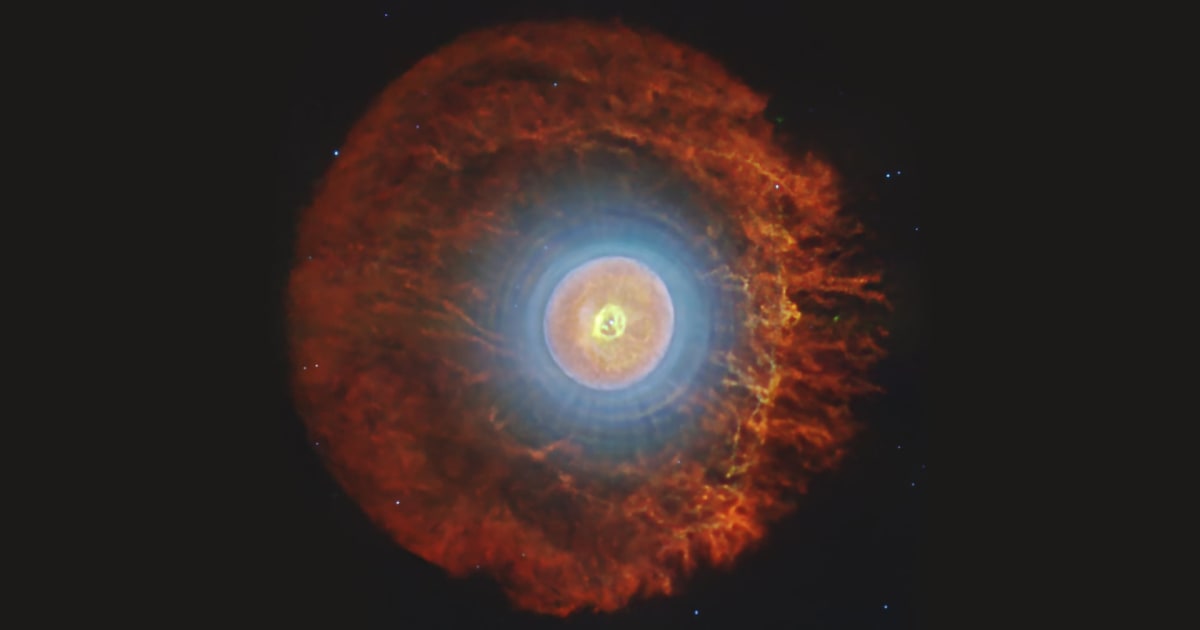
Professor Jan Cami and his team at Western University used the James Webb Space Telescope to peer inside a planetary nebula called Tc 1, located 12,400 light-years from Earth. What they found was breathtaking: intricate shells of glowing gas surrounding a dying star, and within them, the detailed distribution of molecules called buckyballs.
Buckyballs are hollow spheres made of 60 perfectly arranged carbon atoms. They look like miniature soccer balls or geodesic domes. British scientist Sir Harry Kroto first created them in a lab in 1985, earning him a Nobel Prize. He predicted they'd be common in space, but nobody could prove it until Cami spotted them in 2010.
Now, Webb's powerful infrared vision has captured the first detailed image of where these molecules live. The telescope's data revealed something surprising: the microscopic hollow spheres are arranged in the shape of one giant hollow sphere around the central star.
"Buckyballs arranged like one giant buckyball," said PhD candidate Morgan Giese, who led the analysis. The team is still working out exactly why they're distributed this way, but the discovery is already raising exciting questions about stellar chemistry.
The nebula itself tells a fascinating story. Tc 1 was once a star similar to our Sun. When it ran out of fuel tens of thousands of years ago, it collapsed and shed its outer layers. Those expelled gases now glow like cosmic clouds, illuminated by the white dwarf remnant at the center.
Webb's nine different infrared filters captured rays, filaments and gas shells in stunning detail. Blue tones show hotter gas, while red traces cooler material. The images were processed by high school science teacher and amateur astronomer Katelyn Beecroft, who had never seen anything like it.
"There is something wonderful about seeing and bringing out all of the fine detail in a nebula, especially when it is one that you are seeing for the very first time," Beecroft said.
Why This Inspires
This discovery matters for more than just understanding weird space molecules. Buckyballs help scientists track carbon chemistry throughout the universe and explain mysterious cosmic signals. Because carbon is essential for life as we know it, understanding how it behaves in extreme space environments offers clues about life's origins.
Postdoctoral researcher Dries Van De Putte is now investigating whether buckyballs form in space the same way they do on Earth, or through completely different processes. The answer could challenge what we think we know about chemistry beyond our planet.
"Tc 1 was already extraordinary, as it was the object that told us buckyballs exist in space, but this new image shows us we had only scratched the surface," Cami said. The structures are raising as many questions as they answer, opening doors to discoveries we haven't even imagined yet.
Based on reporting by Google: James Webb telescope
This story was written by BrightWire based on verified news reports.
Spread the positivity!
Share this good news with someone who needs it