James Webb Telescope Makes Historic Discovery of Runaway Black Hole Blazing New Star Trail
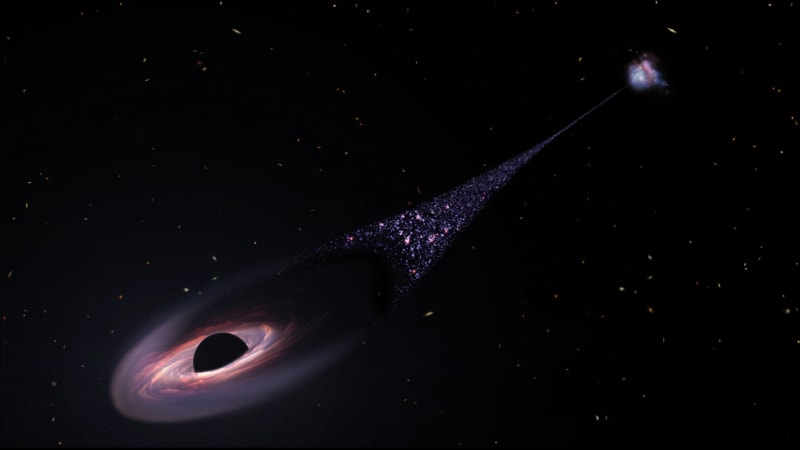
In an astronomical breakthrough, the James Webb Space Telescope has confirmed the first-ever runaway supermassive black hole, creating a stunning 200,000 light-year trail of newborn stars as it journeys through space. This remarkable discovery opens exciting new chapters in our understanding of how galaxies and black holes evolve together.
Scientists are celebrating a groundbreaking cosmic discovery that reveals the universe is even more dynamic and fascinating than we imagined. The James Webb Space Telescope has confirmed the existence of the first-ever "runaway" supermassive black hole, racing through space at an astounding 2.2 million miles per hour while creating something unexpectedly beautiful in its wake.
Rather than destruction, this cosmic wanderer is leaving behind a magnificent trail of newborn stars stretching 200,000 light-years across space—twice the diameter of our entire Milky Way galaxy. It's a breathtaking reminder that even the universe's most mysterious objects can be cosmic creators.
"Everything about this object told us it was something really special," said lead researcher Pieter van Dokkum, a professor of astronomy and physics at Yale University. His excitement is palpable and well-earned—this confirmation represents the culmination of five decades of theoretical research about these elusive objects.
The discovery journey itself showcases the power of human curiosity and technological innovation. Van Dokkum's team first spotted a faint, strange line in archival Hubble Space Telescope images back in 2023. Rather than dismissing this oddity, they pursued it with fresh observations from Hawaii's Keck Observatory, which revealed the incredible trail of young stars.
But the team needed the James Webb Space Telescope's unprecedented sensitivity and sharpness to find their "smoking gun" proof. JWST captured stunning images of a bow shock—similar to waves created by a ship moving through water—at the leading edge of the black hole's journey. The shockwave pushes hydrogen and oxygen gas ahead of it, triggering the formation of new stars along its path.
"Seeing this clear signature in the data was incredibly satisfying," van Dokkum shared, his words reflecting the joy of scientific discovery at its finest.
What makes this finding even more remarkable is how perfectly different observations fit together. Data from Hubble, Keck, and JWST—each capturing different wavelengths of light—combine like puzzle pieces, matching theoretical predictions beautifully. This harmony between observation and theory demonstrates how far our understanding of the cosmos has advanced.
The discovery also solves a longstanding cosmic mystery: can supermassive black holes actually escape their galaxies? The answer opens exciting new research avenues. Scientists now believe this runaway was created through an extraordinary gravitational dance between two or possibly three supermassive black holes, each weighing at least 10 million times our sun's mass.
Looking ahead, researchers are already identifying promising candidates for similar discoveries. Van Dokkum noted that "the obvious next step is to look for more examples," and his team has several intriguing targets lined up, including the mysteriously named "Cosmic Owl" located 11 billion light-years away.
This breakthrough reminds us that we're living in a golden age of astronomy. Advanced telescopes like JWST are revealing cosmic wonders our predecessors could only theorize about, and each discovery brings us closer to understanding our place in this magnificent universe. The runaway black hole, far from being merely an oddity, is teaching us that the cosmos is constantly evolving, creating beauty even in the most unexpected ways.
More Images


Based on reporting by Live Science
This story was written by BrightWire based on verified news reports.
Spread the positivity! 🌟
Share this good news with someone who needs it
More Good News
 🚀 Innovation
Hubble Discovers 'Cloud-9': Rare Cosmic Wonder Confirms How Universe Works
 🚀 Innovation
NASA's 25-Year Timelapse Reveals 400-Year-Old Supernova Still Dazzling Scientists
 🚀 Innovation
NASA's Roman Space Telescope: A Triumph of Science, On Time and Under Budget
Joke of the Day
Why did the dog apply for a job at the bank?
Explore Categories
Quote of the Day
"The greatest thing you'll ever learn is just to love and be loved in return."
— Moulin Rouge (from the film, popularized by Ewan McGregor)