NASA's 25-Year Timelapse Reveals 400-Year-Old Supernova Still Dazzling Scientists
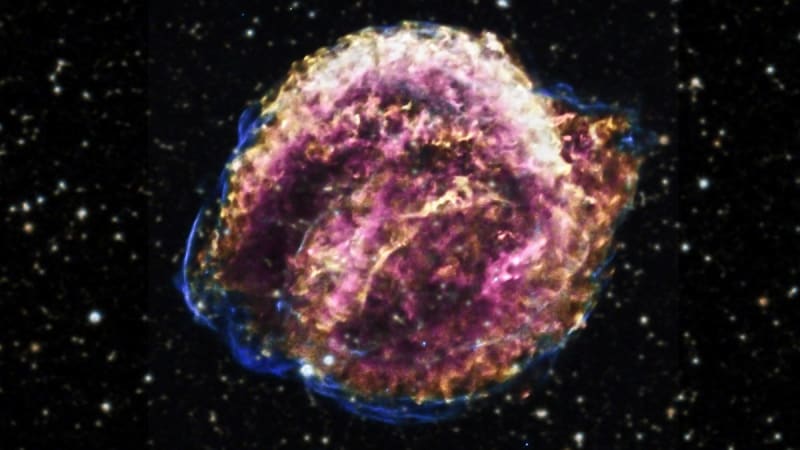
Scientists at NASA have created a stunning 25-year timelapse showing the spectacular expansion of Kepler's Supernova, a cosmic explosion first witnessed in 1604 that continues to unveil the universe's secrets. The breathtaking visualization reveals debris hurtling through space at millions of miles per hour, helping us understand how stars create the building blocks of life itself.
In a spectacular gift to astronomy enthusiasts and scientists alike, NASA's Chandra X-ray Observatory has unveiled a mesmerizing 25-year timelapse of one of history's most famous cosmic events—and the results are absolutely breathtaking.
The star of this cosmic show is Kepler's Supernova, named after the legendary astronomer Johannes Kepler who, along with observers worldwide, witnessed a brilliant new "star" appear in the night sky in 1604. More than four centuries later, this remarkable celestial event continues to captivate and educate, offering invaluable insights into the universe's most powerful phenomena.
Researchers Jessye Gassel of George Mason University and NASA Goddard Space Flight Center, along with Brian Williams of NASA-Goddard Space Flight Center, presented their stunning visualization at the 247th Meeting of the American Astronomical Society. The video compiles observations from 2000, 2004, 2006, 2014, and 2025, revealing the extraordinary speed at which the supernova's remains continue to expand across the cosmos.
What makes this discovery particularly exciting is the sheer velocity at which this cosmic debris is traveling. Some knots of stellar material are racing through space at speeds up to 8,700 kilometers per second—that's approximately 5,400 miles per second, or about 2 percent the speed of light. Even after more than 400 years, this cosmic fireworks display shows no signs of slowing down anytime soon.
Located just 20,000 light-years from Earth, Kepler's Supernova represents a rare astronomical treasure. It's one of only a handful of supernovae for which scientists have a precise historical timeline, making it an invaluable laboratory for understanding these explosive events that shape our universe.
Why It Matters: These observations aren't just beautiful—they're essential to understanding our cosmic origins. "Supernova explosions and the elements they hurl into space are the lifeblood of new stars and planets," Williams explains. When massive stars explode, they scatter heavy elements throughout space—the very building blocks that eventually form new solar systems, planets, and even the elements necessary for life itself. Every atom of iron in your blood and calcium in your bones was once forged in the heart of a dying star.
Type Ia supernovae like Kepler's also serve as cosmic measuring sticks, helping astronomers calculate vast distances across the universe with remarkable precision. This knowledge has revolutionized our understanding of the cosmos and continues to shape modern astronomy.
"The plot of Kepler's story is just now beginning to unfold," Gassel says with palpable enthusiasm. "It's remarkable that we can watch as these remains from this shattered star crash into material already thrown out into space."
Over thousands of years, this stellar debris will gradually dissipate and enrich the surrounding space, potentially contributing to the formation of new stars and planetary systems. We're witnessing a brief but magnificent moment in cosmic time—a front-row seat to the universe's eternal cycle of death and rebirth that makes new worlds possible.
More Images


Based on reporting by Google News - Science
This story was written by BrightWire based on verified news reports.
Spread the positivity! 🌟
Share this good news with someone who needs it
More Good News
 Innovation
South African Hunter-Gatherers Pioneered Poison Arrow Technology 60,000 Years Ago
 Innovation
Scientists in Chile Discover Record-Breaking Asteroid Spinning at Incredible Speed
 Innovation
Hawaii Astronomers Discover Most Massive Black Hole Gas Stream Ever Seen
DAILY MORALE
Why did the dog apply for a job at the bank?
EXPLORE INTEL
MISSION DIRECTIVE
The greatest thing you'll ever learn is just to love and be loved in return.
Moulin Rouge (from the film, popularized by Ewan McGregor)