James Webb Telescope Reveals 10,000 Baby Stars Being Born
Scientists just watched thousands of massive stars being born in a cosmic nursery 17,000 light-years away, thanks to breakthrough images that reveal what was previously invisible. The discovery is teaching us how the universe creates its biggest, brightest stars.
For the first time, astronomers can see through cosmic dust clouds to watch massive stars form in real time, revealing secrets about how the universe builds its brightest lights.
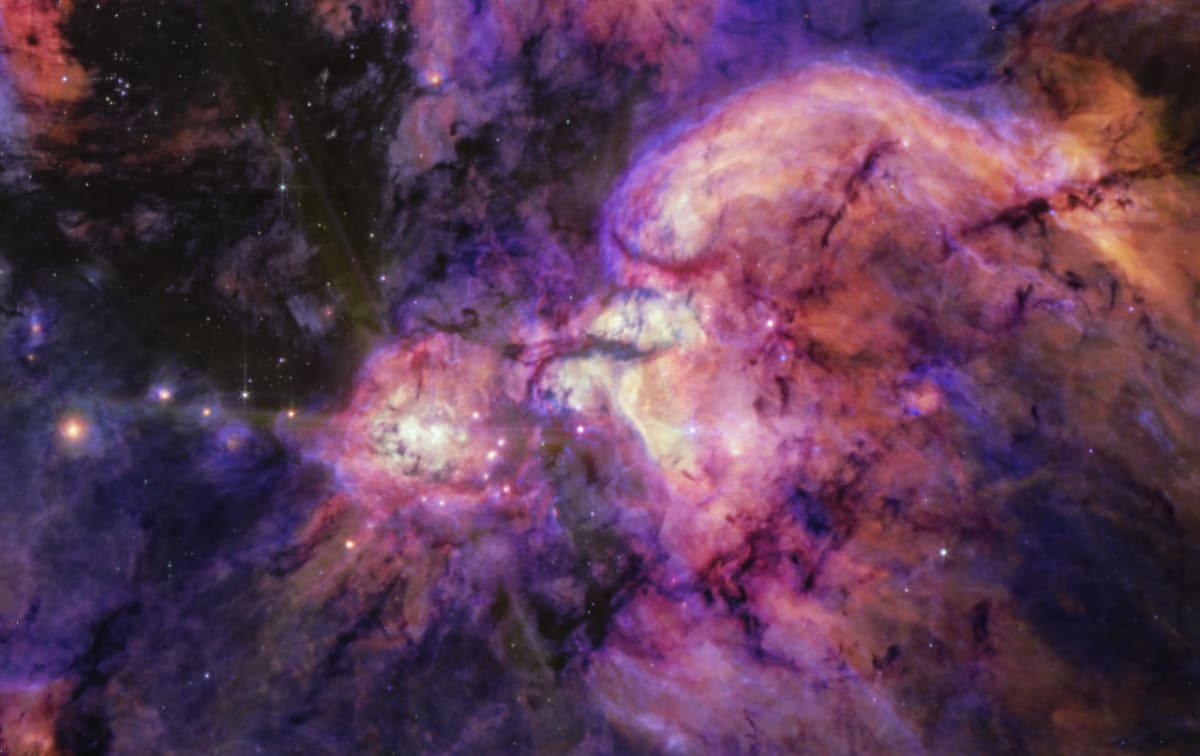
University of Florida researchers used the James Webb Space Telescope to peer into Westerhout 51, a stellar nursery 17,000 light-years from Earth. What they found was breathtaking: roughly 10,000 newborn stars in various stages of formation, many less than a million years old.
"With optical and ground-based infrared telescopes, we can't see through the dust to see the young stars," said Adam Ginsburg, a professor of astronomy at UF. "Now we can."
The images show something that has long puzzled scientists. Massive stars, the powerhouses that light up galaxies, form hidden behind thick clouds of gas and dust. By the time most telescopes can spot them, the dramatic early stages are already over.
Webb's infrared vision changed that. Doctoral candidate Taehwa Yoo and his team captured stunning details of star formation in action: glowing gas bubbles, jets of superheated material streaming from baby stars, and cavities where newborn stars are literally eating away at their birthplaces.
The team focused on W51A, the youngest star-forming region in the area. They spotted dust filaments, cometary-shaped objects sculpted by stellar radiation, and massive protoclusters where multiple stars are forming together like cosmic siblings.
Some stars remain hidden even from Webb, their birth clouds too thick to penetrate. That's where combining observations helps. The team matched Webb's infrared images with data from Chile's ALMA radio array, which detected over 200 spots where stars are actively forming or about to start.
Why This Inspires
These observations are more than pretty pictures. They're solving a cosmic mystery that affects everything we know about how galaxies evolve and how heavy elements spread through space.
Massive stars live fast and die young, exploding as supernovas that scatter elements like carbon and oxygen across the universe. Understanding how they form helps explain where the building blocks of planets and life itself come from.
The newborn stars in W51A are still growing, pulling in material from their surroundings. Their powerful radiation pushes against nearby gas clouds, sometimes triggering new stars to form and sometimes ripping clouds apart to stop formation entirely. It's a cosmic dance of creation and destruction happening on a scale almost impossible to imagine.
What excites researchers most is that many of these stars are so young that scientists can study their earliest stages. "By looking at them, we can study their formation mechanisms," Yoo said.
The research represents a new era in astronomy, where hidden cosmic processes become visible and mysteries that stumped scientists for generations finally yield their secrets, one brilliant star at a time.
Based on reporting by Google: James Webb telescope
This story was written by BrightWire based on verified news reports.
Spread the positivity!
Share this good news with someone who needs it