James Webb Telescope Spots Most Distant Galaxy Ever Seen
NASA's James Webb Space Telescope discovered a galaxy that existed just 280 million years after the Big Bang, breaking the record for the farthest cosmic object ever detected. The surprisingly bright galaxy is rewriting what scientists thought they knew about the early universe.
Scientists just glimpsed further into space and time than any human has ever seen before, and what they found is rewriting cosmic history.
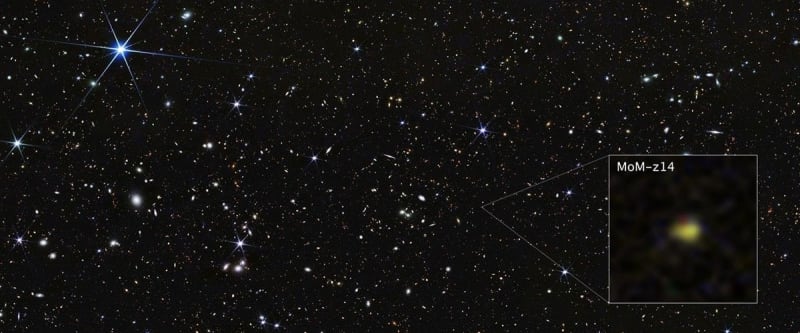
NASA's James Webb Space Telescope has spotted a galaxy called MoM-z14 that existed just 280 million years after the Big Bang. That means the light we're seeing today left that galaxy more than 13 billion years ago, making it the most distant object ever detected.
"With Webb, we are able to see farther than humans ever have before, and it looks nothing like what we predicted, which is both challenging and exciting," said Rohan Naidu, an astronomer at MIT who led the discovery team. His research will soon be published in the Open Journal of Astrophysics.
The galaxy itself is full of surprises. It's brighter, denser, and more chemically rich than astronomers expected possible for such an early stage in our universe's history.
Scientists identified MoM-z14 using something called redshift, which measures how stretched light becomes as objects move away from us through the expanding universe. This galaxy clocked in at a redshift of 14.4, setting a new record.
Why This Inspires
This discovery proves we're living in a golden age of cosmic exploration. The James Webb Space Telescope launched just a few years ago, and it's already transforming our understanding of how galaxies formed in the universe's infancy.
The findings raise fascinating new questions about why these early galaxies shine so brightly. Each answer leads to more mysteries worth solving about our cosmic origins.
"It's an incredibly exciting time, with Webb revealing the early universe like never before," said Yijia Li, a Penn State graduate student on the research team. She added that the discoveries show "how much there still is to discover."
NASA expects this record won't last long. As the telescope's observations improve, scientists anticipate finding even more distant galaxies, pushing our cosmic vision back even closer to the Big Bang itself.
Every new galaxy discovered helps scientists piece together the story of cosmic dawn, those critical first few hundred million years when the universe transformed from darkness into light. We're watching history unfold, one ancient photon at a time.
More Images


Based on reporting by Google: James Webb telescope
This story was written by BrightWire based on verified news reports.
Spread the positivity!
Share this good news with someone who needs it